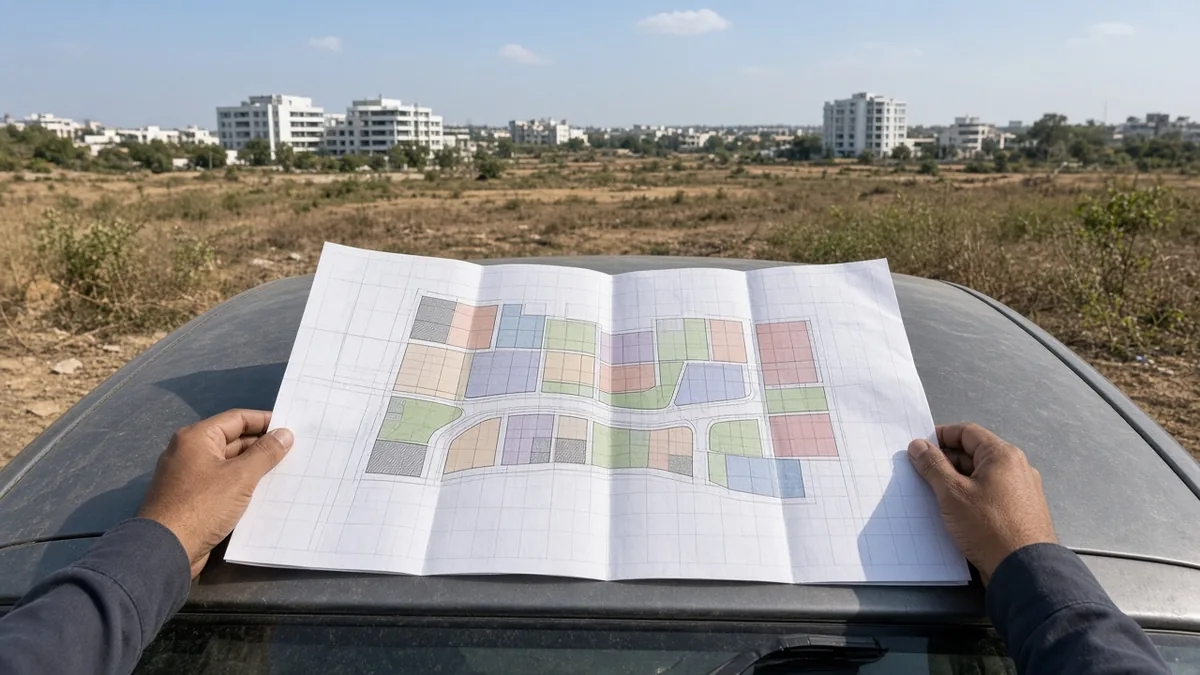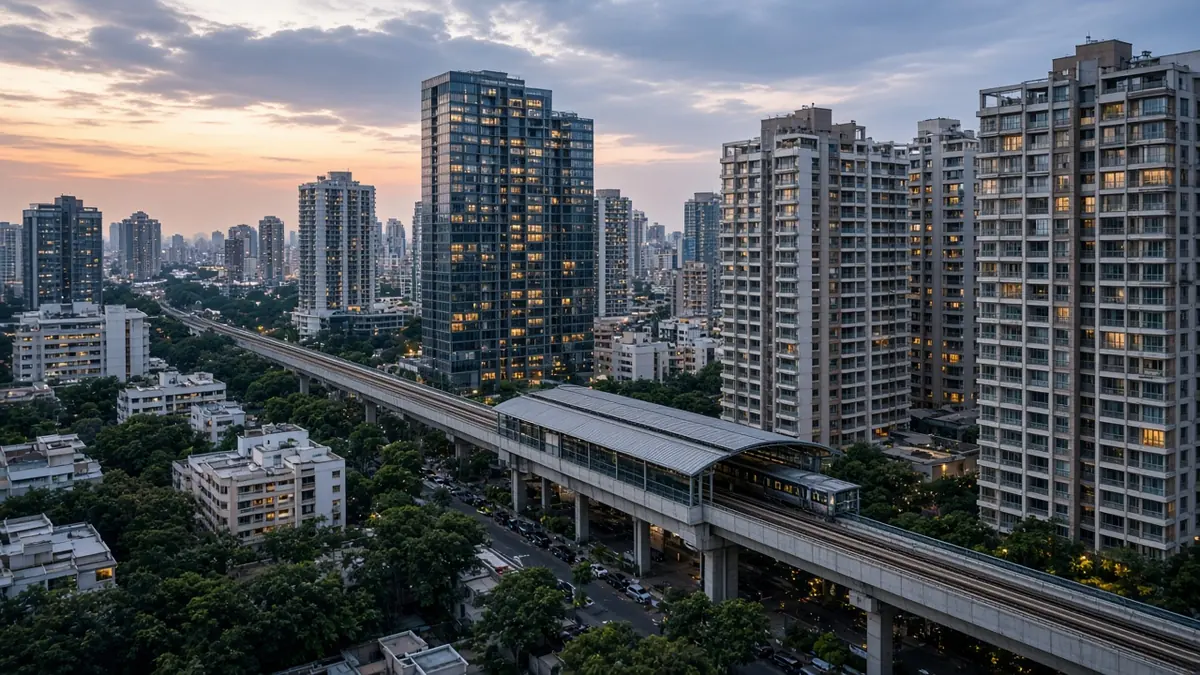
Short answer: Search for metro TOD zones Bengaluru and you'll find ads, not notified plans: we found none on 19 October 2026. What exists since February 2026 is citywide. Builders can buy up to 0.6 times the normal FAR on roads 9 m or wider. For you, that means taller buildings, more flats per plot and a smaller land share.
- No notified station-area TOD plan found for Bengaluru. BMRCL is developing its own station land, including at S.V. Road on Old Madras Road (news).
- Paid extra FAR applies citywide, not just near metro stations: up to 0.6 times the permissible FAR on roads 9 m or wider, from a February 2026 notification.
- The High Court upheld it on 15 June 2026, dismissing challenges to Section 18-B of the planning law.
- The charge is often set by the floor: at least 28% of the site's guidance value per sq m of extra floor area. In our example, that's about ₹2,600 per sq ft.
- Your land share shrinks: 60% more floor area on the same plot cuts each flat's undivided share by 37.5%.
- Our STACK check: site road, TDR or paid FAR, amenities per flat, charges paid, keyed to the sanctioned plan.
- Is there a metro TOD zone where you're buying?
- What is paid extra FAR, and where does it apply?
- What does it cost, and who gets the money?
- What does extra FAR change for you as a buyer?
- The STACK check (our framework)
- Checklist before booking near a station
- What mistakes do buyers make?
- What should you do if...
- Method notes and limits
- Related reading
- Frequently asked questions
- Talk it through with acre&key
- Sources
Transit-oriented development (TOD) means building denser around stations so more people can walk to a train. Bengaluru has talked about it for years, and "TOD zone" turns up in property ads. This piece sorts out what's actually law in October 2026, what's still a plan, and what extra floor area does to the flat you buy.
We relied mainly on the Karnataka High Court's judgment of 15 June 2026, which quotes the law, rules and notifications in full, plus news reports. We haven't named any project or developer.
Is there a metro TOD zone where you're buying?
Not in the legal sense, as far as we can tell. We found no notified, station-specific TOD zone plan for Bengaluru on 19 October 2026. Search results point to a TOD framework being prepared with Asian Development Bank support, under which zone plans would need to be prepared, opened for comment and notified. We couldn't open those documents, so treat any "TOD FAR" figure in a brochure as unconfirmed until you see the notification.
What's real near stations today is BMRCL's own land. In January 2026, BMRCL invited bids for a transaction advisor to develop land at S.V. Road station on Old Madras Road: an 8,063 sq m site with a permissible FAR of 4 and more than 32,000 sq m of built-up area, with similar plans for Majestic, Nagawara and KR Pura (The Hindu, 9 Jan 2026, news). Those are offices, retail and parking on metro land, not rules for your neighbour's plot.
Check which lines actually run near you in our metro lines status page.
What is paid extra FAR, and where does it apply?
FAR (floor area ratio) is total floor area divided by plot area. A 1,000 sq m plot at FAR 2.5 can carry 2,500 sq m of floors. Section 18-B of the Karnataka Town and Country Planning Act, inserted in 2020, lets a planning authority sell extra FAR above that limit, in areas named in the zonal regulations, for a charge of at least half the estimated rise in land and building value.
The High Court's judgment of 15 June 2026 sets out how the rules changed:
| Road width | Max extra FAR, 2 Apr 2025 notification | Of which could be bought for a fee | Max extra FAR, 5 Feb 2026 notification |
|---|---|---|---|
| Over 9 m, up to 12 m | 0.2 × permissible FAR | 0.2 | 0.6 × |
| Over 12 m, up to 18 m | 0.4 × | 0.3 (rest via TDR) | 0.6 × |
| Over 18 m | 0.6 × | 0.4 (rest via TDR) | 0.6 × |
So since February 2026, any site on a road wider than 9 m can go up to 60% above its normal FAR, whether or not there's a metro nearby. The judgment doesn't reproduce how the 2026 table splits that 0.6 between bought FAR and TDR (development rights certificates traded from land given up for roads), so ask the planning authority. The same changes apply in Hoskote, Anekal, the airport area and other local planning areas around the city.
Inside the Greater Bengaluru Area, the city corporations grant it. Outside, the local planning authority does.
What does it cost, and who gets the money?
Under the zonal regulations quoted in the judgment, the charge is 50% of the guidance value of the "additional notional site area", with a floor of 28% of the guidance value per sq m for every sq m of extra floor area built. Extra FAR can't be transferred to another site.
The money is split under Rule 37-E of the Karnataka Planning Authority Rules: half for land acquisition and shifting utilities, half for infrastructure. For metro-linked charges, that share goes to the metro company. In other words, the system is designed so density helps fund transit.
Worked example 1: why the 28% floor usually decides the charge
Illustrative. A 4,000 sq m site with a permissible FAR of 2.5 and a guidance value of ₹1,00,000 per sq m. The builder buys the full 0.6 extra (assume all of it is paid FAR, not TDR).
| Step | Calculation | Result |
|---|---|---|
| Normal floor area | 4,000 × 2.5 | 10,000 sq m |
| Extra floor area | 10,000 × 0.6 | 6,000 sq m |
| Notional extra site area | 6,000 ÷ 2.5 | 2,400 sq m |
| Charge at 50% of GV on notional area | 2,400 × ₹50,000 | ₹12 crore |
| Floor: 28% of GV per sq m built | 6,000 × ₹28,000 | ₹16.8 crore |
| Charge payable (the higher) | ₹16.8 crore | |
| Per sq ft of extra floor area | ₹16.8 crore ÷ 64,584 sq ft | about ₹2,601 |
The 50% rule works out to 50% ÷ FAR per sq m built, which is 20% at FAR 2.5. That's below 28% whenever the FAR is above about 1.79, so in most of the city the floor sets the price. Whether a builder passes that cost on depends on the market, not the rule.
Guidance values are still the 2023 rates; look up a site's line on Kaveri. Our metro uplift analysis shows how guidance values vary near stations.
What does extra FAR change for you as a buyer?
Worked example 2: your share of the land
Illustrative. The same 4,000 sq m site. Assume flats of 100 sq m and ignore common areas to keep it simple.
| Without extra FAR | With 0.6 extra FAR | |
|---|---|---|
| Floor area | 10,000 sq m | 16,000 sq m |
| Flats | 100 | 160 |
| Undivided share per flat | 40 sq m (431 sq ft) | 25 sq m (269 sq ft) |
| Change | 37.5% smaller |
A smaller undivided share matters most decades from now, when an old building is sold or redeveloped. Our answer on undivided share explains why. Sixty per cent more residents also share the same lifts, parking ramps, open space and road frontage, unless the plan adds more.
Can floors be added after you book?
Not freely. Under RERA s.14(2), a promoter can't make alterations or additions to the sanctioned building plan or common areas without the written consent of at least two-thirds of allottees, other than minor changes (RERA, India Code). If a builder later buys extra FAR to add floors, you have a say. Compare the sanctioned plan on the K-RERA page with what you're shown, and ask whether extra FAR or TDR is already loaded into it.
Did the High Court settle it?
For now. On 15 June 2026, a bench of the Chief Justice and Justice C.M. Poonacha dismissed the appeal and two writ petitions challenging Section 18-B, Rule 37-E and the 2025 and 2026 notifications. The court rejected arguments that the scheme was arbitrary, an excessive delegation or akin to regularising violations. A further appeal is possible; we haven't checked for one.
The STACK check (our framework)
- Site road. How wide is the road the plot actually abuts? Extra FAR needs more than 9 m.
- TDR or paid FAR. Is extra floor area loaded into the sanctioned plan, and how much?
- Amenities per flat. Do lifts, parking and open space scale with the extra flats?
- Charges paid. Has the charge been paid and reflected in the sanction? Ask for the receipt.
- Keyed to the plan. Does the RERA page show the same plan, and has it been revised since you booked?
Checklist before booking near a station
- [ ] Metro line near you confirmed as running, under construction or only planned
- [ ] Any "TOD" claim checked against a notification (we found none for station areas)
- [ ] Sanctioned plan seen; extra FAR or TDR in it identified
- [ ] Road width at the gate measured or checked on the plan
- [ ] Flat count and undivided share compared with and without extra FAR
- [ ] Lifts, parking and open space per flat checked
- [ ] RERA plan revisions and consent records checked
- [ ] Guidance value line looked up on Kaveri
For the rest of your checks, see our guides to approvals, legal checks, the occupancy certificate and the site visit. For a station-heavy corridor, see the KR Puram guide, and for prices against official rates, our guidance value gap analysis.
What mistakes do buyers make?
- Taking "TOD zone" in an ad at face value. Ask for the notification.
- Assuming extra FAR is only near metros. Since February 2026 it applies along any road over 9 m.
- Ignoring the flat count. More floors on the same plot means a smaller land share each.
- Not checking plan revisions. Additions after booking need two-thirds of allottees' consent.
- Treating a planned line as a running one. Check the metro status page.
What should you do if...
...a brochure promises "TOD FAR of 4"? Ask for the notification number. BMRCL's FAR of 4 at S.V. Road is for its own land, as reported.
...the builder wants to add floors after you've booked? Ask for the revised plan and the consent process under RERA s.14(2). You don't have to sign.
...you're buying in a resale building on a wide road? Check whether the association has any redevelopment talks. Extra FAR changes the sums for redevelopment.
Lawyer note: planning rules and consent rights are general information here. Have a property lawyer check the sanctioned plan and agreement for the specific project.
Method notes and limits
- The legal provisions are taken from the Karnataka High Court's judgment of 15 June 2026 (WA 1983 of 2025 with WP 14959 of 2020 and WP 2807 of 2026), which quotes Section 18-B, Rule 37-E and the notifications of 2 April 2025. The 5 February 2026 change is as the court describes it. We didn't read the gazette notifications directly.
- The judgment says the 2026 notification substituted the road-width table; it doesn't quote the new split between bought FAR and TDR, so we haven't stated one.
- We couldn't open the ADB TOD framework documents (blocked), and we found no notified station TOD plan. If one has been notified, this piece needs updating.
- Worked examples use illustrative FAR and guidance values, and ignore common areas.
Related reading
Frequently asked questions
We couldn't find a notified, station-specific TOD zone plan on 19 October 2026. A TOD framework is reportedly being prepared. What applies now is the citywide extra FAR rule for sites on roads wider than 9 m.
Up to 0.6 times the permissible FAR on sites abutting roads wider than 9 m, under the notification of 5 February 2026. Part of it may have to come through TDR.
It's 50% of the guidance value of the additional notional site area, but not less than 28% of the guidance value per sq m of extra floor area built. In most cases the 28% floor decides the charge.
No. On 15 June 2026, the High Court dismissed the appeal and writ petitions challenging Section 18-B, Rule 37-E and the 2025 and 2026 notifications.
Yes, if more floor area means more flats on the same land. In our example, 60% more floor area cut each flat's undivided share from 40 sq m to 25 sq m, or 37.5%.
Only with the written consent of at least two-thirds of allottees for alterations to the sanctioned plan or common areas, under RERA s.14(2), apart from minor changes.
Under Rule 37-E, half goes to land acquisition and utility shifting, and half to infrastructure. Where the charge relates to metro, that share goes to the metro company.
It's our five-point check for density near stations: site road width, TDR or paid FAR in the plan, amenities per flat, charges paid, and whether the RERA plan matches.
Sources
Checked 19 Oct 2026.
- High Court of Karnataka, judgment of 15 Jun 2026 in WA 1983 of 2025 with WP 14959 of 2020 and WP 2807 of 2026 (copy): https://www.legalrepublic.in/high-courts/karnataka-hc/karnataka-hc-premium-far-ktcp-act-section-18b-constitutional-validity-krishnamurthy/judgment.pdf
- The Hindu, BMRCL property monetisation at S.V. Road metro station, 9 Jan 2026 (news): https://www.thehindu.com/news/national/karnataka/bengaluru-metro-turns-to-property-monetisation-floats-tender-to-appoint-a-transaction-advisor-for-sv-road-metro-station-land-development/article70490741.ece
- Real Estate (Regulation and Development) Act 2016, s.14(2) (India Code): https://www.indiacode.nic.in/handle/123456789/2158
- Karnataka RERA, View All Projects: https://rera.karnataka.gov.in/viewAllProjects?language=en
- Kaveri Online Services (guidance values): https://kaveri.karnataka.gov.in/