Short answer: Use this site visit checklist before you book, not at handover. Visit twice: once at your commute's peak hour and once in the evening. Inside, check the actual unit's light, layout and finishes. Outside, check the approach road, drainage, water source and common areas. Then ask residents what they pay for water and maintenance.
- Two visits beat one long one: peak-hour traffic and evening noise don't show on a Sunday morning.
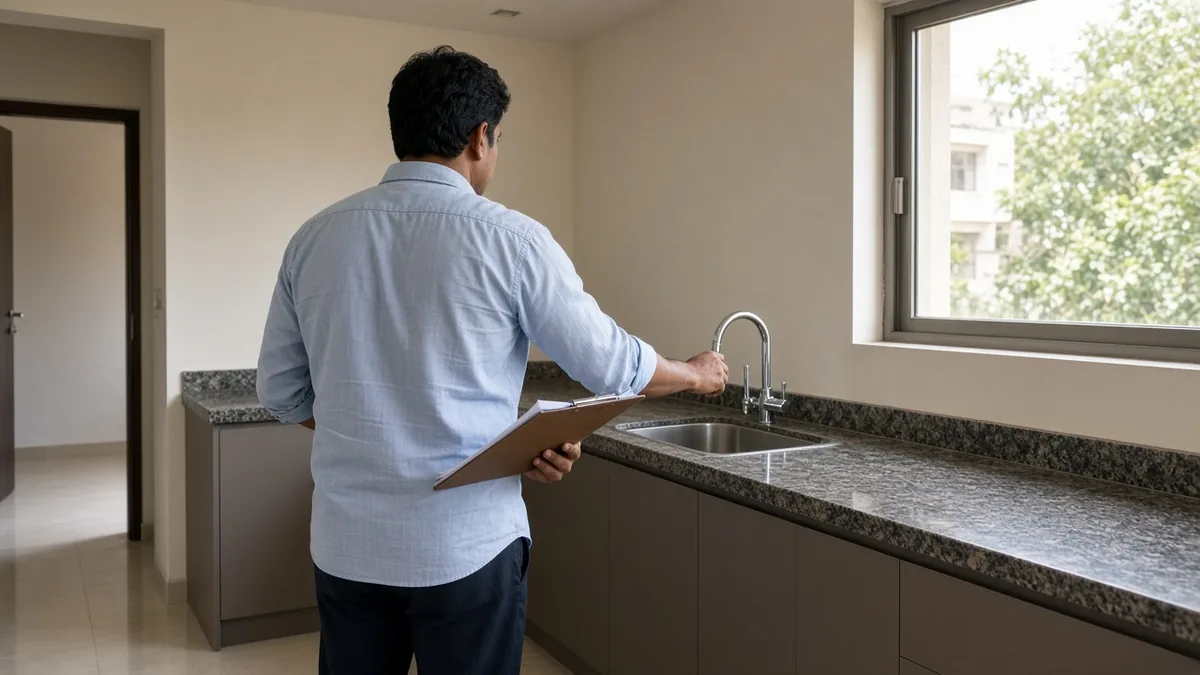
- See your unit, not the sample flat. Sample flats often have upgraded fittings and furniture chosen to fit.
- Water is the question to ask residents: source, supply hours and tanker spend.
- Some roads flood with very little rain. A 2023 KSNDMC report put Panathur Main Road at 1 cm (news).
- Our TWICE check: traffic, water, inside, common areas, evening.
- T: How do you get there and back?
- W: Where does the water come from and go?
- I: What's the unit really like?
- C: What do the common areas tell you?
- E: What's it like in the evening?
- Worked examples
- The TWICE check (our framework)
- What to carry
- After the visit
- Frequently asked questions
- Talk it through with acre&key
- Sources
A site visit is when a brochure meets the street. This checklist is for the visit before you pay a token in Bengaluru. For the handover inspection, use our possession checks instead.
T: How do you get there and back?
- Drive or ride your real commute at peak hour, both ways.
- Is the approach road wide enough for two cars and a delivery truck?
- Is there a footpath, and where's the nearest bus stop or metro station?
- What's on the way: a level crossing, a narrow bridge, a market that blocks traffic?
W: Where does the water come from and go?
- Ask residents nearby about the water source, supply hours and tankers.
- Look at drains along the road. Are they open, silted or blocked?
- Check the road against our KSNDMC flood map and the project area against our flood exposure index.
- Is there a lake, drain or low-lying plot next to the site?
I: What's the unit really like?
- Ask to see your actual unit, or one on a similar floor with the same facing.
- Which rooms get direct sun, and when? See our floor and corner guide.
- Measure two rooms and compare them with the plan's carpet area (carpet area explainer).
- Note what the sample flat has that the specification list doesn't.
- Check the mobile signal in every room.
C: What do the common areas tell you?
- For a ready building: lifts, stairwells, the basement and the generator. Upkeep now predicts your maintenance bills.
- For an under-construction project: does the work on site match the stage in the latest RERA update? Our project review method shows where to look.
- Where's the parking, and how tight are the ramps and turns?
- Are there power lines, a mobile tower, or a garbage point next to the site?
E: What's it like in the evening?
- Come back after dark. Is the street lit? Is it noisy?
- Where do people park on the road at night?
- Ask a resident: "If you were buying here again, would you?"
Worked examples
Worked example 1: what a longer commute costs
Illustrative. Your peak-hour drive from Flat B takes 25 minutes more each way than from Flat A, on 22 working days a month.
| Item | Working | Result |
|---|---|---|
| Extra time a month | 25 × 2 × 22 | 1,100 minutes, about 18 hours |
| Extra time a year | 18.3 hours × 12 | about 220 hours |
| Extra distance (assumed 8 km each way) | 16 km × 22 | 352 km a month |
Time is the bigger cost. About 27 eight-hour working days a year in traffic is a fair thing to weigh against a lower price. Put it in the surroundings score in our side-by-side comparison.
Worked example 2: putting a number on tanker water
Illustrative, using assumed figures. Replace them with what residents tell you. A 200-flat society buys four tankers a day in summer at ₹1,000 each.
| Item | Working | Result |
|---|---|---|
| Society spend a day | 4 × ₹1,000 | ₹4,000 |
| A month (30 days) | ₹4,000 × 30 | ₹1,20,000 |
| Per flat a month | ₹1,20,000 ÷ 200 | ₹600 |
| Per flat over four summer months | ₹600 × 4 | ₹2,400 |
The money is modest. The bigger question is what happens if tankers are short. Ask how many days last summer the society ran out.
The TWICE check (our framework)
| Letter | Covers | When to go |
|---|---|---|
| T: Traffic | Commute, approach road, transport | Weekday peak hour |
| W: Water | Source, drains, flood points | After rain, if you can |
| I: Inside | Your unit, sun, size, signal | Daytime |
| C: Common areas | Upkeep, construction stage, parking | Daytime |
| E: Evening | Lights, noise, parking, residents | After dark |
Score each line 1 to 5 after each visit. Anything at 2 or below goes on your list of questions for the seller.
What to carry
- [ ] Floor plan and specification list
- [ ] Measuring tape
- [ ] Phone with compass and a map app for the commute
- [ ] A notebook, or a phone for numbered photos
- [ ] RERA registration number, to check the stage against the latest update
- [ ] Your questions for residents
After the visit
If the project passes, move on to the money and paper checks in our token checklist before anything is paid.
Frequently asked questions
Your peak-hour commute, the approach road, drains and water source, your actual unit's light and size, common areas, and an evening visit to check noise and lighting.
At least twice: once at your commute's peak hour and once in the evening. A visit after heavy rain tells you about drainage.
No. Sample flats often have upgraded fittings and furniture that makes rooms look larger. Ask to see your unit or a similar one.
Ask residents nearby about the source, supply hours and how often tankers come. Builders' answers are a start, but residents know what happens in summer.
Look at drains and low points around the site, check our flood map and exposure index, and ask residents. A visit after heavy rain helps.
Lifts, stairwells, the basement, the generator, parking ramps and general upkeep. For a building under construction, check the stage against the latest RERA update.
Water source and tanker frequency, maintenance charges, power cuts, and whether they would buy there again.
Yes. Check that the work on site matches the stage being billed and the latest RERA quarterly update.
Sources
Checked 19 Oct 2026.
- Bangalore Mirror, KSNDMC report of flood-prone locations, 12 Apr 2023 (news): https://bangaloremirror.indiatimes.com/bangalore/others/1-cm-of-rain-can-cause-floods-in-bengaluru/articleshow/99416059.cms
- Varunamitra (Govt of Karnataka), vulnerable spots map: https://varunamitra.karnataka.gov.in/Default/Index?service=VulnerableSpots
- K-RERA project search: https://rera.karnataka.gov.in/viewAllProjects?language=en
- Real Estate (Regulation and Development) Act 2016, s.2(k), K-RERA copy: https://rera.karnataka.gov.in/resources/staticpage/Real_Estate_Act.pdf