Short answer: For building plan approval in Bengaluru, first find out where the land sits: a GBA city corporation, a BDA layout, a local planning authority under BMRDA, or a gram panchayat. Then check that the plan sanction, NOCs, occupancy certificate and khata all come from the bodies that cover that land, and that they match each other.
- The authority follows the land, not the brochure. "BMRDA approved" isn't a sanction; BMRDA coordinates 12 local planning authorities that do the approving.
- In a planning area, building needs the planning authority's written permission under Section 14 of the Karnataka Town and Country Planning Act, and unauthorised work can be pulled down.
- Bigger towers carry more NOCs. At 15 m height, 20 units or 20,000 sq m, new clearances kick in.
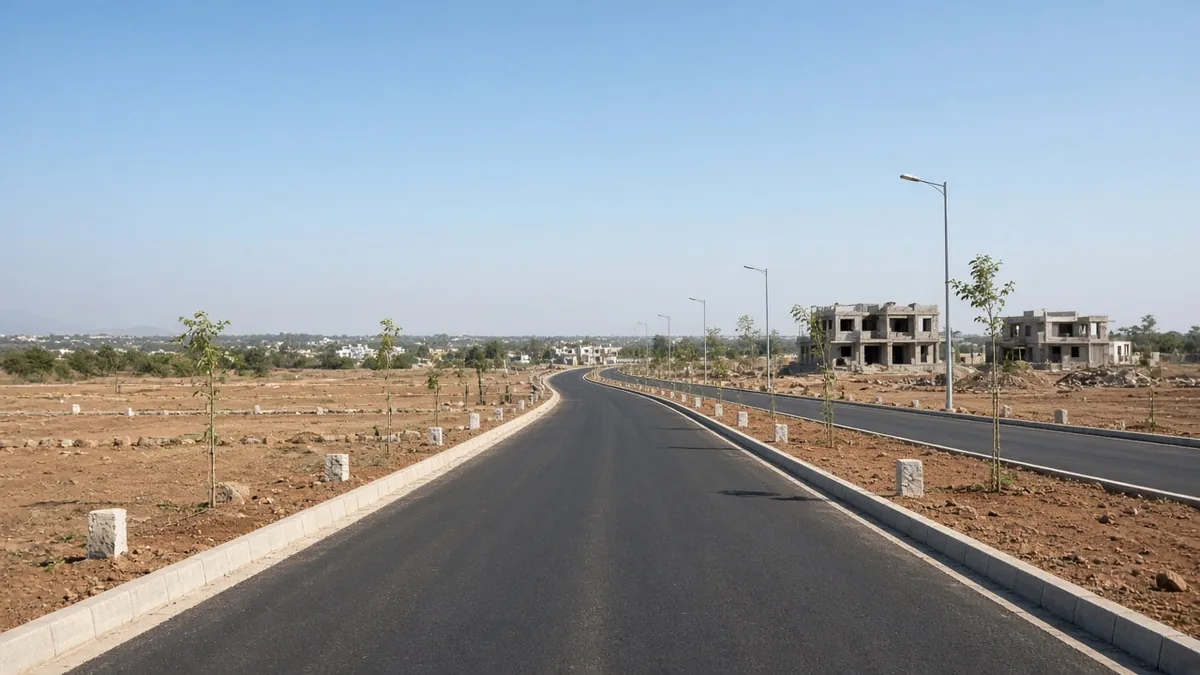
- About 31% of registered projects in our seven-taluk RERA count are in Anekal, Devanahalli and Hosakote, outer taluks where GBA isn't the main approver.
- Use our where, who, what grid to line up every paper with the right body.
- Who approves what around Bengaluru?
- What does the law require in a planning area?
- How do you check a GBA building plan sanction?
- Which NOCs should an apartment project have?
- Worked example 1: which NOCs a tower needs
- Worked example 2: counting units against the plan
- What changes in a panchayat area?
- Where are projects being registered?
- The where, who, what grid (our framework)
- Approval checklist
- Frequently asked questions
- Talk it through with acre&key
- Sources
Most approval trouble isn't a forged document. It's a real document from the wrong body, or for a different building. A plan sanctioned for 10 floors doesn't cover 12. A layout approval doesn't sanction the tower on it. This page shows you how to match each paper to the right authority. The full document order is in our legal checks from title to OC.
Who approves what around Bengaluru?
Four kinds of body show up in Bengaluru papers, and each signs different things.
| Body | What it does | What you'll see on paper |
|---|---|---|
| GBA and its five city corporations | Building plan sanction, commencement and occupancy certificates, khata and property tax inside GBA limits | Sanction and OC through the BPAS portal; e-Khata on e-Aasthi |
| BDA | Planning authority for the BDA area; forms and approves layouts | Layout approvals; development plan approval for large sites |
| Other local planning authorities (Anekal, Hoskote, BIAAPA and others) | Planning permission in their areas under the KTCP Act | Layout approval, commencement certificate |
| Gram panchayat | Records and taxes property in villages | Form 9 / Form 11 on e-Swathu |
BMRDA itself is the regional body over Bengaluru Urban, Bengaluru Rural and Ramanagara districts. It lists 12 local planning authorities, all working under the Karnataka Town and Country Planning Act 1961 (BMRDA). So when a brochure says "BMRDA approved", ask which of those authorities signed, and for what.
Not sure if a flat is inside GBA? Try our ward and corporation lookup or the answer on city or panchayat. For what changed when GBA replaced BBMP, see what the new city corporations mean for buyers.
What does the law require in a planning area?
Section 14(2) of the KTCP Act says no development or change of land use in a planning area can happen without the planning authority's written permission, given as a commencement certificate. Where agricultural land is involved, it also needs conversion under the Karnataka Land Revenue Act. Section 15(4) lets the authority stop unauthorised work and pull it down (KTCP Act, s.14; s.15).
For you, that means two things. A building without the right permission can face action even after you've bought. And a converted-land order is a separate paper you should see, not something the sanction covers.
How do you check a GBA building plan sanction?
Inside GBA, building permission is applied for online through empanelled professionals, using a common application form, with the external NOCs routed automatically (GBA BPAS FAQ). For a buyer:
- Ask for the sanction letter and the sanctioned drawings, with the sanction number and date.
- Verify the sanction with the corporation through the BPAS records or the zonal office. GBA's public site has building plan and occupancy certificate lists by year (GBA).
- Compare the drawings with the building: floors, units per floor, setbacks, basements and parking.
- Check the commencement certificate and, for a finished building, the OC. The OC should carry the same plan number. Our OC and CC guide explains why that matters for power and water.
Which NOCs should an apartment project have?
GBA's BPAS FAQ lists NOCs by building size (GBA BPAS FAQ):
| Trigger | NOCs listed |
|---|---|
| Height 15 m and above | HAL, Jakkur Flying School, Indian Air Force Yelahanka, Airports Authority of India, Fire Force, BESCOM |
| Built-up area over 2,000 sq m, or 20+ dwelling units | Karnataka State Pollution Control Board, BWSSB |
| Built-up area over 20,000 sq m | State Environment Impact Assessment Authority |
| Site area over 20,000 sq m | Development plan approved by BDA |
| Site next to a proposed metro line | BMRCL |
You won't need to collect these yourself, but you should see them. Ask the builder for copies, and check the K-RERA project page, where many are uploaded. Our RERA project search guide shows where.
Worked example 1: which NOCs a tower needs
Illustrative. A project with two towers of 14 floors at about 3 m per floor, 120 flats, averaging 140 sq m of built-up area per flat.
| Check | Maths | Result |
|---|---|---|
| Height | 14 × 3 m = 42 m | Over 15 m: aviation, fire and BESCOM NOCs |
| Units | 120 | Over 20: KSPCB and BWSSB |
| Built-up area | 120 × 140 sq m = 16,800 sq m | Under 20,000 sq m: SEIAA not triggered by this line |
Now make it 160 flats. 160 × 140 = 22,400 sq m, which crosses 20,000 sq m, so you'd expect an environmental clearance too. Real built-up area includes common areas, so the true figure is higher than this rough count. If the numbers suggest a clearance and the builder can't show it, ask why.
Worked example 2: counting units against the plan
Illustrative. The sanctioned drawings show ground plus 12 floors with 8 flats a floor on 12 residential floors: 12 × 8 = 96 flats. The RERA page lists 104 flats.
| Source | Flats |
|---|---|
| Sanctioned plan | 96 |
| RERA registration | 104 |
| Gap | 8 |
Eight flats aren't on the sanctioned plan. There may be a revised sanction, so ask for it. If there isn't one, those flats, and possibly the OC for the building, are at risk. This is the single most useful check you can do with a calculator and two PDFs.
What changes in a panchayat area?
Outside city limits, property is recorded by the gram panchayat on e-Swathu as Form 9 or Form 11. Form 9 is issued only for land converted under the Land Revenue Act with an approved plan, government housing beneficiaries, or Tahsildar-certified gramathana property. Forms 9 and 11 are mandatory for registering non-agricultural panchayat property (e-Swathu FAQ).
So for a panchayat apartment, look for three things: the conversion order, the planning permission from the local planning authority if the village falls in one, and Form 9 or 11 for the land or flat. If the only "approval" is a panchayat tax receipt, that isn't a building plan sanction. We haven't verified each gram panchayat's own licensing role, so ask your lawyer what the panchayat itself has issued and under what power.
For layouts and plots specifically, see our plot approval checklist.
Where are projects being registered?
On the K-RERA register we counted 4,529 approved non-commercial projects in seven Bengaluru taluks (15–16 Oct 2026). 1,412 of them (31.2%) are in Anekal, Devanahalli and Hosakote, outer taluks where a local planning authority, not GBA, is usually the approver. A taluk isn't an authority, so treat that as a rough guide, and read the approval itself. Our Hoskote guide covers one of those areas.
The where, who, what grid (our framework)
Fill this in for any property before you pay more than a token.
| Where | Who should sign | What you hold | Match? | |
|---|---|---|---|---|
| Land | GBA, BDA layout, other planning area or panchayat | Revenue (conversion), planning authority (layout) | Conversion order, layout approval | Survey numbers same on both |
| Building | Same place | Corporation or planning authority | Sanction, commencement certificate, NOCs | Floors and units match the building and RERA |
| Occupation | Same place | Corporation or planning authority | OC | Same plan number |
| Record | Same place | Corporation (e-Khata) or panchayat (Form 9/11) | Khata or Form 9/11, tax receipt | Name, area and PID match |
Any blank row, or any "no" in the last column, is a question for your lawyer before you go further. Khata types are explained in our A-khata vs B-khata guide.
Approval checklist
- [ ] Confirm whether the land is in GBA, a BDA area, another planning area or a panchayat
- [ ] Conversion order covering the survey numbers
- [ ] Layout approval, if the building sits in a layout
- [ ] Building plan sanction letter and drawings, with number and date
- [ ] Sanction verified with the issuing body
- [ ] Commencement certificate
- [ ] NOCs matching height, units and area
- [ ] Flat count on the plan equals the count on RERA
- [ ] OC with the same plan number, for a ready building
- [ ] e-Khata or Form 9/11 matching the papers
- [ ] Lake and drain buffers checked (buffer guide)
Frequently asked questions
Ask for the sanction letter and drawings with the sanction number and date. Confirm which body issued it, then verify with that body: inside GBA, through BPAS records or the zonal office. Compare floors, units, setbacks and parking with the building, and check the OC carries the same plan number.
No. BMRDA is the regional body over Bengaluru Urban, Bengaluru Rural and Ramanagara districts. It lists 12 local planning authorities, such as Anekal, Hoskote and BIAAPA, which give planning permission. Ask which authority signed the approval, and for what: a layout, or the building itself.
BDA is the planning authority for its area and forms and approves layouts. GBA's city corporations sanction building plans and issue OCs and khatas inside GBA limits. A flat can sit in a BDA-approved layout and still need its building plan sanctioned and OC issued by a corporation.
A panchayat records property on e-Swathu as Form 9 or 11, and Form 9 needs converted land with an approved plan. In a local planning area, building needs the planning authority's written permission under the KTCP Act. A panchayat tax receipt alone isn't a building plan sanction.
GBA's BPAS FAQ lists aviation, fire and BESCOM NOCs for buildings 15 m or taller, pollution board and BWSSB NOCs for over 2,000 sq m or 20+ units, and state environmental clearance above 20,000 sq m of built-up area. Ask for copies or find them on RERA.
Ask for a revised sanction covering the extra flats. If there isn't one, the extra units may be unauthorised, which can affect the OC, utility connections, khata and resale. Stop paying beyond the token and get a lawyer's view before going further.
The law allows it. Section 15(4) of the KTCP Act lets a planning authority stop unauthorised work and, after inquiry, pull it down. Buying doesn't cure a missing permission, which is why matching the sanction to the building matters before you pay.
Lawyer note: Approvals, conversion, khata and title are legal questions, and which body has authority can depend on notifications we haven't covered here. This page is general information. Have a property lawyer check every approval before you pay or sign.
Sources
Checked 19 Oct 2026.
- BMRDA, local planning areas: https://bmrda.karnataka.gov.in/8/local-planning-areas/en
- Karnataka Town and Country Planning Act 1961, s.14: https://indiacode.ecourtsindia.com/karnataka-town-country-planning-act-1961/section/14/
- Karnataka Town and Country Planning Act 1961, s.15: https://indiacode.ecourtsindia.com/karnataka-town-country-planning-act-1961/section/15/
- GBA BPAS, FAQs (building permission process, NOC table): https://bpas.bbmpgov.in/BPAMSClient4/CommonForms/FAQs.aspx
- GBA, building plan approval and occupancy certificate lists: https://site.bbmp.gov.in/buildingplanoccupancy.html
- e-Swathu public FAQ (Form 9 / Form 11): https://eswathu.karnataka.gov.in/PublicFAQ.aspx
- Karnataka RERA, project search (counted 15–16 Oct 2026): https://rera.karnataka.gov.in/viewAllProjects?language=en