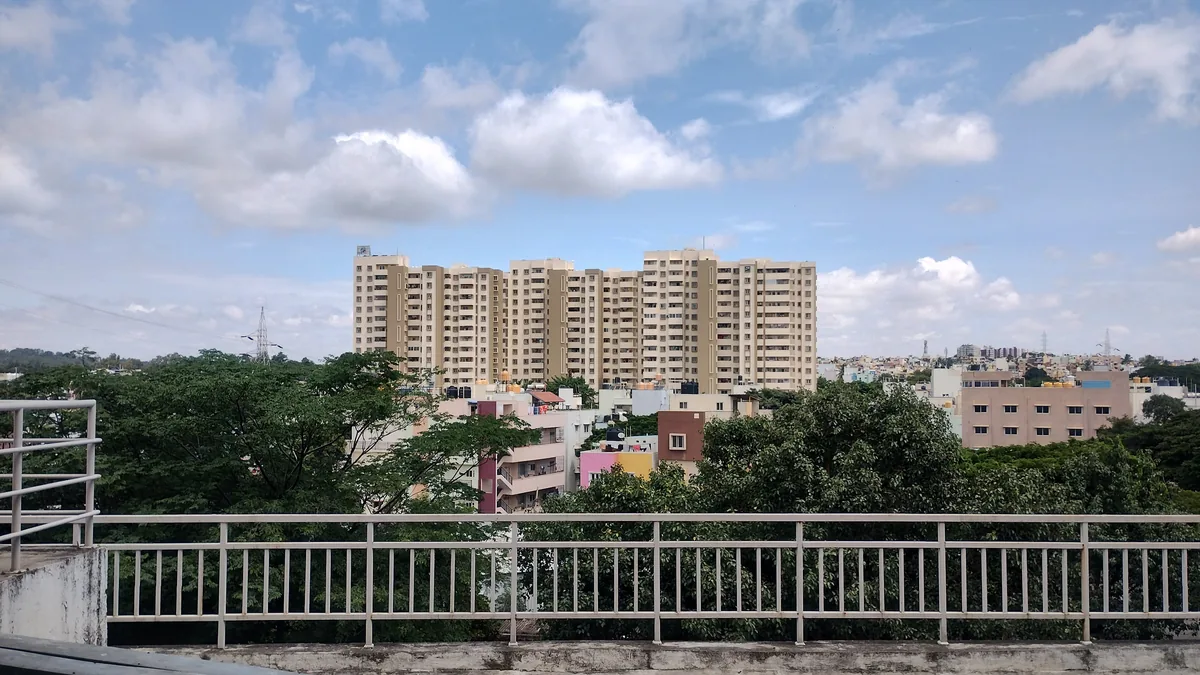
Photo: Gpkp, Wikimedia Commons, CC BY-SA 4.0.
Direct Answer: Purchasing a resale flat in an established, association-run apartment complex in Bengaluru means buying into a shared legal entity and balance sheet, not merely acquiring private square footage. Before executing an agreement or transferring a token, buyers must scrutinize five governance pillars: (1) **Registered Bye-Laws:** Inspect the society's registered constitution under the Karnataka Societies Registration Act, 1960 or Karnataka Cooperative Societies Act, 1959, verifying pet policies, tenant curbs, and modification permissions; (2) **Financial Reserve Audit:** Review the last 2 years of audited financial statements, confirming that long-term sinking funds are held in scheduled commercial bank fixed deposits rather than being depleted by operational deficits; (3) **Parking Register Alignment:** Verify that the parking bay matches the association's official master allocation register; (4) **Litigation Disclosures:** Review pending court cases involving the promoter, municipal bodies, or builder handover disputes; and (5) **Transfer Formalities:** Clarify transfer fees, share certificate procedures, and obtain an official No-Objection Certificate (NOC).
Disclosure: acre&key's advice is free to buyers. We're an authorised sales partner for some projects and may be paid by the developer.
Buying into an established community provides stability, but unvetted society liabilities can trigger sudden assessments. The operational questions to ask the management committee are detailed in 10 questions to ask the association before a resale token. Formal transfer certificate procedures are covered in apartment association NOC for resale. Builder handover responsibilities are mapped in when a builder must hand over khata, meters, and corpus and the builder handover checklist. Legal parking standards are analyzed in our apartment parking rights checklist.
Buying into an institution: what changes on an established campus
In an under-construction project, buyers interact directly with the builder's sales office. In an established resale property, the Apartment Owners Association (AOA) or Resident Welfare Association (RWA) controls day-to-day community life, security infrastructure, water management, and amenity maintenance:
- The Association as Gatekeeper: While the association does not hold ownership title to your private apartment, it governs common utilities (lifts, STP, backup diesel generators, borewells) and controls common facility access.
- Inherited Liability Principle: Under standard apartment association bye-laws, maintenance debts attach to the specific flat. If the previous owner accumulated Rs 1,00,000 in unpaid maintenance or penalty interest, the association can legally demand payment from the incoming purchaser before transferring membership.
- The Sinking Fund Reality: An older building (7 to 15 years old) inevitably requires major capital expenditures—replacing lift elevator ropes, repainting the building facade, rewiring transformers, and relining STP tanks. If the association failed to accumulate a healthy sinking fund, the general body will vote for a special capital assessment levy, charging Rs 1.5 lakh to Rs 4 lakh per flat to fund emergency overhauls.
Reviewing the association's legal and financial dossier
Before paying non-refundable tokens, review these critical records directly with the management committee:
| Document / Area | What to Inspect | Warning Sign to Avoid |
|---|---|---|
| 1. Registered Bye-Laws | The constitution registered with the Registrar of Societies or Cooperative Department | Outdated, unnotified bye-laws containing unlawful restrictions (e.g., blanket bans on bachelor tenants or pets) |
| 2. Audited Financial Statements | The last 2 years of audited balance sheets, profit & loss statements, and auditor's notes | High default rates (>15% of owners defaulting on monthly maintenance) or persistent operating cash deficits |
| 3. Sinking Fund Balance | Official bank deposit slips showing long-term capital reserves held in fixed deposits | Sinking funds mixed with daily operational accounts or depleted by routine generator diesel bills |
| 4. Master Parking Register | The committee's official ledger recording basement and stilt parking allotments | The seller's bay is not officially recorded, is marked "temporary visitor parking," or conflicts with a neighbor's slot |
| 5. Pending Litigation Schedule | Written disclosure of disputes before City Civil Courts, High Court, NGT, or Consumer Forums | Active litigation over environmental clearances, rajakaluve buffer violations, or unhanded builder corpus funds |
| 6. Statutory Handover Papers | As-built drawings, KSPCB Consent for Operation (CFO), lift licenses, and BWSSB bulk water meter sanctions | The promoter never handed over original structural drawings or building completion records |
Understanding the Registration Framework
In Karnataka, residential apartment associations have historically registered under two distinct statutes: - Karnataka Societies Registration Act, 1960 (KSRA): Historically the most common vehicle. However, Karnataka High Court rulings (Confederation of Real Estate Developers Association of India v. State of Karnataka) observed that KSRA is meant for literary, scientific, and charitable societies, creating ongoing legal debates regarding property management enforceability. - Karnataka Cooperative Societies Act, 1959 (KCSA): Provides robust statutory authority for managing common immovable properties and recovering maintenance arrears as land revenue arrears. - Upcoming KAOMA 2026 Framework: The Karnataka Apartment (Ownership and Management) Act, 2026 (Act 45 of 2026) aims to streamline association registration under a unified real estate authority once formally commenced.
Interactive Association-Run Resale Due Diligence Checklist
Use this interactive 10-step checklist to review community governance, sinking fund health, and association rules before buying an established apartment:
Interactive Due Diligence Checklist
Track your resale association due diligence steps. Check items off as verified:
Frequently asked questions
In a builder-managed property, operations are subsidized or run by developer facility teams, often concealing operational deficiencies. In an association-managed campus, residents control maintenance, meaning audited accounts, sinking fund health, and community bye-laws are fully transparent and documented.
An association cannot arbitrarily block a lawful property conveyance between buyer and seller. However, if the seller has unpaid maintenance dues, outstanding utility penalties, or unauthorized architectural violations on common property, the committee can legally withhold its No-Objection Certificate until cleared.
Older apartment complexes face major capital replacements every 8 to 12 years (lifts, STP aeration blowers, external paint, diesel generator overhauls). If the sinking fund is insufficient, the association must pass special levies charging each owner substantial lump sums to finance emergency repairs.
Request the association secretary or facility manager to inspect the society's Master Parking Allocation Register. Ensure the slot number, basement level, and boundaries in the association ledger match the seller's registered sale deed and physical markings.
Under Indian law and Animal Welfare Board guidelines, associations cannot legally ban pets or prohibit them from using elevators. While some committees attempt to ban bachelor or unmarried tenants, such restrictions lack constitutional backing; however, living in a community with hostile internal bye-laws causes persistent day-to-day friction.
Examine discussions regarding water tanker expenditures, recurring sewage treatment plant (STP) breakdowns, builder litigation, elevator maintenance quality, or debates over insufficient reserve funds.
An association transfer fee is an administrative charge levied by the society to update member registers, issue share certificates, and modify billing accounts. The Agreement to Sell should explicitly state whether the buyer or seller pays this fee.
If the promoter retains custody of corpus funds, common meters, or original drawings, the association often spends resident funds fighting legal battles before K-RERA or civil courts. Buyers should budget for potential legal contributions and review active suit papers.
No. An association NOC is an internal administrative verification of maintenance dues. An Encumbrance Certificate from Kaveri Online Services is a statutory government search proving the property is free from bank mortgages, court attachments, or third-party registered claims.
Obtain a preliminary written statement of dues before paying an advance token, and collect the final sealed No-Dues Certificate / NOC from the Management Committee 3 to 5 days prior to final deed registration at the Sub-Registrar Office.
Lawyer note: The information provided on this page is for educational and procedural guidance under Indian property, apartment ownership, and society registration legislation and does not constitute formal legal counsel. Resolving association disputes, verifying bye-law legality, or assessing builder handover litigation requires review by an experienced property advocate. Obtain qualified legal counsel before executing purchase agreements.
CA note: Monthly maintenance payments made to an apartment association are subject to 18% GST if the individual unit's monthly billing exceeds Rs 7,500 and the association's total annual turnover crosses Rs 20 lakh. Consult a chartered accountant for GST thresholds and capital expenditure tax treatment.
Sources
Checked 18 Nov 2026.
-
Karnataka Societies Registration Act, 1960 and Karnataka Cooperative Societies Act, 1959: https://dpal.karnataka.gov.in/
-
Karnataka Apartment (Ownership and Management) Act, 2026 (Act 45 of 2026): https://prsindia.org/files/bills_acts/acts_states/karnataka/2026/Act45of2026KA.pdf
-
Real Estate (Regulation and Development) Act, 2016, Section 17 (Handover of common areas): https://rera.karnataka.gov.in/resources/staticpage/Real_Estate_Act.pdf
-
Kaveri Online Services Portal, Department of Stamps and Registration, Government of Karnataka: https://kaveri.karnataka.gov.in/