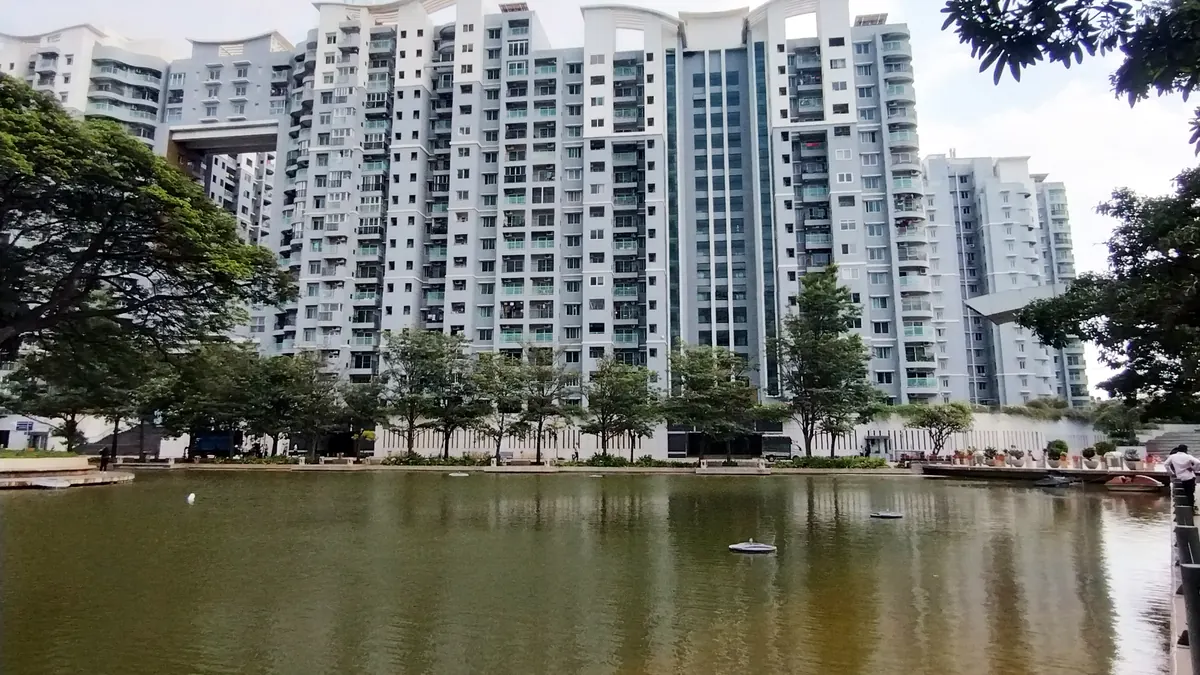
Photo: Gpkp, Wikimedia Commons, CC BY-SA 4.0.
An Apartment Owners Association (AOA) or Resident Welfare Association (RWA) No Objection Certificate (NOC) is an essential operational clearance in a secondary market purchase, but it does not constitute a title deed or municipal occupancy certificate. A legally complete association NOC verifies that the seller has settled all monthly maintenance dues, sinking corpus contributions, and special infrastructure levies up to the exact date of conveyance. It also confirms that the society's internal master register acknowledges the seller as the lawful owner, identifies assigned parking bays, and outlines formal membership transfer fees.
When purchasing a resale apartment in an established Bengaluru gated community, buyers frequently collect a one-line "No Objection Certificate" from the management committee and assume all property liabilities are resolved.
However, an association NOC is purely an internal administrative clearance governed by society bye-laws. It does not validate structural plan sanction compliance, prove an unbroken 30-year chain of title, or substitute for a municipal Final e-Khata.
Failing to audit what an association NOC actually states—and neglecting to cross-verify it against original deeds and accounts ledgers—can leave buyers inheriting lakhs of unpaid maintenance arrears, disputed parking allocations, or arbitrary membership transfer fines.
The legal scope of an association NOC
+--------------------------------------------------------------------------------+
|                 ASSOCIATION NOC: SCOPE VS LIMITATIONS                          |
+--------------------------------------------------------------------------------+
|  [WHAT AN ASSOCIATION NOC PROVES]                                              |
|  - Zero outstanding monthly maintenance dues up to certified date             |
|  - Sinking fund and corpus contributions are paid and credited                 |
|  - Society master register reflects seller as current lawful unit occupant    |
|  - Specific covered/open parking bay assigned in association records          |
|  - Clear transition of clubhouse and shared common amenity usage rights        |
|                                                                                |
|  [WHAT AN ASSOCIATION NOC CANNOT PROVE]                                        |
|  - Marketable legal title or absence of civil court litigation / stays        |
|  - Validity of BBMP/BDA Occupancy Certificate (OC) or structural safety       |
|  - Municipal e-Khata authentication or property tax clearance                  |
|  - Freehold ownership of parking bays (parking cannot be sold as separate title)|
+--------------------------------------------------------------------------------+
Essential components of a comprehensive resale NOC
A vague, generic "The management committee has no objection to the transfer of Flat 402" is legally fragile. A robust NOC issued by a Bengaluru association must explicitly detail six distinct operational items:
| NOC Line Item | Verification Requirement | Critical Risk if Omitted |
|---|---|---|
| 1. Maintenance Ledger | Itemized breakdown of monthly maintenance debits | Unpaid arrears (sometimes dating back years) transfer to buyer |
| 2. Sinking / Corpus Fund | Written confirmation that capital corpus is fully paid | Management demands fresh corpus contribution from new buyer |
| 3. Special Levies | Status of one-time assessments (STP overhaul, painting) | Buyer forced to fund pending capital improvement resolutions |
| 4. Parking Slot Allocation | Specific basement level and bay number matching deed | Risk of finding parking reallocated to another resident |
| 5. Transfer / Mutation Fee | Explicit fee structure stated per registered bye-laws | Management committee levies arbitrary, inflated transfer fees |
| 6. Structural Modifications | Certification of zero unauthorized balcony/wall alterations | Association withholds access until illegal alterations are undone |
1. Differentiating monthly maintenance from special levies
In mature communities (10+ years old), associations periodically pass general body resolutions imposing "Special Capital Assessments"—such as Rs 1.5 to Rs 3 Lakhs per flat to overhaul aging Schindler/Otis lifts, re-waterproof terrace slabs, or replace STP filtration membranes.
A seller may be current on basic Rs 4,500/month upkeep while quietly carrying an unpaid Rs 2,00,000 special assessment ledger balance. The NOC must explicitly certify that both routine maintenance and extraordinary capital levies are fully liquidated.
2. The parking bay verification trap
Parking bays are common property under Karnataka apartment jurisprudence and cannot be conveyed as standalone freehold titles.
A seller may point to a well-located ground-floor covered parking bay during viewings. However, if that bay was informally swapped with a neighbor or leased from the builder without formal association register endorsement, the association can reassign the new buyer to an inconvenient basement stacker bay. The NOC must specifically certify the assigned bay number matching the registered Sale Deed schedule.
3. Society transfer fees: legal limits in Bengaluru
Many apartment associations attempt to charge predatory "transfer fees" ranging from Rs 25,000 to over Rs 1,00,000 when ownership changes hands.
Under Karnataka cooperative society and apartment ownership principles: - Transfer fees must be explicitly codified in the society's registered bye-laws. - Arbitrary transfer charges designed as revenue-generating penalties have been repeatedly struck down by consumer commissions and civil courts as unreasonable restrictions on alienation. - The Agreement to Sell must explicitly state whether the seller or the buyer bears this fee.
What to do if the association refuses to issue an NOC
In contentious resale transactions—such as where the developer never handed over the corpus fund, or where an ongoing dispute exists between the seller and the committee—associations sometimes threaten to block property sales by withholding the NOC.
Under Karnataka High Court precedents (including rulings delivered in 2026): 1. No Absolute Power to Restrain Conveyance: An apartment owners association does not possess statutory authority to prohibit a property owner from executing a registered Sale Deed before the Sub-Registrar. 2. Essential Services Cannot Be Disconnected: An association cannot disconnect water supply, electricity metering, or lift access to coerce settlement of disputed pre-registration developer dues. 3. Escrowing Disputed Amounts: If genuine maintenance arrears exist, the buyer's legal counsel can hold back the disputed sum from the final sale consideration in an escrow arrangement, paying the association directly upon conveyance.
Apartment association resale NOC checklist
Verify critical society covenants before releasing final sale deed balance.
Frequently asked questions
Under the Registration Act, 1908, an association NOC is not a statutory prerequisite for the Sub-Registrar to execute a conveyance deed. However, financial institutions funding resale purchases almost universally mandate an association NOC prior to disbursing loan proceeds to ensure the property carries zero maintenance liens.
In practice, apartment associations attach maintenance liabilities to the specific apartment unit rather than the individual debtor. If a seller moves away leaving unpaid dues, the association can legally demand payment from the new purchaser or restrict access to common amenities until settled. Always demand an NOC and hold back funds if arrears exist.
No. Transfer fees must be reasonable, non-discriminatory, and codified within the registered bye-laws of the society. Excessive arbitrary fees can be challenged before the Registrar of Societies or the jurisdictional Consumer Disputes Redressal Commission.
Most managed apartment communities require the new owner to submit a registered Sale Deed and complete formal membership orientation before tenant move-in permissions and elevator padding slots are granted.
No. Many apartment complexes in Bengaluru function with active associations despite lacking an official BBMP or BDA Occupancy Certificate. An association NOC only reflects community accounting records; buyers must verify the physical OC separately with civic town planning records.
Legal Note: Association governance is bound by the Karnataka Societies Registration Act, 1960 or the Karnataka Apartment Ownership Act, 1972. Consult a qualified real estate advocate if management committees threaten property access or impose unauthorized transfer penalties.
Financial Note: Ensure the Agreement to Sell clearly defines escrow arrangements for pending society assessments. Reconcile ledger debits with your legal counsel before transferring closing consideration.
Sources
Checked 18 Nov 2026.
- Karnataka Apartment Ownership Act, 1972 (Section 13 - Bye-laws and maintenance administration): https://dpal.karnataka.gov.in/
- Karnataka Societies Registration Act, 1960 (Society Management & Transfer Norms): https://dpal.karnataka.gov.in/
- High Court of Karnataka, Landmark Rulings on Apartment Common Facilities Access: https://karnatakahihecourt.kar.nic.in/