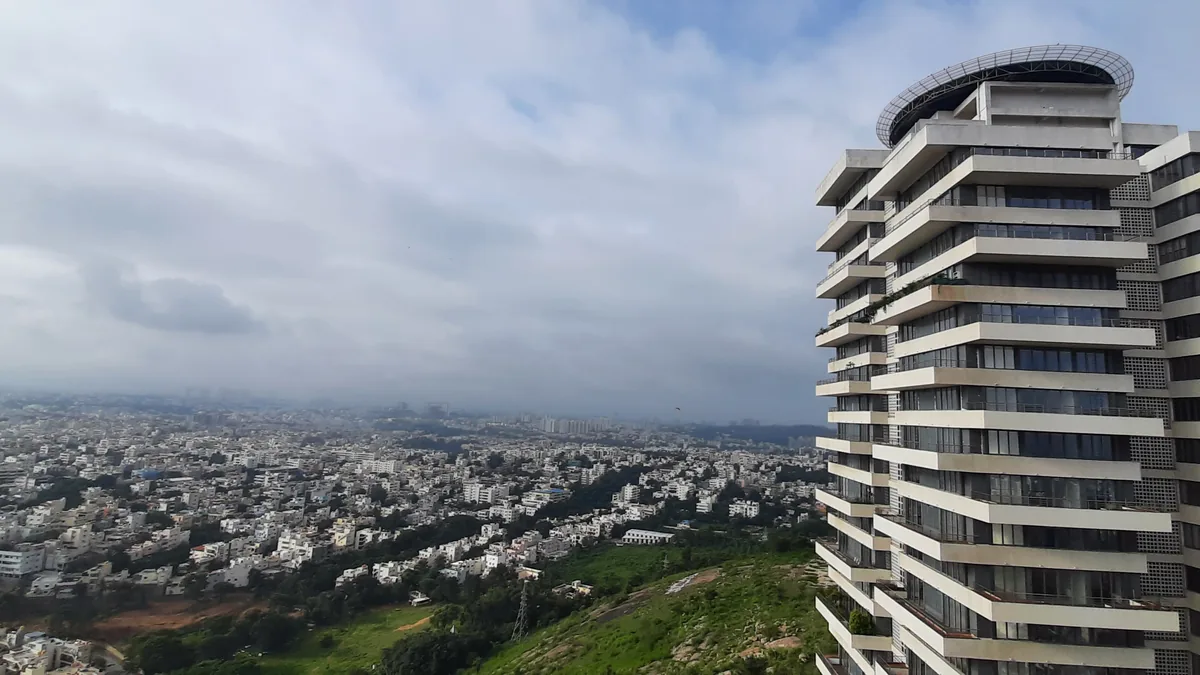
Photo: Kushagra140, Wikimedia Commons, CC BY-SA 4.0.
Direct Answer: In Bengaluru, an apartment parking bay cannot be legally bought or sold as a standalone freehold real estate title. Under landmark Supreme Court jurisprudence (*Nahalchand Laloochand v. Panchali Co-operative Housing Society*) and Section 2(n) of RERA, 2016, basements, stilts, and open podium parking constitute common areas belonging collectively to all apartment owners. What a buyer acquires is an **exclusive right to use** an assigned parking slot, which must be clearly identified by number, basement level, and architectural coordinates in the registered Agreement for Sale and Sale Deed. The Karnataka Apartment (Ownership and Management) Act, 2026 (KAOMA), published in October 2026, codifies that common parking areas cannot be privatized through arbitrary builder demarcation. Buyers must verify the sanctioned building plan and RERA parking disclosures before paying deposits.
Disclosure: acre&key's advice is free to buyers. We're an authorised sales partner for some projects and may be paid by the developer.
Parking disputes remain among the most frequent flashpoints in Bengaluru apartment communities. The statutory transition of parking spaces is detailed in stilt, basement and podium parking under KAOMA 2026. How to draft parking clauses into sales contracts is covered in car park and extra charges in the sale agreement. Land share calculation rules are outlined in the UDS calculation guide. For resale properties, verify association governance via 10 questions to ask the apartment association, and check project disclosures via how to check any Bengaluru project on K-RERA.
The legal reality: why parking cannot be sold as a separate title
Homebuyers often encounter builder quotations featuring line items like "Covered Car Park: Rs 4,00,000" or "Basement Stack Parking: Rs 2,50,000." Understanding the legal structure prevents costly ownership disputes:
- Supreme Court Precedent (Nahalchand Doctrine): The Supreme Court of India established that a promoter has no statutory right to sell open spaces, stilt parking, or basement areas as separate individual tenements or flats. These areas form part of the common areas and facilities.
- RERA, 2016 Definitions: Under Section 2(n) of the Real Estate (Regulation and Development) Act, 2016, "common areas" specifically encompass basements, parking areas, and common storage spaces. Promoters are required to disclose the total number of covered and open parking bays to the regulatory authority.
- KAOMA 2026 Statutory Framework: The Karnataka Apartment (Ownership and Management) Act, 2026 (Act 45 of 2026), published in the Karnataka Gazette on 15 October 2026, reinforces that open, stilt, basement, and podium parking forming part of the common area cannot become private property merely through developer allotment or physical striping.
- The "Exclusive Right to Use": While the developer cannot convey standalone freehold title to the floor concrete, they can lawfully assign an exclusive, irrevocable license / right to park tied directly to the specific apartment number.
Reconciling the three critical documents
To ensure your parking right is legally secure, you must reconcile three distinct records:
| Verification Document | What to Inspect | Critical Discrepancy Risk |
|---|---|---|
| 1. Registered Sale Deed / Agreement for Sale | Specific schedule describing: "Exclusive right to use Covered Car Parking Space No. B2-145 in Basement 2" | Vague clauses like "Parking will be allotted at the sole discretion of the promoter at possession." |
| 2. Sanctioned Architectural Floor Plan | Check BBMP/BDA approved basement drawing showing delineated, numbered parking stalls and minimum 6m driveways | The builder created extra parking stalls in utility shafts, setback areas, or emergency fire-tender driveways. |
| 3. Karnataka RERA Project Filing | Check the Form B disclosure and quarterly compliance report detailing covered vs open parking inventory | The developer sold 300 parking bays when the sanctioned municipal plan cleared only 220 bays. |
Mechanical and Tandem (Dependent) Parking Checks
If your allotted bay involves mechanical stack systems (hydraulic two-tier lifts) or tandem parking (where one car is parked behind another, blocking exit): - Verify that the basement ceiling height clears the mandatory minimum clearance (typically ≥ 4.2 metres for hydraulic double-stackers). - Confirm who bears ongoing hydraulic pump maintenance, annual safety certification, and power consumption bills. - For tandem parking, ensure both dependent slots are formally allotted to your unit alone, rather than pairing two different apartment owners together.
Common area rights beyond car parking
The same statutory principles governing parking apply to other common spaces often marketed as "exclusive":
- Private Terraces and Roof Access: Unless an adjoining terrace is explicitly sanctioned as exclusive built-up balcony space in the BBMP plan, roof terraces remain common property accessible to all residents for emergency egress and solar/overhead tank maintenance.
- Private Garden Pockets: Ground-floor garden spaces adjacent to flats are frequently common peripheral setbacks. If a promoter sells a ground-floor garden, confirm whether it is reflected as private exclusive area in the sanctioned plan.
- Clubhouse and Amenity Access: Common facilities (swimming pools, fitness centers, party halls) cannot be retained by the developer as proprietary commercial clubs once the project is handed over to the Apartment Owners Association (AOA).
Interactive Parking & Common Area Due Diligence Checklist
Use this interactive 10-step checklist to verify car parking allotments and common-area covenants before signing purchase agreements:
Interactive Due Diligence Checklist
Track your apartment parking verification steps. Check items off as verified:
Frequently asked questions
Under Supreme Court rulings (Nahalchand Laloochand) and Section 2(n) of RERA, 2016, parking spaces located in basements, stilts, and open podiums form part of common areas and cannot be sold as standalone freehold title. A builder can only charge an agreed cost and allocate an exclusive right of use attached to a specific residential unit.
The schedule of the registered sale deed must explicitly identify the parking bay by its designated number, floor/basement level, covered/stilt/open classification, and boundary dimensions. Avoid open-ended clauses stating "one car park as allotted by the promoter at possession."
Covered parking is located within an enclosed basement structure. Stilt parking is on the ground level beneath the building supported by structural pillars. Open parking is on the surface within the layout compound. Under RERA, open parking spaces cannot be sold for consideration and must remain common to all residents.
If the developer painted unauthorized parking slots in emergency driveways, setback zones, or utility service corridors, the civic authority or resident association can declare those bays illegal, leaving the buyer without parking and no refund from the builder.
Mechanical stack parking uses electro-hydraulic systems to park one car vertically above another. It requires specific municipal approval and strict ceiling height compliance (typically 4.2m). The maintenance and power costs are generally shared or borne by the allotted owner according to association bye-laws.
No. Because the parking right is an appurtenant right tied to the ownership of the specific apartment, it cannot be severed or sold to a third party outside the apartment community. An owner may only lease or reallocate the bay to another resident within the same association subject to bye-laws.
Yes. The Occupancy Certificate is issued after municipal engineers inspect the completed building, including basements and stilts, to verify that parking spaces comply with setback and fire evacuation norms.
Tandem parking consists of two parking bays positioned end-to-end where the inner car cannot exit without moving the outer car. Tandem slots should only be allotted together to a single multi-car apartment owner; pairing two different owners in a tandem bay leads to severe daily conflict.
If your sale deed explicitly conveys the exclusive right to use a numbered bay matching sanctioned plans, the RWA cannot unilaterally confiscate or reassign your space. However, if the deed contains vague language and the association manages parking under common pool rules, reassignments may occur under general body resolutions.
Verify whether the building's electrical ducting permits laying an armored cable from your individual flat's BESCOM meter to your parking bay, or whether the community uses centralized shared EV charging stations managed by a third-party vendor.
Lawyer note: The information provided on this page is for educational and procedural guidance under Indian property and municipal legislation and does not constitute formal legal counsel. Resolving parking ambiguities, tandem disputes, or unrecorded allotments requires thorough scrutiny of the registered deed and sanctioned drawings by a qualified property advocate. Obtain written legal clearance before executing purchase agreements.
CA note: Parking allotment charges form part of the total capital acquisition cost of the residential property. Ensure the full consideration is recorded within the registered agreement to maximize cost basis indexation benefits and avoid unaccounted cash liabilities.
Sources
Checked 18 Nov 2026.
-
Real Estate (Regulation and Development) Act, 2016, Section 2(n) (Common areas definition): https://rera.karnataka.gov.in/resources/staticpage/Real_Estate_Act.pdf
-
Supreme Court of India, Nahalchand Laloochand Pvt. Ltd. v. Panchali Co-operative Housing Society Ltd. (2010) 9 SCC 536: https://main.sci.gov.in/
-
Karnataka Apartment (Ownership and Management) Act, 2026 (Act 45 of 2026): https://prsindia.org/files/bills_acts/acts_states/karnataka/2026/Act45of2026KA.pdf
-
Karnataka Real Estate Regulatory Authority (K-RERA) Approvals Portal: https://rera.karnataka.gov.in/