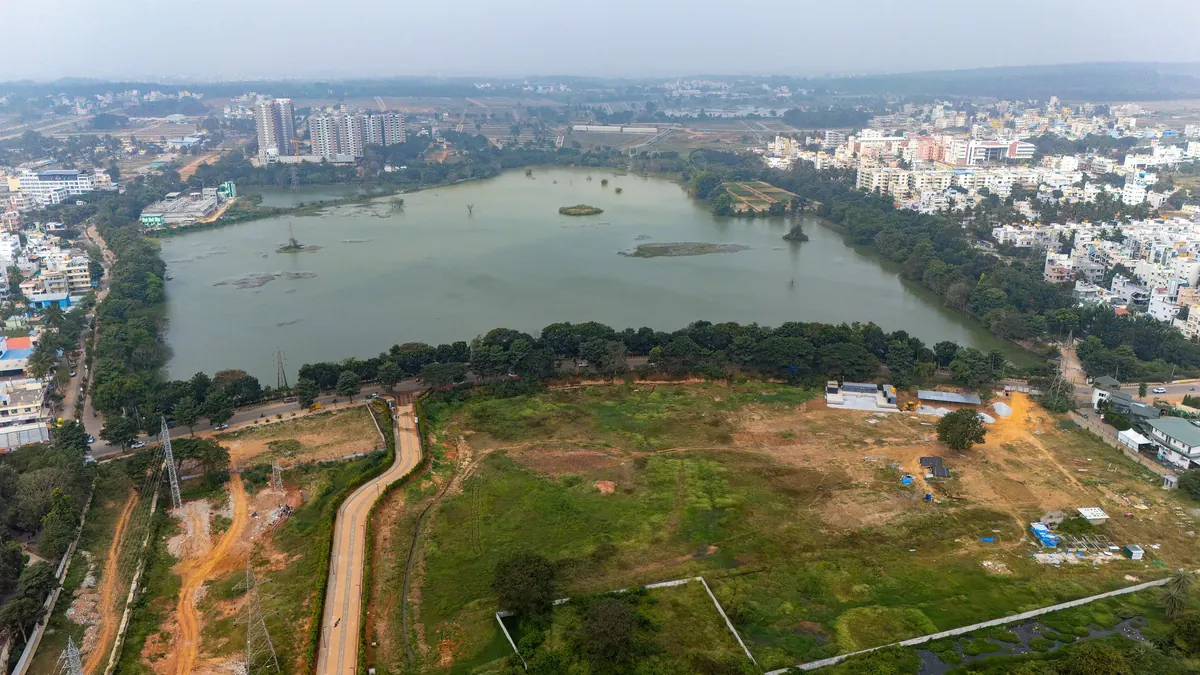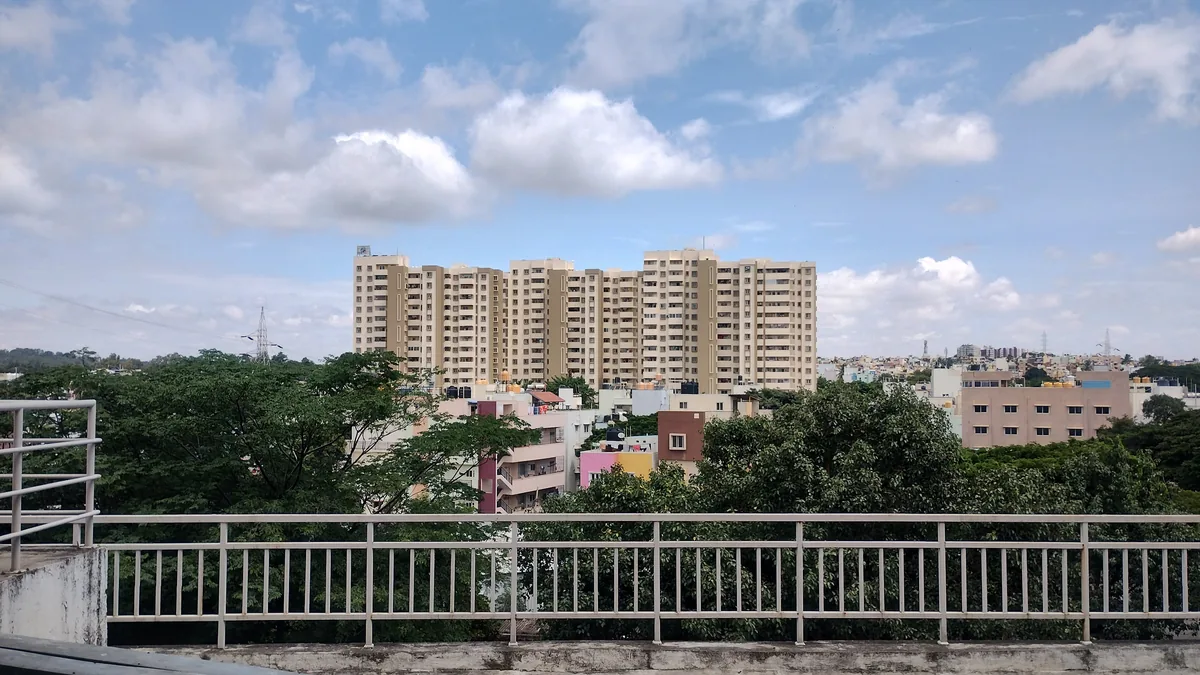
Photo: Ashwin Kumar, Wikimedia Commons.
Direct Answer: In Bengaluru real estate marketing, "Super Built-Up Area" (SBA) or "Saleable Area" is an undefined commercial marketing metric that inflates actual living space by 20% to 40% through "loading" common areas (corridors, lift shafts, staircases, and clubhouse spaces). Under Section 2(k) of the Real Estate (Regulation and Development) Act, 2016, the only legally recognized measure is **RERA Carpet Area**, defined as the net usable floor area within an apartment, including internal partition walls, but strictly excluding external boundary walls, service shafts, and exclusive balconies or verandahs. Section 4(2)(h) requires promoters to disclose carpet area and exclusive balconies separately. To evaluate true pricing, buyers must divide the total all-inclusive quotation by the RERA carpet area, rather than comparing distorted square-foot rates calculated on arbitrary super built-up metrics.
Disclosure: acre&key's advice is free to buyers. We're an authorised sales partner for some projects and may be paid by the developer.
Decoding property area measurements protects buyers from paying inflated per-square-foot rates for phantom space. Land share calculation rules are detailed in our UDS calculation guide for Bengaluru apartments. How preliminary sale documents must reflect statutory areas is covered in allotment letter vs agreement for sale vs sale deed. How to cross-verify promoter disclosures on the state regulatory database is mapped in how to check any Bengaluru project on K-RERA. Contractual drafting requirements are detailed in car park and extra charges in the sale agreement.
The statutory hierarchy: what RERA includes and excludes
To prevent misleading marketing practices where builders sold common lobby space as private floor area, the Real Estate (Regulation and Development) Act, 2016 established precise legal demarcations:
| Area Classification | Legal Definition under RERA / Building Bye-Laws | What Is Included? | What Is Excluded? |
|---|---|---|---|
| RERA Carpet Area (Section 2(k)) | Net usable internal floor area of the residential apartment | Living rooms, bedrooms, kitchen, bathrooms, corridors, utility rooms, and internal partition walls | External perimeter walls, utility shafts, pipe ducts, lift lobbies, and all balconies/terraces |
| Exclusive Balcony / Verandah Area | Adjoining usable open or covered exterior space appurtenant to the unit | Floor area of private balconies, utility balconies, and private sit-outs | Common escape balconies, external fire-tender paths, structural ledges |
| Exclusive Open Terrace Area | Open-to-sky terrace space directly accessible from and appurtenant to the flat | Demarcated private rooftop or podium terrace assigned to a specific penthouse or garden flat | Common building terraces, lift machine room slabs, solar plant roofs |
| Super Built-Up Area (SBA) | Undefined in RERA; a legacy commercial construction formulation | Carpet area + external walls + balconies + proportionate share of all common lobbies, lifts, and amenities | Basements and stilt parking spaces (under Supreme Court Nahalchand doctrine) |
The Inclusion of Internal Partition Walls
A frequent source of consumer confusion is whether internal partition walls count as carpet area. - Under Section 2(k), the thickness of internal partition walls separating rooms inside the apartment is legally included in the RERA carpet area. - Conversely, the external perimeter walls enclosing the flat (typically 200mm solid concrete blocks) and party walls shared with adjacent neighbors are strictly excluded (or shared 50% in standard architectural practice).
Decoding "Loading" and true per-square-foot cost
"Loading" represents the percentage difference between the usable carpet area and the inflated super built-up area marketed by the developer.
$$\text{Loading Percentage} = \left( \frac{\text{Super Built-Up Area} - \text{RERA Carpet Area}}{\text{RERA Carpet Area}} \right) \times 100$$
The Loading Math Illustrated
Consider two competing Bengaluru projects quoting what appears to be the same headline rate:
| Project Comparison Parameters | Project A (High Loading Campus) | Project B (Efficient Design Campus) |
|---|---|---|
| Advertised Super Built-Up Area | 1,500 sq.ft | 1,350 sq.ft |
| RERA Carpet Area | 1,000 sq.ft | 1,000 sq.ft |
| Exclusive Balcony Area | 100 sq.ft | 100 sq.ft |
| Effective Loading Percentage | 50% | 35% |
| Quoted Base Rate (on SBA) | Rs 8,000 / sq.ft | Rs 8,500 / sq.ft |
| Quoted Base Apartment Cost | Rs 1,20,00,000 (1.20 Cr) | Rs 1,14,75,000 (1.147 Cr) |
| True Cost per sq.ft of Carpet Area | Rs 12,000 / sq.ft | Rs 11,475 / sq.ft |
The Reality: While Project A appeared cheaper at Rs 8,000/sq.ft compared to Project B's Rs 8,500/sq.ft, Project A is actually Rs 5.25 lakh more expensive for the exact same 1,000 sq.ft of living space because the developer added 50% loading for oversized corridors and commercial amenities.
Reconciling the RERA portal disclosure with your agreement
When reviewing project documentation, execute this step-by-step verification:
- Open the K-RERA Portal: Navigate to rera.karnataka.gov.in and search the project by PRM registration number.
- Download Form B and Apartment Inventory: Open the disclosed apartment inventory schedule under Section 4(2)(h).
- Match Flat Configuration: Locate your specific unit number, wing, and floor. Verify that the RERA carpet area (in square metres) listed in the regulatory database matches the figure stated in your draft Agreement for Sale down to two decimal places.
- Inspect Sanctioned Architectural Floor Plans: Download the BBMP/BDA sanctioned plan blueprint from the portal. Verify the internal dimensions (length x breadth) of bedrooms, living areas, and kitchen against the sales brochure floor plan.
Interactive Area & Measurement Due Diligence Checklist
Use this interactive 10-step checklist to verify carpet area, balcony dimensions, and loading factors before signing a property purchase agreement:
Interactive Due Diligence Checklist
Track your area verification milestones. Check items off as verified:
Frequently asked questions
Under Section 2(k) of the Real Estate (Regulation and Development) Act, 2016, carpet area is defined as the net usable floor area of an apartment, excluding external walls, service shafts, and exclusive balconies/terraces, but including internal partition walls.
Super built-up area allows developers to present a lower, more attractive headline price per square foot by diluting the cost over common areas (lobbies, lifts, staircases, and amenities). While marketing may mention SBA, the registered contract must disclose RERA carpet area.
No. Under Section 2(k) and Section 4(2)(h), exclusive balconies, verandahs, and open terraces are excluded from the core carpet area and must be disclosed as separate, distinct line items in the regulatory filings and the sale agreement.
Yes. RERA Section 2(k) explicitly includes the area covered by internal non-structural partition walls within the apartment. However, external perimeter walls separating the flat from corridors or neighboring flats are excluded.
In Bengaluru, loading percentages typically range from 20% to 25% for low-rise and mid-segment developments, and 30% to 40% for large high-rise township projects with expansive double-height lobbies, wide corridors, and multi-tier clubhouses.
Under RERA rules, if the final carpet area delivered at completion is less than what was contracted in the registered Agreement for Sale, the promoter is legally required to refund the excess money collected, with interest, within 45 days of handover.
No. Under Section 14 of RERA, 2016, a developer cannot make major alterations or additions to the sanctioned plans, layout, or specifications of an individual apartment without the prior written consent of the buyer.
Carpet area measures the internal usable floor space of your private apartment unit. Undivided Share of Land (UDS) represents your fractional freehold ownership share in the underlying plot of land on which the entire building complex is erected.
No. The RERA Act does not establish a statutory cap on loading percentages. It mandates transparency by requiring developers to disclose exact carpet areas, allowing buyers to evaluate whether the loading is justified by the provided common amenities.
Visit the official Karnataka RERA portal (rera.karnataka.gov.in), search for the project by name or registration number, open the "Approvals / Project Details" tab, and download Form B and the sanctioned architectural floor plans.
Lawyer note: The information provided on this page is for educational and due diligence guidance under Indian real estate and consumer protection legislation and does not constitute formal legal counsel. Resolving area discrepancies, drafting compensation clauses for area shortfalls, or enforcing RERA Section 14 obligations requires review by an experienced property advocate. Obtain qualified legal counsel before executing registered contracts.
CA note: Capital gains computations and stamp duty valuations in Karnataka are assessed on the registered consideration or the government guidance value (whichever is higher). Ensure your purchase agreement correctly reflects carpet and super built-up ratios to avoid discrepancies during income tax capital gains assessments upon future resale.
Sources
Checked 18 Nov 2026.
-
Real Estate (Regulation and Development) Act, 2016, Section 2(k) and Section 4(2)(h) (Carpet area definitions and disclosures): https://rera.karnataka.gov.in/resources/staticpage/Real_Estate_Act.pdf
-
Karnataka Real Estate (Regulation and Development) Rules, 2017: https://rera.karnataka.gov.in/
-
Supreme Court of India, Nahalchand Laloochand Pvt. Ltd. v. Panchali Co-operative Housing Society Ltd. (Common areas and parking): https://main.sci.gov.in/
-
Kaveri Online Services Portal, Department of Stamps and Registration, Government of Karnataka: https://kaveri.karnataka.gov.in/