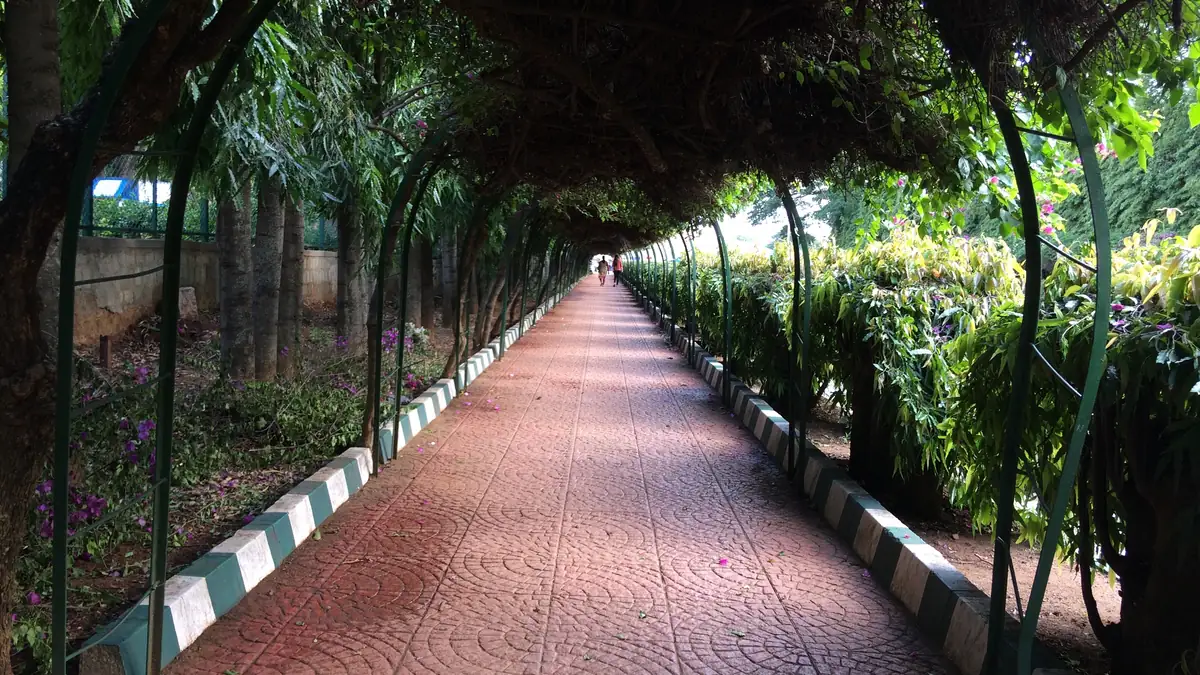
Photo: Adil Jamal, Wikimedia Commons, CC BY-SA 4.0.
On 17 November 2026, Bangalore Mirror reported that the Karnataka State Government has instructed Bengaluru Smart Infrastructure Mobility Infrastructure Limited (B-SMILE) to eliminate all land acquisition within Lalbagh Botanical Garden for the proposed 16.75 km Hebbal-to-Silk Board twin-tube tunnel road. B-SMILE is currently evaluating four alternative engineering alignments to relocate construction shafts and access ramps away from the historic botanical park. However, the project has not received final Cabinet alignment approval or contractual financial closure. The selected bidder's tender offer of ₹22,267 Crore remains under commercial renegotiation against the state estimate of ₹17,780 Crore. Homebuyers along Hebbal, Wilson Garden, Jayanagar, and Silk Board must evaluate real estate on existing transit infrastructure rather than paying speculative premiums on an unawarded civil project.
The operational transit landscape across northern corridors is detailed in living in Hebbal and our analysis of Ballari Road 18-month traffic curbs and Blue Line metro timelines. Southern transit alternatives are covered in our Bengaluru metro lines guide. This guide clarifies the engineering changes, commercial tender status, and real estate implications of the proposed subterranean corridor.
The project parameters: Original blueprint vs. public opposition
The proposed Bengaluru Underground Tunnel Road is conceived as a north-south subterranean expressway designed to bypass chronic arterial bottlenecks between Bellary Road and Hosur Road:
Hebbal (Esteem Mall) ↔ Seshadri Road (CBD) ↔ Central Silk Board
Total Length: 16.745 km (Twin-Tube Tunnel, Build-Operate-Transfer Model)
The contested original alignment around Lalbagh
Under the original Detailed Project Report (DPR) prepared for B-SMILE: * Land Acquisition Imprint: Authorities proposed acquiring over 2.56 lakh square feet of land around Siddapura Main Road and the southern perimeter of Lalbagh. * Surface Ramps & Commercial Complexes: Plans included a 1.41 km entry ramp originating near Ashoka Pillar and a 1.08 km exit ramp emerging near Siddapura Road in Wilson Garden, alongside a proposed 5-storey commercial complex. * Ecological Disruption: The plan required excavating heavy construction retrieval shafts spanning more than two acres inside Lalbagh itself. * Judicial & Public Pushback: Tree lovers, environmental groups, and heritage activists filed public-interest litigations (PILs) before the High Court of Karnataka, citing irreversible damage to the garden's centuries-old botanical root systems, natural aquifers, and biodiversity.
What 17 November changed: Four engineering alternatives
Following intense civic protests and expert committee findings, the Chief Minister directed executing agencies to formulate alternative tunneling methods that avoid taking any land from Lalbagh:
Option 1: Two TBMs launched from Race Course Road boring continuously south toward Silk Board.
Option 2: Four TBMs boring simultaneously in opposite directions (adds ~₹1,500 Cr + extends timeline).
Option 3: Relocating shafts to Shantinagar KSRTC Bus Depot (surface takeover ~4 acres).
Option 4: Relocating retrieval shafts to Rajiv Gandhi Institute of Chest Diseases (adds ~1 km / ₹1,000 Cr).
While the policy decision to spare Lalbagh is ecologically welcome, the engineering trade-offs directly impact project viability: 1. Capital Cost Escalation: Relocating shafts outside the garden perimeter increases overall tunnel length by 1 to 1.5 kilometers, adding roughly ₹1,000 Crore per kilometer in tunneling and ventilation costs. 2. Subterranean Machine Retrieval: Dismantling giant Tunnel Boring Machine cutterheads deep underground without surface extraction pits introduces severe technical complexity and structural risk. 3. Cabinet Feasibility Review Required: The executing agency must compile a formal Comprehensive Feasibility Report analyzing the four options. Only after the State Cabinet officially adopts a revised alignment can statutory notifications and design clearances be frozen.
The tender commercial gap: ₹4,487 Crore negotiation
Homebuyers must distinguish between political infrastructure announcements and signed concession contracts:
- The Government Benchmark: The state administration pegged baseline project civil execution at ₹17,780.13 Crore.
- The Commercial Tender Bid: The selected L1 infrastructure consortium submitted an offer of ₹22,267 Crore—a cost divergence of nearly ₹4,487 Crore (over 25% above government estimates).
- Concession Period Friction: Under the proposed Build-Operate-Transfer (BOT) public-private partnership, private concessionaires recoup capital expenditure through vehicle toll levies. Lengthening the tunnel alignment and absorbing higher construction costs would necessitate extending concession toll tenures or introducing viability gap funding (VGF) that remains unresolved.
Until the state government reconciles tender pricing, settles revised environmental impact assessments (EIA), and signs the final concession agreement, the tunnel road remains an unawarded capital project.
Real estate reality: How homebuyers should treat the tunnel
Developers and property brokers across Hebbal, Yelahanka, Jayanagar, and Silk Board frequently use tunnel graphics to promise "15-minute cross-city commutes." Homebuyers must apply strict commercial discipline:
- Do Not Pay Tunnel Premiums: Never pay a price markup for an unawarded infrastructure project whose final shafts, entry ramps, and toll plazas remain unnotified.
- Evaluate Present Commute Times: Measure your daily travel times based on operating arterial roads and functional metro networks: - For northern travels, budget around existing traffic and Ballari Road 18-month civil curbs. - For southern travels, evaluate the operational Pink Line elevated stretch and the Yellow Line at Jayadeva.
- Check Ramp Proximity Risks: Living directly adjacent to a tunnel entry/exit portal is not an unalloyed amenity. Tunnel mouths concentrate heavy vehicular idling, exhaust emissions, and persistent surface traffic queuing.
Review neighborhood dynamics in our Jayanagar living guide and Hosur Road corridor analysis.
Step-by-step interactive checklist: Tunnel road property diligence
Frequently asked questions
No. While tender bids were opened and an L1 bidder identified, the financial offer of ₹22,267 Crore significantly exceeds the state's ₹17,780 Crore estimate. Contractual award and financial closure remain pending negotiation and Cabinet approval of alternative alignments.
The original alignment required acquiring over 2.56 lakh sq ft around Siddapura and utilizing more than two acres inside Lalbagh Botanical Garden for construction shafts and ramps. Public protests and environmental PILs prompted the government to seek alternative engineering designs that avoid taking any garden land.
B-SMILE is examining four alternative options, including launching TBMs exclusively from Race Course Road, using underground machine disassembly, or shifting construction shafts to the Shantinagar KSRTC Bus Depot and the Rajiv Gandhi Institute of Chest Diseases.
A 16.75 km twin-tube subterranean tunnel represents a massive civil engineering undertaking typically requiring 5 to 7 years from financial closure and shaft mobilization. Given that feasibility studies for alternative routes are still ongoing, an operational opening before the early 2030s remains speculative.
No. The tunnel is planned under a Build-Operate-Transfer (BOT) public-private partnership model. Commercial vehicles and private cars will be subject to electronic toll collection to repay the concessionaire's capital investment and maintenance costs.
While speculative listings cite the tunnel to justify price increases, astute buyers should not pay infrastructure markups today. Properties in Hebbal and Jayanagar already possess strong intrinsic demand based on existing business districts, green cover, and operational metro networks.
For detailed analysis on Bengaluru transit connectivity and locality diligence, explore: - Living in Hebbal: Infrastructure, Rates & Civic Analysis - Ballari Road 18-Month Traffic Restrictions & Blue Line Airport Timelines - Living in Jayanagar: Heritage Neighborhoods & Urban Livability - Bengaluru Metro Lines 2026: Official Network Status for Homebuyers
Legal Notice: This article summarizes reported journalistic accounts and official infrastructure proposals. It does not constitute formal legal counsel. Alignment gazettes, land acquisition notices, and builder claims require case-specific vetting by a practicing property attorney.
Accounting Notice: Infrastructure capital allocations, toll economics, and long-term property investments involve capital gains and yield considerations under the Income-tax Act. Consult a Chartered Accountant regarding investment asset structuring.
Sources
- Bangalore Mirror: Tunnel Project May Take a New Route to Avoid Touching Lalbagh (Published 17 Nov 2026)
- Bengaluru Smart Infrastructure Mobility Infrastructure Limited (B-SMILE): Hebbal-Silk Board Twin-Tube Tunnel Project DPR Overview
- Urban Development Department (UDD), Government of Karnataka: High-Level Steering Committee Infrastructure Proposals