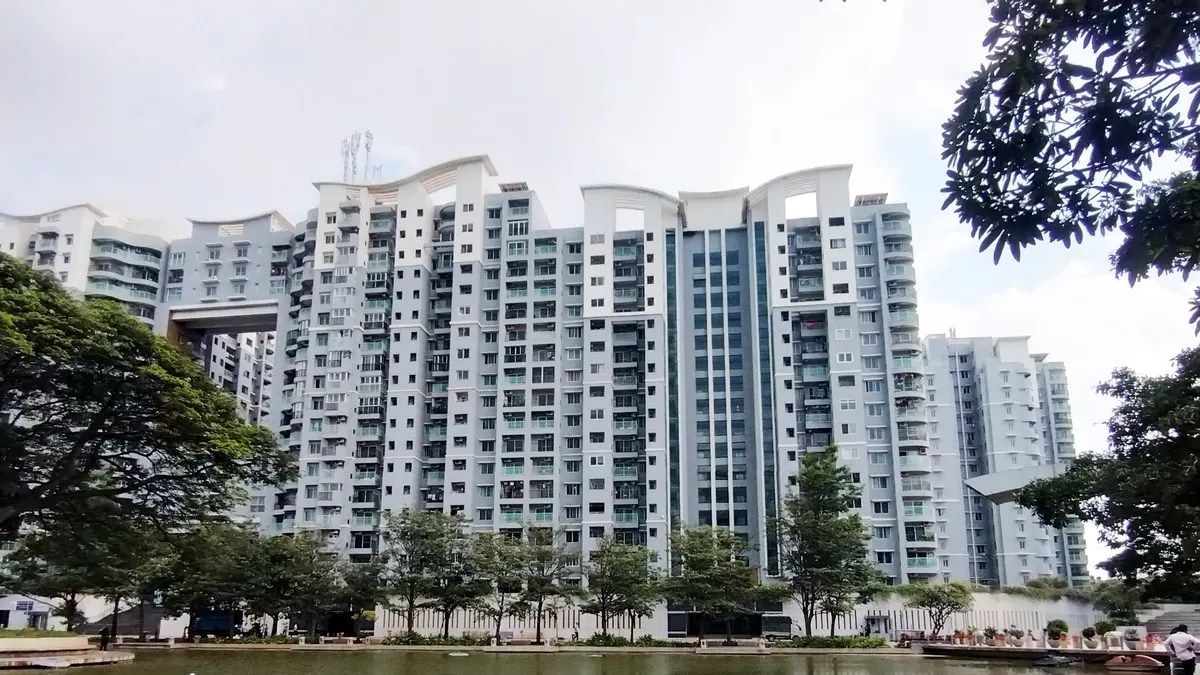
Photo: Gpkp, Wikimedia Commons, CC BY-SA 4.0.
Under the statutory definitions of the Karnataka Apartment (Ownership and Management) Act, 2026 (Karnataka Act No. 45 of 2026), open, stilt, basement, and podium parking bays are classified as common areas and facilities that cannot be converted into private parking merely by floor demarcation, stenciling, or promoter allotment letters. To qualify as lawful private parking, a bay must satisfy an unyielding three-part test: it must be an enclosed or demarcated built-up unit (such as a garage), specifically approved as a distinct parking unit in the sanctioned building plan, and conveyed via registered instrument as an appurtenant right. While the Act awaits official Section 1(2) gazette commencement, homebuyers must ensure parking rights are anchored in registered conveyance deeds rather than informal builder receipts.
The broader constitutional framework and legislative status of Karnataka's new apartment statute is analyzed in what in the 2026 Karnataka Apartment Act is law. Operational checklists for physical garage inspection are detailed in our 25 final checks before taking possession. This guide clarifies the statutory parking definitions, developer pricing loopholes, and how to draft enforceable parking covenants today.
The three-part statutory test for private parking
Under Section 2 of Karnataka Act No. 45 of 2026, the legislature established a rigorous structural boundary between communal parking and private vehicular units:
Parking Space Classification:
├── Common Parking Area (Default): Open, Stilt, Basement, Podium, Visitor & Driveways
└── Private Parking Space (Strict Exception requiring ALL 3 Conditions):
      ├── 1. Physical Enclosure: Separate built-up unit (e.g., lockable garage / enclosed bay)
      ├── 2. Sanctioned Plan Unit: Distinct parking unit approved in municipal architectural blueprints
      └── 3. Registered Conveyance: Formally conveyed to the owner as an appurtenant right in the sale deed
Deconstructing the statutory explanations
Three mandatory explanations attached to the definition of "parking area" clarify the legal status of conventional Bengaluru apartment slots: 1. Explanation 1 (The Demarcation Bar): No open, stilt, basement, or podium parking area forming part of common parking shall be treated as private parking merely because a promoter painted a slot number, erected a wheel lock, or issued an allotment letter. 2. Explanation 2 (Presumption of Commonality): Any vehicular space that fails to satisfy all three statutory conditions is legally deemed part of the common areas and facilities belonging indivisibly to the Association of Allottees. 3. Explanation 3 (Area Calculation Exclusions): The square footage of a private parking space cannot be loaded into apartment carpet area, private area, or super built-up area unless expressly conveyed as an integral part of the residential unit in the registered deed.
Furthermore, the Act explicitly restricts alienation: a qualifying private parking space can only be sold, leased, or transferred to an existing apartment owner within the same project—it can never be severed and transferred to an external third party.
Exposing conventional builder parking marketing practices
Bengaluru real estate developers routinely charge between ₹2,50,000 and ₹7,00,000 for "car parking allocations." Evaluating these offers against the 2026 statutory definitions exposes significant legal vulnerability:
1. "Reserved Stilt Car Park" (Cost: ₹3 Lakh to ₹5 Lakh)
- The Reality: Stilt parking consists of open or semi-covered ground-level space beneath residential pilotis. Under the Supreme Court's landmark ruling in Nahalchand Laloochand (2010) and reinforced by the 2026 Karnataka Act, stilt areas constitute common property. Promoters have no legal title to sell stilt spaces.
- The Buyer Risk: An allotment letter for a stilt bay confers an accessory right of use, not freehold ownership. If an association reconfigures common parking under new bye-laws, an informal allotment provides weak legal protection.
2. "Covered Basement Slot with Stenciled Number"
- The Reality: Basement parking levels are engineered within the building's structural footprint and counted toward statutory Floor Area Ratio (FAR) common service calculations. Painting "Flat 402" on the concrete floor is mere demarcation.
- The Buyer Risk: Unless the specific bay is demarcated on the municipal sanctioned blueprint and scheduled in the registered deed, it remains common association property.
3. "Exclusive Podium Parking Behind Boom Barrier"
- The Reality: Access barriers and boom gates represent traffic management systems, not instruments of conveyance. Mechanically restricted podium bays that fail the three-part test remain common parking.
4. "Mechanical / Stack Parking Systems"
- The Reality: Section 2 explicitly includes mechanical hydraulic stack parking within the definition of "parking area." The mechanical lift apparatus forms part of common building infrastructure. Promoters cannot sell upper or lower hydraulic cradles as standalone real estate units without registered appurtenant covenants.
How to draft parking covenants in agreements today
Even while awaiting formal Section 1(2) commencement, smart buyers can eliminate future title disputes by embedding the 2026 statutory principles directly into their Agreement for Sale and Sale Deed:
- Schedule C Inclusion: Ensure the registered sale deed contains a dedicated Schedule C explicitly granting an exclusive, irrevocable accessory use right to a specifically numbered parking slot (e.g., "Covered Basement-1 Bay No. B-42").
- Sanctioned Blueprint Reference: The contract must cross-reference the exact sheet number and revision date of the approved municipal building plan displaying the numbered parking layout.
- Price Absorption in Total Consideration: Never remit parking payments via cash or off-the-books cheques. The parking allocation fee must be accounted for within the total registered agreement consideration, attracting standard stamp duty and GST invoices.
- Indemnity and Refund Covenants: Include an explicit clause stating: "If any statutory authority, court of law, or resident association reallocates or invalidates the exclusive use right of the designated parking bay, the promoter shall provide an equivalent replacement bay or refund the proportionate parking consideration with interest."
Review our comprehensive guide on how to read builder sale agreements before signing.
Step-by-step interactive checklist: Apartment parking due diligence
Frequently asked questions
No. The Supreme Court of India in Nahalchand Laloochand (2010) ruled that promoters have no right to sell open or stilt parking spaces as standalone real estate units, as they form part of common areas. Under the published Karnataka Act No. 45 of 2026, open and stilt bays are deemed common areas that cannot be converted to private title by mere allotment.
Common parking comprises all open, basement, stilt, podium, and visitor spaces managed collectively by the Association of Allottees. Private parking exists only if a space is an enclosed built-up unit (like a lockable garage), approved as a distinct parking unit in the sanctioned plan, and conveyed via registered deed.
No. Explanation 1 of Section 2 of Karnataka Act No. 45 of 2026 explicitly stipulates that no common parking space becomes private property merely by virtue of physical demarcation, numbering, or promoter allotment letters.
If parking slots were distributed through informal promoter allotment letters without registered deed covenants, resident associations can legally restructure and reallocate common parking under amended society bye-laws. However, if a slot is conveyed as an exclusive appurtenant right in a registered sale deed matching the sanctioned plan, the association cannot unilaterally strip that right.
Under the 2026 Act, a qualifying private parking space can be sold or leased to another apartment owner within the same project. It can never be sold, leased, or transferred to any person who is not an owner in the building.
All parking consideration must be formally integrated into the registered sale agreement and deed consideration. Paying separate unreceipted fees leaves the transaction legally undocumented and creates significant risk of forfeiture during future association audits.
For comprehensive resources on Karnataka apartment statutes and contract vetting, consult: - Karnataka Apartment Act 2026: Comprehensive Enforceability Analysis - 25 Essential Pre-Possession Inspection Checks - How to Check Builder Sale Agreements Before Signing - RERA Carpet Area vs Advertised Area in Bengaluru Listings
Legal Notice: This article summarizes published state legislation and judicial precedents. It does not constitute formal legal counsel. Parking allocations, sanctioned plan compliance, and deed covenants require individualized review by a practicing real estate advocate.
Accounting Notice: Parking charges bundled into property transactions represent capital expenditure subject to stamp duty and GST schedules. Consult a Chartered Accountant regarding proper asset valuation and invoice segregation.
Sources
- Karnataka Act No. 45 of 2026: Karnataka Apartment (Ownership and Management) Act, 2026 Official Text, Section 2 Definitions, PRS India
- Supreme Court of India: Nahalchand Laloochand Pvt. Ltd. v. Panchali Co-operative Housing Society Ltd. (2010) 9 SCC 536 (Stilt Parking as Common Area Ruling)
- The Real Estate (Regulation and Development) Act, 2016: Section 2(n) Common Areas & Garage Definitions, India Code
- Bruhat Bengaluru Mahanagara Palike (BBMP): Building Bye-Laws on Mandatory Parking Norms