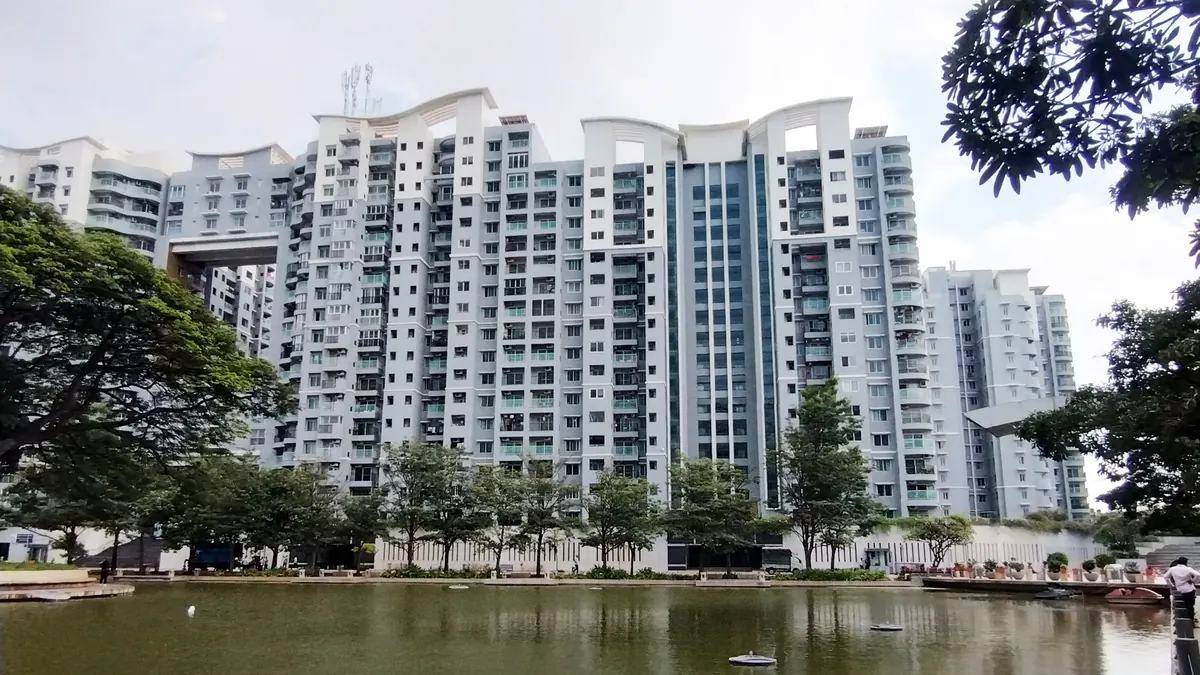
Photo: Sandip Bhattacharya, Wikimedia Commons.
When a revised Greater Bengaluru Authority (GBA) property-tax demand arrives, never pay solely based on the aggregate balance displayed. Systematically verify the Assessment Year (AY), Property Identification (PID) number, built-up area (BUA), and usage classification against your registered sale deed, sanctioned floor plan, and occupancy certificate. Crucially, the municipal tax portal explicitly stipulates that acceptance of property tax revision is confirmed upon downloading the Demand Notice. If you dispute reassessment metrics derived from drone surveys or GIS data, do not trigger the download preview. Instead, formally petition your jurisdictional Assistant Revenue Officer for an on-ground physical inspection before remitting payment under protest.
The municipal context behind Bengaluru's large-scale automated audit drive is analyzed in GBA's 37,216 revision cases. This guide provides an actionable framework to audit the formal demand document, dissect administrative claims, and safeguard your legal remedies.
Read the demand as a set of contested claims, not a routine invoice
When municipal authorities issue a revised property tax demand, do not approach it as an ordinary utility bill. Treat the document as an administrative assertion that must be matched element-by-element against baseline records:
Total Demand = Base Tax Differential + Statutory Cesses + Section 144 Penalty + Penal Interest (2% per month)
Systematically document the following eight parameters: 1. Notice date vs. earlier show-cause date: Verify whether a statutory show-cause notice was ever served and whether the response window expired. 2. PID & SAS application number: Confirm the 10-digit Property Identification number matches the specific physical unit. 3. Recorded ownership identity: Check if ownership matches your registered title or reflects the erstwhile developer/landowner. 4. Assessment years covered: Note the exact retrospective span (e.g., 2018–19 to 2025–26). 5. Built-up area (BUA) & carpet area: Record the municipal square footage calculation. 6. Usage classification: Differentiate between residential, non-residential, commercial, or mixed-use categorizations. 7. Penalties & interest breakdown: Segregate principal tax differentials from compounding penal charges. 8. Jurisdictional authority: Identify the specific ward Assistant Revenue Officer (ARO) issuing the order.
Comparing demand metrics against statutory baselines
- Identity & Location: Ensure the ward and corporate boundary reflect your correct jurisdiction. If your boundary is uncertain following civic restructuring, consult our GBA ward and corporation lookup.
- Area Inflation from Drone Surveys: Drones and satellite imagery often capture terrace overhangs, open balconies, and structural cantilevers as enclosed taxable built-up area. For an apartment unit, GIS algorithms frequently misallocate undivided share or common lobbies directly into private flat footage. In June 2026, the High Court of Karnataka held that computerized GIS imagery cannot substitute on-site physical measurement when area calculations are disputed.
- Unauthorized Usage Conversion: Non-residential and commercial tax slabs are substantially higher than residential rates. If a home-office or tenant setup has caused an automated reassessment under commercial Unit Area Value (UAV) tables without factual basis, this must be challenged immediately.
- Retrospective Assessment Limits: Municipal notices frequently attempt to levy arrears for periods prior to physical construction or issuance of the Occupancy Certificate. In July 2026, the High Court established that property tax liability cannot commence prior to factual building completion, irrespective of algorithmically back-dated revenue entries.
- Due Process & Natural Justice: In October 2026, the High Court set aside reassessment orders in Rajajinagar where municipal officers issued pre-printed demand orders before reviewing timely objections filed by property owners.
The portal download trap: Understanding deemed acceptance
On the official property tax portal at bbmptax.karnataka.gov.in/eassthidemandnotice.aspx, municipal authorities have integrated automated acceptance logic:
"Acceptance of property tax revision is confirmed upon downloading the Demand Notice. A demand notice is generated against each assessment year. If there are discrepancies in measurements, built-up area, or usage, contact the concerned Assistant Revenue Officer."
This digital mechanism presents serious legal ramifications for property owners:
- Digital Waiver Risk: Downloading the PDF demand creates a digital timestamp in municipal database logs that authorities argue constitutes constructive acceptance of revised area parameters and tax brackets.
- Loss of Leverage: Once accepted online, tax portals automatically update baseline property dimensions for all future Self-Assessment Scheme (SAS) filings, converting temporary claims into permanent tax baselines.
- Disputed Protocol: If you intend to dispute the figures, do not download the notice from the unauthenticated user interface. Instead, note the displayed summary numbers, draft a formal objection letter citing baseline deeds, and serve it directly to the ARO requesting physical inspection.
Step-by-step audit protocol: First 7 days after notice
- Capture Digital Evidence: Screenshot the summary page displaying the PID and demand balance without clicking the download hyperlink.
- Collate Foundation Records: Gather registered sale deed, sanctioned building plan, occupancy certificate (OC), and the last 3 years of SAS tax receipts.
- Conduct Direct Physical Measurement: Measure internal carpet area and exterior plinth dimensions with an architect or civil surveyor to calculate verified super built-up area.
- Draft Formal Written Objection: Formulate a structured written representation addressed to the Assistant Revenue Officer highlighting specific area discrepancies and incorrect retrospective years.
- Demand Physical Joint Inspection: Expressly invoke High Court precedent requiring on-site verification before computational reassessment.
- Obtain Official Inward Stamping: Submit the objection at the ARO office and secure a signed, dated acknowledgment seal with inward register number.
- Remittance Under Protest (If Urgently Required): If property transactions or loan disbursements necessitate clearing tax portals immediately, pay exclusively through a formal letter stating payment is made under protest and subject to final adjudication.
Interactive audit checklist: GBA demand notice review
Frequently asked questions
The municipal software uses the download action as a digital sign-off confirming the property owner has reviewed and accepted the recomputed metrics. If you dispute the area or retrospective years, downloading the notice can compromise your ability to challenge the assessment before the revenue appellate authority.
Measure your internal carpet area and external wall perimeter. Assemble your sanctioned building plan and sale deed schedule. Submit a written petition to the Assistant Revenue Officer stating that computer-generated drone metrics miscalculated common areas as private built-up space, and formally request a joint physical inspection under High Court guidelines.
No. In July 2026, the High Court of Karnataka ruled that reassessments cannot reach back prior to the actual physical completion of the structure. Tax demands covering periods before the Occupancy Certificate or power/water synchronization dates must be challenged with completion documentation.
A show-cause notice is an initial procedural communication granting the owner 15 to 30 days to explain discrepancies before an order is passed. A demand notice is a formal assessment order fixing tax, penalties, and interest. If an authority issues a demand notice without providing a prior show-cause hearing, the order violates natural justice principles and can be quashed.
The jurisdictional Assistant Revenue Officer (ARO) of your BBMP/GBA ward has statutory power to review objections, conduct site inspections, and rectify clerical or area errors in the revenue register.
Property tax arrears constitute a statutory charge on immovable property. If a seller does not resolve an outstanding demand prior to registration, the liability transfers to the incoming buyer. Buyers must insist on an updated SAS receipt, a nil-demand certificate, and a specific seller indemnity clause in the sale deed.
For detailed analysis on property taxation and municipal diligence, read: - A Drone or GIS Image Is Not a Final Tax Bill: Karnataka High Court Guidelines - GBA Property-Tax Revision: 37,216 Cases & Queue Status - GBA Property Tax Calculation & Arrears Verification - Post-Purchase Property Roadmap: First 90 Days
Legal Notice: This guide is intended for informational and educational purposes. Municipal tax litigation, writ remedies, and appellate procedures under the Bruhat Bengaluru Mahanagara Palike Act / Greater Bengaluru Governance framework require tailored legal assessment. Consult an experienced municipal property advocate before responding to formal revenue notices.
Accounting Notice: Property tax adjustments, penalties, and commercial usage reclassifications impact municipal deductions under Section 22(1) of the Income-tax Act, 2025. Consult a Chartered Accountant regarding proper treatment of municipal tax adjustments in commercial or rental accounts.
Sources
- Bruhat Bengaluru Mahanagara Palike Property Tax Portal: Official Demand Notice Section
- High Court of Karnataka: Writ Petition Rulings on Drone & GIS Property Tax Reassessment (June, July & October 2026 Orders)
- The Greater Bengaluru Governance Act, 2024: Municipal Governance & Tax Assessment Provisions, DPAL Karnataka
- Bruhat Bengaluru Mahanagara Palike Act, 2020: Sections 144 & 148, Property Tax Assessment & Appeals, India Code