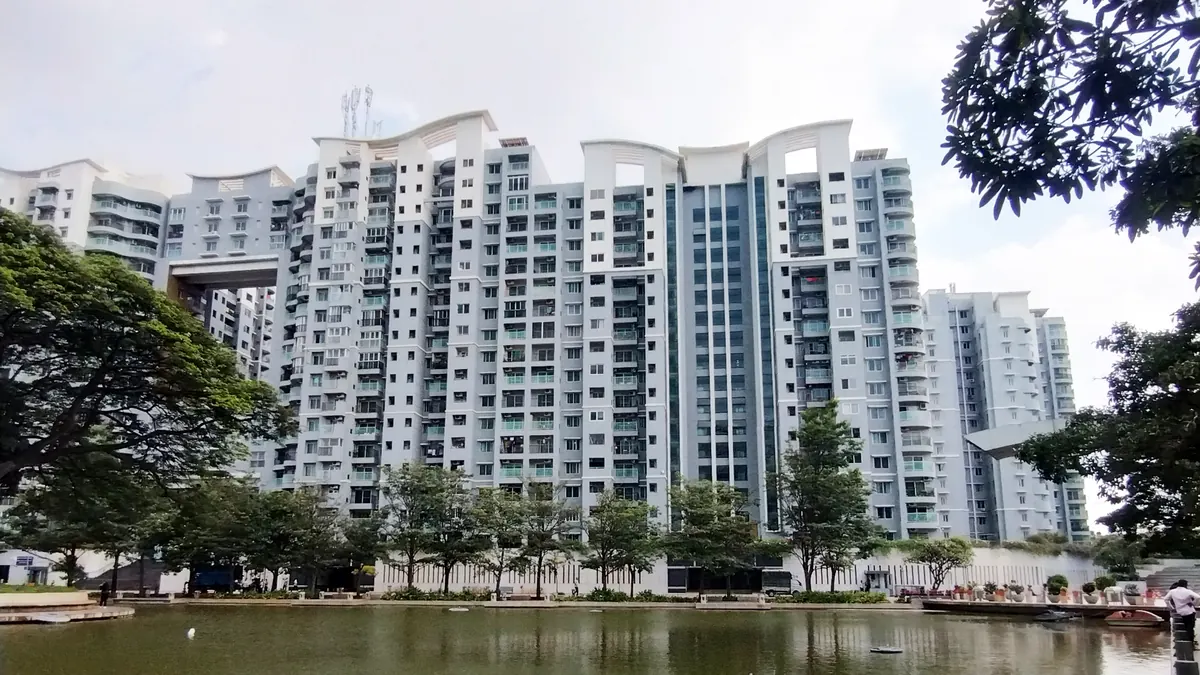
Photo: Sameer2905, Wikimedia Commons, CC BY-SA 4.0.
A Sale Deed is the definitive legal instrument that permanently transfers freehold real estate ownership under Section 54 of the Transfer of Property Act, 1882. Never view your sale deed for the first time across a Sub-Registrar's biometric desk. A rigorous clause-by-clause audit requires examining seven core sections: Party Identification & Title Derivation (Recitals), Operative Conveyance Words, Schedule A (Entire Land Parcel) & Schedule B (Specific Flat & UDS), Consideration & TDS Withholding Receipts, Covenant of Title & Indemnity Clauses, Specific Covered Parking Bay Demarcation, and Physical Vacant Possession Delivery.
When concluding a property acquisition in Bengaluru, the execution of the registered Sale Deed before the Sub-Registrar represents the legal finish line.
Too many homebuyers treat the deed as standard, bureaucratic boilerplate—glancing at the price, signing 25 pages under pressure, and posing for Sub-Registrar webcams.
However, once a Sale Deed is registered on Kaveri 2.0, its terms become permanent public record. Clerical errors in boundary schedules, missing Undivided Share (UDS) recitals, weak seller indemnity clauses, or ambiguous parking language cannot be resolved with casual verbal promises. Rectifying mistakes requires executing expensive registered Rectification Deeds with seller cooperation.
Knowing how to audit a Bengaluru sale deed clause-by-clause protects your ownership rights and eliminates resale bottlenecks.
Structural anatomy of a standard Bengaluru sale deed
+--------------------------------------------------------------------------------+
|                 ANATOMY OF A BENGALURU SALE DEED                               |
+--------------------------------------------------------------------------------+
|  [CLAUSE 1: PARTIES & LEGAL CAPACITY]                                          |
|  Vendor (Seller) and Vendee (Buyer) particulars, PAN, Aadhaar, GPA authority   |
|                                                                                |
|  [CLAUSE 2: RECITALS & TITLE DERIVATION]                                       |
|  Historical narrative: Mother deeds, conversions, sanctions, RERA registration |
|                                                                                |
|  [CLAUSE 3: OPERATIVE CONVEYANCE & CONSIDERATION]                              |
|  "Grant, convey, transfer, and assign forever" + Full consideration & 1% TDS   |
|                                                                                |
|  [CLAUSE 4: COVENANTS OF TITLE & INDEMNITY]                                    |
|  Absolute warranty of marketable title + Duty to defend buyer at seller cost   |
|                                                                                |
|  [CLAUSE 5: ENCUMBRANCE-FREE TITLE]                                            |
|  Confirmation of zero mortgages, charges, liens, attachments, or tax arrears   |
|                                                                                |
|  [CLAUSE 6: VACANT POSSESSION & KEYS]                                          |
|  Delivery of actual, physical, peaceful, and vacant possession                 |
|                                                                                |
|  [SCHEDULES: SCHEDULE A, B & C]                                                |
|  Sched A: Total Layout Land | Sched B: UDS & Unit | Sched C: Specific Car Park|
+--------------------------------------------------------------------------------+
Clause-by-clause breakdown and critical audit checks
Clause 1: Identification of parties and authority
- Vendor (Seller): Verify full legal name, spouse/parent name, PAN, Aadhaar, and permanent address. Ensure names match the parent title deed exactly.
- Corporate Promoters: If buying from a builder company or LLP, verify the Director's or Partner's name and the specific Board Resolution authorizing them to execute deeds.
- Attorney Representation: If an agent signs, ensure the registered Special Power of Attorney (SPA) document number and SRO details are recited in the party clause.
Clause 2: Recitals (The historical title trail)
Recitals constitute the preamble explaining how the seller acquired ownership. - Trace the chain: Agricultural land grant -> Section 95 DC Conversion -> Joint Development Agreement (JDA) -> Sharing Agreement -> Plan Sanction -> Building Completion. - Verify that every prior registered document number and date stated in the recitals matches your 30-year Encumbrance Certificate (Form 15).
Clause 3: Operative conveyance words and consideration
This is the core sentence that legally transfers title:
"The Vendor doth hereby grant, convey, transfer, sell, and assign unto the Vendee, by way of absolute sale, all that piece and parcel of the Schedule Property..."
- Consideration Breakdown: Ensure the text specifies the exact agreed purchase price, detailing previous booking advances, bank loan disbursements, and banker cheque numbers.
- Section 194-IA / Section 393 TDS: The clause must explicitly state that the buyer deducted 1% statutory TDS and deposited it with the Central Government, detailing the Form 141 / 26QB acknowledgement number.
Clause 4: Title covenants and indemnity protection
The indemnity clause is the buyer's statutory insurance policy against future legal challenges. A robust indemnity clause must state: 1. The seller holds good, valid, marketable, and subsisting title, free from all defects. 2. The property is completely free from mortgages, charges, court attachments, lis pendens, family disputes, and tax arrears. 3. If any third party (including undisclosed legal heirs or revenue authorities) raises an adverse title claim, the seller shall indemnify, defend, and hold harmless the buyer from all financial losses, legal costs, and damages.
Clause 5: Delivery of vacant possession
The deed must declare that the seller has handed over actual, physical, peaceful, and vacant possession of the apartment or plot to the buyer, alongside keys, access cards, and original parent documents. Reject clauses that describe possession as "constructive" or "deferred to a later date."
Auditing the property schedules (A, B, and C)
The legal description of what you own does not sit in the body of the deed; it sits in the Schedules. In Bengaluru apartment conveyances, three separate schedules are standardly utilized:
+--------------------------------------------------------------------------------+
|                 APARTMENT DEED SCHEDULE ARCHITECTURE                           |
+--------------------------------------------------------------------------------+
|  [SCHEDULE A: THE ENTIRE PROJECT LAND PARCEL]                                  |
|  Total mother land acreage (e.g., 4 Acres 20 Guntas in Survey No. 45/2)        |
|  Comprehensive geographical boundaries (East, West, North, South)              |
|                                                                                |
|  [SCHEDULE B: THE APARTMENT UNIT & UNDIVIDED SHARE (UDS)]                      |
|  - Exact Undivided Share of Land in Schedule A (e.g., 542 sq ft of UDS)        |
|  - Unit Details: Flat No., Floor, Tower Name, RERA Carpet Area, Balcony Area   |
|  - Boundary demarcations of the specific flat within the building floor plate  |
|                                                                                |
|  [SCHEDULE C: ACCESSORY RIGHTS & PARKING BAY]                                  |
|  Exclusive right to use specific Covered Car Parking Bay No. (e.g., Bay B2-48) |
+--------------------------------------------------------------------------------+
Schedule B: The UDS reconciliation rule
The square footage of Undivided Share of Land (UDS) recited in Schedule B must match the mathematical proportion of the sanctioned plan. Never accept vague wording such as "proportionate undivided share"; demand the exact area in square feet or square meters.
Schedule C: Car park demarcation
Parking cannot be sold as a standalone freehold title under Supreme Court and Karnataka apartment regulations. However, Schedule C must grant an exclusive, irrevocable accessory use right to a specifically numbered covered parking slot in the basement or stilt area, matching the society master layout.
Sale deed pre-registration audit checklist
Perform these line-by-line checks on your draft sale deed 48 hours before signing.
Frequently asked questions
If a clerical or typographical mistake occurs in property boundaries, survey numbers, or names, the parties must execute a Rectification Deed (also called a Correction Deed). This instrument must be registered before the same Sub-Registrar Office on nominal stamp duty.
Under Karnataka high-court directives and civic regulations, Sub-Registrars in Bengaluru require an approved Occupancy Certificate issued by BBMP or BDA to register conveyances for newly completed multistory apartment buildings. Registering without an OC risks utility cut-offs and municipal penalties.
An Agreement for Sale is a contract promising to transfer property in the future upon satisfaction of agreed conditions, attracting 0.5% stamp duty. A Sale Deed is the actual conveyance that transfers absolute legal ownership title, attracting 5% stamp duty and 2% registration fees.
If a third party holds an indirect financial interest, development agreement rights, or potential inheritance claim over the land (such as a developer in a Joint Development Agreement or a family member), they join the conveyance as a "Confirming Party" to formally relinquish all claims.
No. Registration transfers ownership, but municipal mutation is separate. The buyer must submit the registered Sale Deed to the Greater Bengaluru Authority (e-Aasthi 2.0 portal) to execute Khata transfer and update the property tax assessment roll.
Legal Note: A Sale Deed is a binding legal contract governed by the Transfer of Property Act, 1882 and the Registration Act, 1908. Never sign a draft without formal review by an empanelled property lawyer.
Disclaimer: This article is published for educational guidance and regulatory compliance analysis. It does not constitute formal legal counsel.
Sources
Checked 18 Nov 2026.
- Transfer of Property Act, 1882 (Section 54 - Definition and Mode of Transfer by Sale): https://www.indiacode.nic.in/handle/123456789/2338
- Registration Act, 1908 (Section 17 - Documents of which registration is compulsory): https://www.indiacode.nic.in/handle/123456789/2186
- Department of Stamps and Registration, Government of Karnataka (Kaveri 2.0 Conveyancing Rules): https://kaveri.karnataka.gov.in/