In Short A gate, a cabin and a camera are a contract and a monthly bill, not a title. Until the allottees' association takes over, section 11(4)(d) of the RERA Act keeps essential services with the promoter, on reasonable charges. After that, the Karnataka Apartment Ownership Act, 1972, once the property is submitted to it, shares common expenses by undivided interest and leaves the method to the bye-laws. Read the rate, what it excludes, and the sinking fund before you add the EMI.
People say "gated" as if it were a grade of building. In the papers it is a boundary wall, a list of staff, and a charge you will meet every month for as long as you own the flat. The rupee-per-square-foot ranges buyers argue about are collected on our page on maintenance per square foot in a new Bengaluru gated community. This note is the bill behind that rate: security, services, and what the law actually assigns.
What the gate is, and what it is not
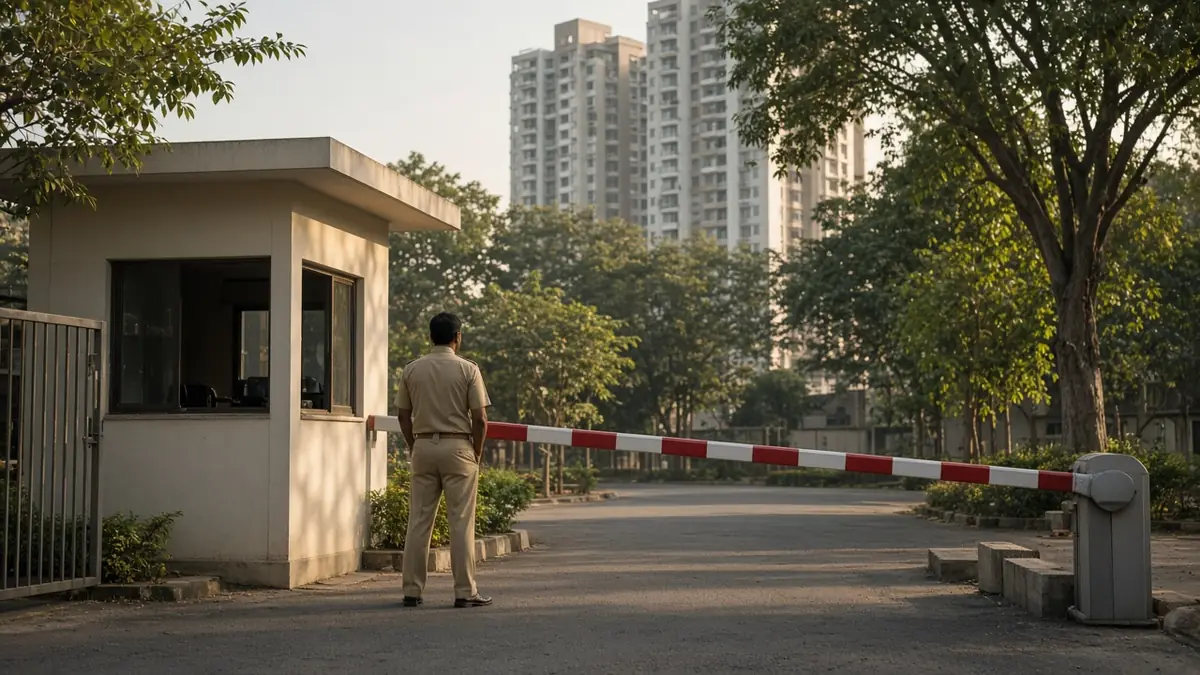
A boom barrier does not change khata, title or the occupancy certificate. It changes who walks in, and who is paid to watch. That watch is a private contract. It is not the city police, and it is not a promise that nothing will go missing.
Ask for the security scope in writing before you treat the cabin as a feature you have bought. How many posts, which gates, whether the cameras are recorded and for how long, and who can pull the footage. A brochure line that says the community is "secure" has none of those. The same agreement schedules that list a clubhouse should list the gate. If security is missing from Schedule E, it is missing from the promise. How a large common area changes the purchase, next to a smaller building, is in gated community or standalone building.
Pets, visitors and domestic help are where gate rules get sharp. House rules can be fair. They can also be made up by the agency the promoter has appointed, before any association exists. Read the draft bye-laws, not the welcome card. Pet rules in Bengaluru gated communities is the worked example for one kind of rule. The same habit, of reading the bye-law before you believe the guard, applies to deliveries and to staff.
Who maintains, and for how long
Section 11(4)(d) of the RERA Act makes the promoter responsible for providing and maintaining essential services, on reasonable charges, till the association of allottees takes over the maintenance of the project. "Reasonable" is the word in the Act. It is not a number. If the quote and the headcount do not match, ask for the headcount.
Section 19 makes the allottee responsible for payments in the manner and time the agreement states, including municipal taxes, water and electricity, maintenance charges, ground rent and other charges. Withholding the bill because the gym is dusty is not a switch the Act gives you. A dispute about the rate, and a duty to pay an agreed rate, are different things. The route when a builder-appointed agency and the residents fall out is covered in a builder maintenance dispute.
Two later steps sit beside the monthly bill. Section 11(4)(e) requires the promoter to enable the formation of an association, society or co-operative society of the allottees under the applicable law. Section 11(4)(f) and section 17 deal with conveyance of the common areas to that body. Until those happen, the agency at the gate is still the promoter's contractor. You are not yet the client.
What the apartment law adds, once it applies
The Karnataka Apartment Ownership Act, 1972, applies to property whose owners submit it to the Act by a registered declaration. The statement of objects and the clauses, as printed with the Act on India Code, are plain about the point of that statute. Each apartment, with its undivided interest in the common areas, is to be heritable and transferable property. An owner is not to sue to partition those common areas. Common expenses are shared by the percentage of undivided interest. An owner is not to do work that would jeopardise the soundness or safety of the property, or add a material structure, unless the other owners agree first. Bye-laws carry the day-to-day rules.
Not every Bengaluru "association" is this statute. Some projects use a society, some a company, some a co-operative, which is why section 11(4)(e) lists all three. Ask which one the draft uses, whether the declaration is registered, and whether the bye-laws you were shown are the ones that will be filed. A WhatsApp group is not an association.
Where the money actually goes
A gated quote hides several bills inside one rate, and several more outside it. Split them before you compare two projects.
| Line | While the promoter maintains | After the association takes over | Paper to see |
|---|---|---|---|
| Security payroll and cameras | Promoter's agency, charged on | Association's contract | Headcount and the contract, not the brochure |
| Lifts, pumps, sewage plant power | Essential services under s.11(4)(d) | Common electricity | Last three bills, or the load in the sanction |
| Diesel for the generator | Often a separate pool | Same, if the bye-laws say so | Wattage and who refills |
| Water, if there is no BWSSB line | Tankers or a borewell | The same bill, now yours | Source named in writing |
| Housekeeping and garden | Inside the rate, or not | Inside the rate, or not | The inclusion list |
| Sinking fund | Sometimes collected from day one | Replacement of lifts, pumps, waterproofing | The amount per flat, and the bank account |
| Property tax and your own BESCOM bill | Yours, even in a new block | Yours | Do not let these hide inside "maintenance" |
Water is the line that surprises people who only priced the gate. A community can be gated and still wait on tankers. What to ask on BWSSB, a borewell and tankers belongs in the same folder as the maintenance quote.
Keep stamp and GST out of the monthly rate. Maintenance is the bill for the years after you buy.
How to read a quote without a city average
Do not average two quotes that do not cover the same things. A lower rate that excludes the sewage plant, diesel and a sinking fund is not lower. Write each exclusion in the margin.
Ask whether the rate is per square foot of super built-up area or of carpet area. The same rupee on a larger denominator looks kinder and is not. Ask the number of flats sharing the gate. A cabin staffed for 40 flats and a cabin staffed for 800 flats are different payrolls. We are not publishing a single "normal" rate on this page. The sourced ranges sit on the maintenance answer linked above. If a salesperson offers a figure with no inclusion list, you do not yet have a figure.
Ask which account holds any corpus, and whether it moves to the association with the common areas.
A working, not a city average and not a quote for a project: Quote A is ₹6 a square foot on super built-up area and leaves diesel and the sinking fund out. Quote B is ₹8 a square foot and includes both. On a 1,500 sq ft super built-up figure, A is ₹9,000 a month plus those extras; B is ₹12,000. If diesel and the fund add more than ₹3,000, A was not cheaper. Replace every number with the two quotes in your hand, and with the inclusion lists, before you repeat either rate.
Buyer checklist
- [ ] Gate, cameras and posts named in the agreement, not only on the hoarding
- [ ] Draft bye-laws read for visitors, staff, pets and deliveries
- [ ] Which body will be formed: association under the 1972 Act, society, or co-operative
- [ ] Section 11(4)(d) period understood: promoter maintains until takeover, on reasonable charges
- [ ] Inclusion list: security, plants, diesel, housekeeping, sinking fund
- [ ] Rate tied to carpet or super built-up, and to the flat count
- [ ] Corpus account named, and marked to move with the common areas
- [ ] Water source written down, separate from the gate
- [ ] Your own tax and power bill kept out of the maintenance quote
- [ ] EMI worked with the maintenance added, not beside a forgotten zero
Related reading
- Maintenance per square foot in a new Bengaluru gated community
- Gated community or a standalone building
- Pet rules before you buy in a gated community
- BWSSB, borewell and tanker questions
- Full cost of a Bengaluru flat
- When maintenance becomes a dispute with the builder
Due diligence checklist for Gated community costs in Bengaluru
Frequently asked questions
No. Title, khata and the occupancy certificate are separate papers. The gate is a service you pay for, under a contract and a monthly bill. A cabin at the entrance does not cure a missing OC or a weak deed.
The promoter, on reasonable charges, until the association takes over, under section 11(4)(d). After takeover, the owners share the cost. Ask which monthly line covers the pumps, the sewage plant and the diesel, and whether any of those sit outside the quote.
Section 19 still expects the agreed charges on time, including maintenance. A poor service is a written dispute, not an automatic pause. Withholding the bill because a gym is dusty is not a switch the Act gives you. Talk to a lawyer before you copy a withhold.
No. The Karnataka Apartment Ownership Act, 1972, applies when the property is submitted by a registered declaration. Section 11(4)(e) of the RERA Act also allows a society or a co-operative. Ask which body this project will use, and whether the bye-laws you were shown are the ones that will be filed. A WhatsApp group is not an association.
Write the rate, the area it is charged on, and every exclusion. Convert both to a rupee-per-month figure for your flat, then add diesel, tanker water and the sinking fund if they were left out. The lower printed rate is not the lower bill until those lines are filled.
Paper note: This is not a legal opinion. RERA sections refer to the 2016 Act. The apartment statute is the Karnataka Apartment Ownership Act, 1972, read with the statement of objects printed with it. Your declaration and bye-laws control the project in front of you. Checked 17 Nov 2026.
Sources
Checked 17 Nov 2026.
-
Real Estate (Regulation and Development) Act, 2016. Section 11(4)(d): essential services, on reasonable charges, until the association takes over maintenance. Section 11(4)(e): enable formation of an association, society or co-operative society of the allottees. Section 11(4)(f) and section 17: conveyance of title and common areas. Section 19: allottee to pay, in the manner and time agreed, including taxes, water, electricity, maintenance and other charges: https://www.indiacode.nic.in/indiacode/bitstream/123456789/2158/1/A201616.pdf
-
Karnataka Apartment Ownership Act, 1972 (Act 17 of 1973), India Code text, including the statement of objects and clauses. The Act applies where owners submit the property by a declaration. Each apartment with its undivided interest is heritable and transferable. Common areas are not to be partitioned at the suit of an owner. Common expenses are shared by that interest. An owner is not to jeopardise the soundness or safety of the property, or add a material structure, without the agreement of the other owners. Bye-laws carry maintenance, repair and house rules: https://www.indiacode.nic.in/bitstream/123456789/7623/1/17_of_1973_%28e%29.pdf