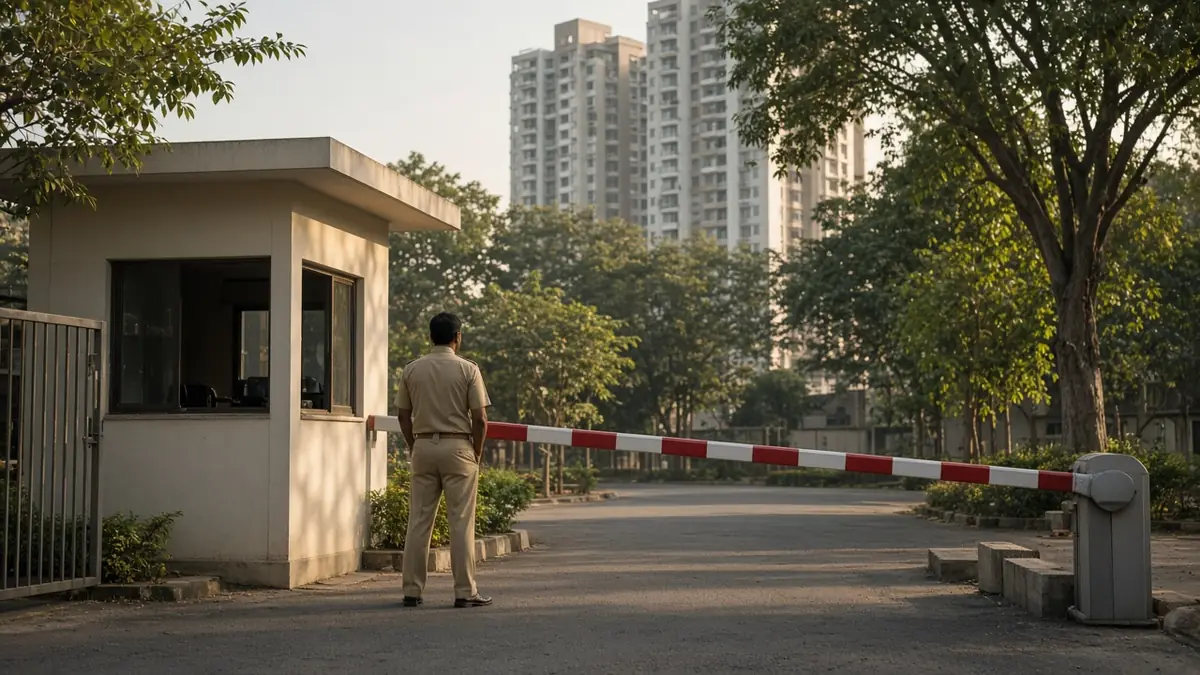
In Short Until the allottees' association takes over, the agency at the gate is the promoter's contractor. Section 11(4)(d) of the RERA Act keeps essential services with the promoter, on reasonable charges, and section 19 still expects you to pay the agreed charges on time. The Act does not list "stop the delivery rider" as a way to collect dues. On 25 Oct 2026 residents of a Greater Noida society protested after a builder-appointed agency restricted deliveries, domestic workers and visitors over unpaid dues. Police eased the restriction. That was not a Bengaluru society. The papers you want before handover are the same: the charge, the service, and the date the association takes both.
Handover is a date people celebrate and then forget. The agency does not forget. It keeps the gate, the app and the bill. Your rights are clearer if you know which side of that date you are on.
What happened on 25 Oct, and what it does not prove
Hindustan Times, Asmita Seth, updated 27 Oct 2026, reported a protest at Ajnara Homes in Greater Noida West. Residents gathered on 25 Oct. They said the builder-appointed maintenance agency had restricted entry to food-delivery workers, domestic workers and visitors because maintenance was unpaid. Residents had withheld payments for four months, citing poor upkeep, billing they could not see through, and complaints left open.
Resident Dinker Pandey told the paper he had stopped ordering because parcels were held, and that guests, domestic workers and delivery workers were not being allowed in. He said a crowd of about 300 to 400 people was at Gate 3 by evening. He also alleged a fixed charge for diesel-generator power after the distribution company connection was in, and referred to an outstanding sum of ₹77,000. Those are one resident's figures, as reported. They are not a Bengaluru tariff.
The estate manager, Rajendar Kumaria, told the paper the site had about 80 security staff, 45 housekeeping and a technical team of around 100. That is his account of that payroll, not your quote.
Ranjeet Singh, station house officer at Bisrakh, told the paper that unpaid common-area charges had affected the app residents use to approve visitors, that security would allow people in, and that both sides had been called to a meeting. Residents said that after the protest, and after the police stepped in, entry was allowed again, and that the agency then said it would not take responsibility for security if anyone could enter.
A gate that blocks a maid is not a recovery suit. The lesson that travels is the shape of the fight, not the rupee. That society does not use Karnataka's apartment law.
What the Act gives you before the association exists
Section 11(4)(d) puts essential services on the promoter, on reasonable charges, until the association takes over maintenance. The agency is how the promoter performs that duty. It is not a second government. If the bill arrives from a private company's name, ask for the contract between that company and the promoter, and for the schedule of what "essential" includes in your agreement.
Section 11(4)(e) requires the promoter to enable an association, society or co-operative society of the allottees, or a federation, under the law that applies. Section 11(4)(f) requires execution of the conveyance of title, including the undivided proportionate title in the common areas, to the association. Section 17 puts a clock on transfer of title: within three months from the occupancy certificate where no local law provides otherwise, with the common areas going to the association. Karnataka has its own apartment statute, so do not assume the three months is the only date. Write down the date in your agreement, and ask which filings are still open. A worked reading of one Karnataka direction on forming the association and conveying the common areas is in how to read a builder's RERA complaint history.
Section 19 runs the other way. The allottee pays the share of taxes, water, electricity, maintenance and other charges, in the time the agreement states. A four-month withhold, of the kind the Greater Noida residents described, is a serious step. It can be answered with interest, a recovery case, or pressure at the gate. Only the first two are methods you can point to in the Act. Talk to a lawyer before you copy the withhold.
What changes on the day of handover
Handover of maintenance is not the day you get keys. It is the day the association, properly formed, takes the contracts, the accounts and the common areas.
Before that day, ask for the agency agreement, including its term and who can end it. Ask for the last twelve months of common-area accounts, not a one-page rate card. Ask for the corpus and sinking-fund bank statements, and the mandate that will move them. Ask for a list of staff the association would inherit, and which contracts end with the promoter. Ask for camera logins, gate software and the admin account, in the association's name. Ask for copies of lift, fire and generator contracts.
On that day, the client becomes the association. A rule about visitors should then come from the bye-laws, passed the way those bye-laws require, not from an estate manager's circular. If you are still months from an occupancy certificate, the agency question is early but the clause should already be in the draft. Occupancy and completion certificates are the other half of "we have handed over".
A dispute that has already started, with bills and a gate, has a shorter page of its own: maintenance disputes with the builder before the association is in charge.
What you can do when the gate is used as a collector
Write down the date, who was stopped, and what the guard said. Ask the agency, copied to the promoter, which clause authorises a block on deliveries, domestic help or guests. Pay what you agree is due, and keep the dispute in a separate letter. If the promoter is failing the agreement, the complaint path is in how to file a complaint online. Bring the agreement, not the brochure. The police in the Greater Noida report called a meeting. That is not a title decree.
A table you can take to the meeting
| Question | Before association takeover | After takeover |
|---|---|---|
| Who is the agency's client? | The promoter | The association |
| Who must keep essential services running? | Promoter, s.11(4)(d), on reasonable charges | The association, funded by owners |
| Who must pay the agreed charge? | The allottee, s.19 | The member, under the bye-laws |
| Can unpaid dues close the gate to deliveries? | Not a remedy the Act lists | Only if a real bye-law says so, and even then a lawyer should read it |
| What should move on handover? | Accounts, corpus, logins, contracts | Those, plus the common-area conveyance |
Buyer checklist
- [ ] Agency named, and the contract with the promoter requested
- [ ] What "essential services" includes in your agreement, written out
- [ ] The monthly charge, the due date, and the interest clause read
- [ ] Corpus and sinking-fund account numbers noted
- [ ] Date the association is to be formed, and under which statute
- [ ] Conveyance of common areas: which section the agreement cites, and the status
- [ ] Admin logins for the gate app marked to transfer
- [ ] Any house rule on deliveries traced to a bye-law, or marked as having none
- [ ] Disputed bills paid or protested on advice, with the dispute in a separate letter
- [ ] Complaint, if you file one, matched to the right bench
Related reading
- Maintenance disputes while the builder is still in charge
- How to read a Karnataka RERA order on a builder
- Occupancy certificate and completion certificate
- Filing a Karnataka RERA complaint online
- Security, maintenance and cost in a gated community
Due diligence checklist for Rights before the maintenance handover
Frequently asked questions
No. Until the association takes over, the agency at the gate is the promoter's contractor, not your landlord and not a body you elected. After handover it should work for the association, if the association chooses to keep it. Ask to see the contract, and who the client will be on the day of conveyance.
The RERA Act does not list cutting off access, deliveries or staff as a remedy for unpaid charges. The Greater Noida protest reported on 25 Oct 2026 is one account of that tactic, not a Bengaluru rule. Record the date, ask which clause they rely on, and have a lawyer read your agreement and bye-laws before you treat the restriction as lawful.
Section 19 requires the agreed charges on time. Write the dispute separately, with photographs and the missed service named. A four-month withhold, as described in that Greater Noida report, is a serious step. Talk to a lawyer before you copy one, and do not assume a protest elsewhere rewrites your deed.
When it is formed, takes maintenance, and receives the common areas. Section 17 states three months from the occupancy certificate where no local law says otherwise. Check your agreement for the date, the statute under which the body will be formed, and whether the corpus account moves with the common areas.
Keep a written record of what was restricted and when. Pay any charge that is clearly due under the agreement, unless a lawyer has told you otherwise. Ask, in writing, for the clause they rely on, and for the date the association is due to take over. Do not sign a new undertaking at the gate in a hurry.
Paper note: This is not a legal opinion and not a report on Ajnara Homes beyond the Hindustan Times article cited. RERA sections are from the 2016 Act. For a recovery suit or a complaint, use a lawyer who has read your agreement. Checked 17 Nov 2026.
Sources
Checked 17 Nov 2026.
-
Hindustan Times, Asmita Seth, updated 27 Oct 2026. Protest on 25 Oct 2026 at Ajnara Homes, Greater Noida West. Agency said to have restricted deliveries, domestic workers and visitors during a four-month withhold. Pandey: crowd about 300 to 400, outstanding ₹77,000. Kumaria: about 80 security, 45 housekeeping, technical team around 100. SHO Ranjeet Singh on the visitor app and a meeting: https://www.hindustantimes.com/real-estate/rwa-watch-can-a-builder-appointed-maintenance-agency-restrict-food-deliveries-and-domestic-help-over-unpaid-maintenance-dues-101793011319341.html
-
Real Estate (Regulation and Development) Act, 2016. Section 11(4)(d), (e) and (f): essential services until association takeover, formation of the association, conveyance of common areas. Section 17: transfer within three months of the occupancy certificate where no local law provides otherwise. Section 19: allottee's duty to pay agreed taxes, water, electricity, maintenance and other charges: https://www.indiacode.nic.in/indiacode/bitstream/123456789/2158/1/A201616.pdf
-
The Economic Times, report of lawyers' comments on societies blocking app-based deliveries over maintenance dues. Heena Chheda and Apurva Agarwal, as quoted there, on interference with use of the home and on recovery through bye-laws or a suit. Their view of the questions they were asked, not a Karnataka order: https://economictimes.indiatimes.com/wealth/legal/will/can-housing-societies-stop-amazon-zomato-swiggy-and-other-online-apps-from-delivering-to-residents-for-non-payment-of-society-maintenance-dues/articleshow/129771228.cms