Short answer: Most Bengaluru apartment water problems come down to three things: where the water comes from, what fills the gap in summer, and what happens to used water. Ask whether the building has a live BWSSB connection, whether its borewells are permitted and still working, what residents spent on tankers last summer, and whether the STP and rainwater harvesting actually run.
- A Cauvery Stage 5 village isn't a connection. About 1.15 lakh of an estimated 1.8 lakh buildings there were connected by May 2026.
- Borewells need permission. BWSSB began enforcing prior approval for new borewells in its limits from 15 Mar 2024.
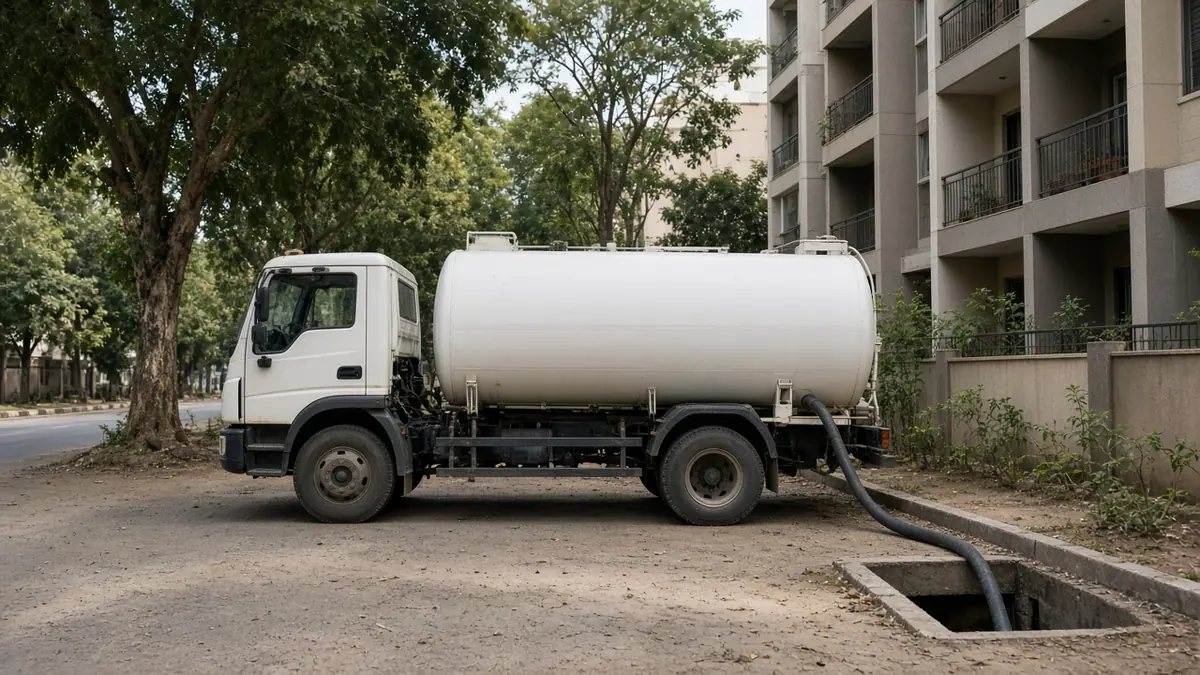
- Tanker water is the expensive backup. The 2024 district cap was ₹1,000–₹1,200 for 12,000 litres; on our illustrative building, a 40% shortfall costs about ₹600 a flat a month.
- In-situ STPs are required for more than 120 flats making over 80 KLD in sewered areas, and 20+ flats where there's no sewer line (Karnataka notification, 12 Mar 2024).
- Use the source, backup, return map below to score any building in ten minutes.
- The source, backup, return map (our framework)
- Which questions should you ask, and who can answer them?
- Does a BWSSB connection mean enough water?
- What are the rules on borewells?
- How much do tankers cost?
- Does the building need an STP?
- What's the rule on rainwater harvesting?
- What mistakes do buyers make about water?
- What should you do if...
- Water checklist
- Frequently asked questions
- Talk it through with acre&key
- Sources
The brochure says "24×7 water". Residents say something else in April. This page gives you the questions to ask before you pay, and for each one, the record or person that can actually answer it.
If the project is on the city's edge, start with our guide to Cauvery Stage 5 coverage, which covers the 110 villages and connection charges in detail. This page is the wider checklist.
The source, backup, return map (our framework)
Every building's water has three parts. Score each one before you book.
| Part | Question | Strong | Weak |
|---|---|---|---|
| Source | Where does daily water come from? | Live BWSSB connection with a meter | "Applied for", or borewells only |
| Backup | What fills the gap in summer? | Permitted borewells still yielding; a tanker spend residents can tell you | "We've never needed tankers" in a new building with no history |
| Return | What happens to used water and rain? | Working STP with treated water reused; maintained rainwater harvesting | STP "installed" but not run; RWH pits silted up |
Three strongs: water probably isn't your problem. A weak source and a weak backup together: price in tankers for years, or walk away.
Which questions should you ask, and who can answer them?
| # | Question | Who or what answers it |
|---|---|---|
| 1 | Does the building have a live BWSSB connection? | BWSSB connection number and recent water bill |
| 2 | If it's "applied for", what's the application number and demand note? | BWSSB demand note; builder |
| 3 | Is the property in a Cauvery Stage 5 village, and is the building actually connected? | BWSSB; our Stage 5 guide |
| 4 | What water source did the builder declare to K-RERA? | Project documents on K-RERA |
| 5 | How many borewells are there, and were they permitted? | BWSSB or KGWA permission; association records |
| 6 | Which borewells still yield in April and May? | Residents; facility manager |
| 7 | What did the association spend on tankers last summer? | Association accounts |
| 8 | Is tanker water metered before it goes into the sump? | Facility manager |
| 9 | Does each flat have its own water meter? | Site visit; builder specification |
| 10 | Is there an STP, and does the law require one here? | Builder; the 2024 STP notification |
| 11 | Is treated water reused for flushing and gardens? | Site visit; dual plumbing in the specification |
| 12 | Is rainwater harvesting installed and maintained? | Site visit; association records; BWSSB bill (no RWH penalty) |
| 13 | How many days does sump and overhead storage last? | Builder; facility manager |
| 14 | Who pays BWSSB pro-rata and connection charges? | Agreement for sale; demand note |
| 15 | Does the building have an OC, so it can get a permanent connection? | OC copy; K-RERA |
Question 4 matters more than buyers think. K-RERA began requiring builders to show a water-source NOC from the water board or panchayat at registration, rather than just an affidavit, according to a 2021 news report Look in the project's documents on the K-RERA project search.
Question 15 matters because utilities now connect only buildings with an OC or CC, after a December 2024 Supreme Court ruling (judgment, para 21(iv)). Our OC and CC explainer covers this.
Does a BWSSB connection mean enough water?
Not necessarily, but it's the strongest start. Two things to check:
- Is it live? Ask for the connection number and a recent bill. "Sanctioned" or "applied" isn't the same.
- Is it new? Cauvery Stage 5 brought piped water to 110 villages on the city's edge from October 2024, with 87,000 new connections in the first year (The Hindu, news). By May 2026, about 1.15 lakh of an estimated 1.8 lakh buildings there were connected (The Hindu, news).
Projects outside city limits, in the wider BMRDA region, aren't part of Stage 5. There, water depends on the local body, borewells and tankers. Our answer on the BWSSB connection for new apartments explains the process.
What are the rules on borewells?
Borewells need permission. BWSSB said it would take legal action against unauthorised borewells, and from 15 Mar 2024 required prior approval for drilling in its limits, citing section 11 of the Karnataka Ground Water (Regulation and Control of Development and Management) Act, 2011. Approval comes after a site inspection (New Indian Express, news). The Karnataka Ground Water Authority runs an online portal for registering existing borewells, permission for new ones and permission to withdraw groundwater (KGWA portal).
What to ask:
- How many borewells, and are they registered or permitted?
- How deep, and how many still yield in summer?
- Is groundwater withdrawal metered?
At the same time, BWSSB banned using drinking water for non-essential uses such as washing cars, construction and fountains, with a ₹5,000 fine (same report). Ask the association whether it's ever been fined.
How much do tankers cost?
In March 2024, the Bengaluru Urban district administration capped private tanker prices, including GST, for a four-month period (The News Minute, news):
| Tanker size | Up to 5 km | 5 to 10 km |
|---|---|---|
| 6,000 litres | ₹600 | ₹750 |
| 8,000 litres | ₹700 | ₹850 |
| 12,000 litres | ₹1,000 | ₹1,200 |
The cap was temporary. In May 2026, a resident quoted ₹1,290 for 12,000 litres from BWSSB's Sanchari Cauvery tankers, against about ₹1,400 from private tankers (The Hindu, May 2026, above). Use the cap as a floor and recent quotes as a guide.
Worked example 1: what a summer shortfall costs each flat
Illustrative. A 200-flat building uses an assumed 500 litres per flat per day, and its source covers only 60% in summer.
| Step | Working | Result |
|---|---|---|
| Daily demand | 200 × 500 L | 1,00,000 L |
| Shortfall (40%) | 40% × 1,00,000 L | 40,000 L a day |
| Tankers needed | 40,000 ÷ 12,000 | 3.33 a day |
| Cost a day at ₹1,200 a tanker | 3.33 × ₹1,200 | ₹4,000 |
| Cost a month (30 days) | × 30 | ₹1,20,000 |
| Per flat a month | ÷ 200 | ₹600 |
At ₹1,400 a tanker, it's ₹700 a flat a month. A shortfall of 40% for four summer months adds ₹2,400 to ₹2,800 a year to each flat's maintenance, and more if the shortfall is bigger or lasts longer. Ask residents for last year's real figure; it beats any estimate.
Does the building need an STP?
Karnataka's notification of 12 Mar 2024 split the rule by whether an area has sewer lines (The Hindu; New Indian Express, news):
- Areas with sewer lines and a local-body STP: residential projects with more than 120 units and generating more than 80 KLD of sewage need an in-situ STP.
- Areas without sewer lines: residential projects with 20 or more units, or built-up area above 2,000 sq m, need one.
- Projects that already installed STPs before the notification may continue to run them, or discharge to the drain with BWSSB and KSPCB permission.
Worked example 2: does this project need an STP?
| Project | Area | Units | STP required? |
|---|---|---|---|
| A | Sewered | 100 | No, 120 units or fewer |
| B | Sewered | 300 | Yes, if it also makes over 80 KLD (at 4 people and 135 litres each with 80% to sewer, 300 flats make about 130 KLD) |
| C | No sewer line | 40 | Yes, 20 units or more |
| D | No sewer line | 12 flats, 1,500 sq m | No, below both limits |
If an STP is required, ask to see it running, and ask whether the treated water goes to flushing and gardens. Reuse is where an STP actually saves fresh water.
What's the rule on rainwater harvesting?
Under section 72A of the BWSS Act, owners of buildings on sites of 2,400 sq ft and above, and anyone building on a site of 1,200 sq ft and above, must provide rainwater harvesting (BWSS (Amendment) Act 2009). Buildings that don't comply pay an extra charge on their water bill. BWSSB's 2016 regulations set it at 25% of the water and sanitary charges for three months and 50% after that for homes (BWSSB RWH Regulations 2015); The Hindu reported in 2026 that 49,431 buildings were paying an average of ₹4.56 crore a month in such penalties (The Hindu, news).
A quick check: ask for a recent BWSSB bill. An RWH penalty line tells you the system is missing or not accepted.
What mistakes do buyers make about water?
- Trusting "24×7 water" in a brochure. Ask residents about April.
- Assuming a Stage 5 village means a connection. Ask for the connection number.
- Counting borewells, not yield. Ask how many still work in summer.
- Ignoring tanker costs in maintenance. Ask for last year's accounts.
- Accepting an STP that isn't running. Ask to see it working.
- Forgetting the OC. No OC can mean no permanent connection.
What should you do if...
...there's no BWSSB connection yet? Get the application number, demand note and a written date. Agree who pays the charges, and budget for tankers until then.
...the borewells are unpermitted? Ask whether the association plans to register them on the KGWA portal, and treat the supply as uncertain.
...it's a new building with no water history? Ask the builder for the declared source on K-RERA and the NOC behind it, and ask nearby buildings what they pay for tankers.
...the bill shows an RWH penalty? Ask when the system will be installed. BWSSB has offered to install RWH and recover the cost in instalments (The Hindu, 2026, above).
Water checklist
- [ ] Live BWSSB connection number and recent bill, or a dated application and demand note
- [ ] Water source and NOC in the K-RERA project documents
- [ ] Borewells counted, permitted and still yielding in summer
- [ ] Last summer's tanker spend from the association
- [ ] Individual water meters per flat
- [ ] STP required? If so, running, with treated water reused
- [ ] RWH installed and maintained; no penalty on the bill
- [ ] Storage lasts at least a day or two
- [ ] Who pays BWSSB charges written into the agreement
- [ ] OC in place for a permanent connection
Water sits alongside flood risk: see the Bengaluru flood-prone areas map. For the full list of checks before you buy, see 100 things to know before buying, and add any BWSSB charges to your full cost of buying. If you're not sure which corporation or ward the flat is in, use our ward and corporation lookup.
Frequently asked questions
Ask for the BWSSB connection number and a recent bill, check the water source the builder declared on K-RERA, count the borewells that still work in summer, and ask the association what it spent on tankers last year. Then check the STP and rainwater harvesting are running.
No. Stage 5 covers 110 villages on the city's edge, but the building needs its own connection. By May 2026, about 1.15 lakh of an estimated 1.8 lakh buildings there were connected, according to The Hindu. Ask for the connection number, not just the area.
Yes. BWSSB began enforcing prior approval for new borewells in its limits from 15 March 2024, under section 11 of the Karnataka Ground Water Act, 2011, with approval after a site inspection. The Karnataka Ground Water Authority's portal handles registration of existing borewells and new permissions.
In March 2024, the district administration capped private tankers at ₹600 to ₹750 for 6,000 litres and ₹1,000 to ₹1,200 for 12,000 litres, including GST, for four months. In May 2026, residents quoted about ₹1,290 to ₹1,400 for 12,000 litres. Ask the association for its actual rate.
It depends on the area. Since March 2024, projects with more than 120 units and generating more than 80 KLD of sewage need an in-situ STP where sewer lines exist. Where there's no sewer line, the threshold is 20 units or 2,000 sq m of built-up area.
Yes, for buildings on sites of 2,400 sq ft and above, and for new buildings on sites of 1,200 sq ft and above, under section 72A of the BWSS Act. Buildings that don't comply pay an extra charge on their water bill until it's installed, so check the bill for a penalty line.
Ask whether they ran short last summer and for how long, how many borewells still work in April and May, what the association spent on tankers, whether each flat has a water meter, and whether the STP runs. Residents' answers are more reliable than any brochure.
Check whether the law requires one for the building's size and area, ask to see it running, and ask whether treated water goes to flushing and gardens. A plant that's installed but switched off saves nothing.
Lawyer note: The legal points on this page are general information, not legal advice. Consult a property lawyer before paying, signing or registering.
Sources
Checked 17–19 Oct 2026.
- The Hindu, a year since Cauvery Stage V, 8 Oct 2025 (news): https://www.thehindu.com/news/national/karnataka/in-a-year-since-cauvery-stage-v-was-commissioned-87000-got-new-connections/article70139770.ece
- The Hindu, piped connections and Sanchari Cauvery, 14 May 2026 (news): https://www.thehindu.com/news/national/karnataka/bengalurus-water-woes-piped-connections-sanchari-cauvery-reduce-tanker-demand/article70978412.ece
- Times of India group city paper, K-RERA water-source disclosure, 2021 (news): https://bangaloremirror.indiatimes.com/bangalore/others/buying-a-house-check-the-water-source-first/articleshow/87116683.cms
- K-RERA project search: https://rera.karnataka.gov.in/viewAllProjects?language=en
- Supreme Court, Rajendra Kumar Barjatya v. U.P. Avas Evam Vikas Parishad, 17 Dec 2024: https://api.sci.gov.in/supremecourt/2014/41119/41119_2014_14_1501_57982_Judgement_17-Dec-2024.pdf
- New Indian Express, BWSSB borewell permission and potable-water ban, 11 Mar 2024 (news): https://www.newindianexpress.com/cities/bengaluru/2024/Mar/11/water-crisis-legal-action-against-drilling-unauthorised-borewells-in-bengaluru-bwssb
- Karnataka Ground Water Authority portal: https://www.kgwa.in/Public/home
- The News Minute, district administration fixes tanker rates, Mar 2024 (news): https://www.thenewsminute.com/karnataka/bengaluru-district-administration-introduces-fixed-rates-for-water-tankers
- The Hindu, STP mandatory for 120+ apartments, Mar 2024 (news): https://www.thehindu.com/news/cities/bangalore/water-woes-karnataka-amends-law-makes-in-situ-stp-mandatory-for-residential-complex-in-bengaluru-with-over-120-apartments/article67997490.ece
- New Indian Express, Karnataka revises STP order, 13 Mar 2024 (news): https://www.newindianexpress.com/states/karnataka/2024/Mar/13/karnataka-govt-revises-stp-order-still-mandatory
- BWSS (Amendment) Act 2009, s.72A (via KSCST): https://www.kscst.org.in/rwh_files/pdf/BWSSB_RWH_Act.pdf
- BWSSB (Rain Water Harvesting) (Amendment) Regulations 2015, notified 25 Feb 2016: https://urbanwaters.in/wp-content/uploads/2023/07/Guidelines-on-Rain-Water-Harvesting.pdf
- The Hindu, BWSSB to install RWH and recover in instalments, 2026 (news): https://www.thehindu.com/news/national/karnataka/dont-pay-fine-anymore-bwssb-will-install-rwh-and-recover-its-cost-in-monthly-installments/article70905605.ece