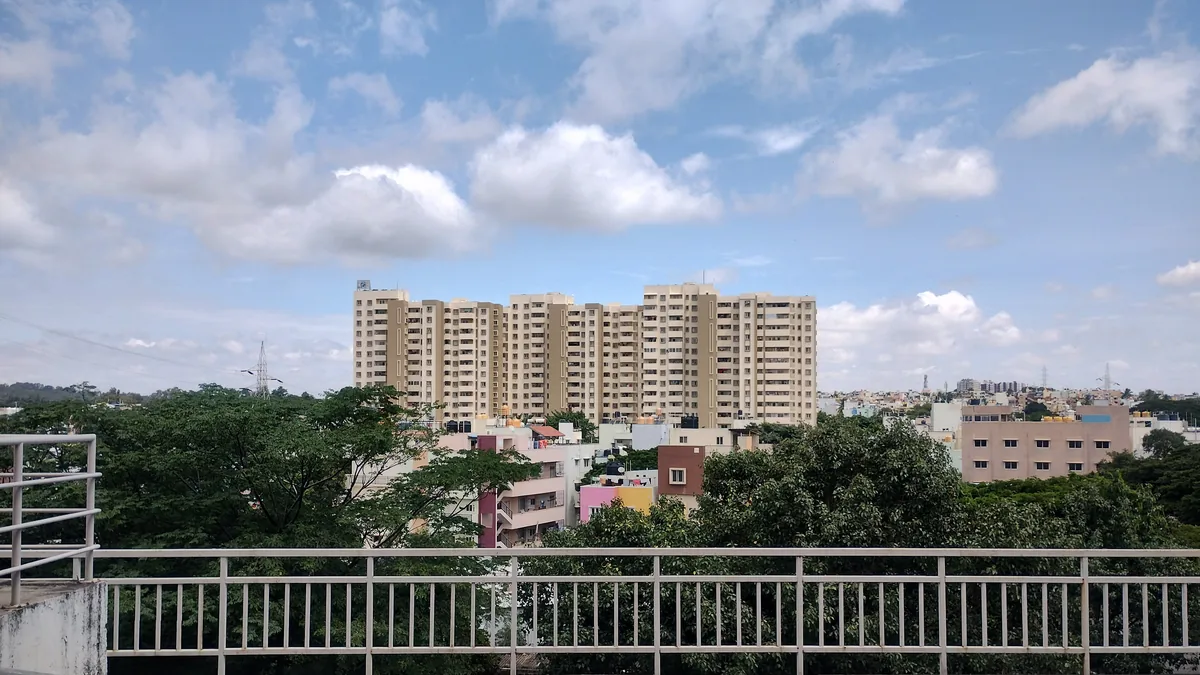
Photo: Ashwin Kumar, Wikimedia Commons.
Direct Answer: Not every apartment project in Bengaluru requires an Environmental Clearance (EC). Under Item 8(a) of the EIA Notification, 2006 (issued under the Environment (Protection) Act, 1986), prior clearance from the State Environment Impact Assessment Authority (SEIAA) Karnataka is mandatory whenever a building and construction project has a total built-up area of 20,000 square metres or more (up to 1,50,000 sq.m). Built-up area includes all covered floor space—including basement parking, podiums, stilts, and service areas—not just marketable carpet area. For townships crossing 1,50,000 sq.m or 50 hectares, Item 8(b) applies. Buyers must cross-check the official EC order on the PARIVESH portal and the K-RERA approval uploads before signing an allotment or sale agreement. A sanctioned BBMP/BDA plan or fire clearance cannot legally substitute for a missing EC.
Disclosure: acre&key's advice is free to buyers. We're an authorised sales partner for some projects and may be paid by the developer.
Environmental due diligence protects buyers from project stop-work orders, National Green Tribunal (NGT) penalties, or withheld Occupancy Certificates. For RERA verification, review our guide on how to check any Bengaluru project on K-RERA. Mandatory fire safety approvals are detailed in the high-rise fire-NOC guide, while title, plan sanction, and completion parameters are mapped in legal checks from title to OC. Official environmental proposal filings can be tracked directly on the PARIVESH portal.
Statutory thresholds under the EIA Notification, 2006
The regulatory framework governing real estate environmental clearance derives from the Environment (Protection) Act, 1986, and the Environmental Impact Assessment (EIA) Notification, 2006 (S.O. 1533(E)):
| EIA Schedule Item | Project Classification | Statutory Threshold Limits | Appraising & Issuing Authority |
|---|---|---|---|
| Item 8(a) | Building & Construction Projects | Built-up area from 20,000 sq.m to < 1,50,000 sq.m (~2.15 lakh to 16.14 lakh sq.ft) | SEIAA Karnataka (State Level Environment Impact Assessment Authority) |
| Item 8(b) | Townships & Area Development Projects | Built-up area ≥ 1,50,000 sq.m OR land area ≥ 50 hectares | SEIAA Karnataka / MoEFCC (EIA report and public consultation norms apply) |
| Non-Threshold Projects | Mid-scale / Standalone Residential | Built-up area < 20,000 sq.m | Exempt from prior EC (Subject to local municipal and KSPCB consent norms) |
What counts as "Built-Up Area"?
A common area of confusion occurs when sales brochures report "Super Built-Up Area" or "RERA Carpet Area." For EIA statutory clearance, the Ministry of Environment, Forest and Climate Change (MoEFCC) defines built-up area as the total covered area of all floors, including basements, stilts, service shafts, machine rooms, and podium parking.
A project marketing 1,80,000 sq.ft of apartment space may actually cross 25,000 sq.m (~2,69,000 sq.ft) once multi-level basements and utility rooms are accounted for, triggering mandatory prior EC requirements under Item 8(a).
How environmental approvals sit alongside other civic gates
Real estate clearances follow a distinct statutory sequence. Each gate addresses a different legal requirement:
- Environmental Clearance (EC): Evaluates environmental carrying capacity, hydrogeology, groundwater drawal, sewage treatment, solid waste management, and solar integration before ground-breaking. Issued by SEIAA Karnataka.
- Consent for Establishment (CFE): Issued by the Karnataka State Pollution Control Board (KSPCB) under the Water (Prevention and Control of Pollution) Act, 1974 and the Air Act, 1981, confirming technical design compliance of Sewage Treatment Plants (STP) and DG stack heights.
- Building Plan Sanction & Commencement Certificate (CC): Issued by BBMP, BDA, or GBA planning departments, confirming setback distances, FAR utilization, and structural engineering. Under planning regulations, a plan sanction for projects exceeding 20,000 sq.m cannot be lawfully released without a valid EC.
- K-RERA Registration: The Real Estate Regulatory Authority verifies that all mandatory statutory approvals—including the EC, Fire NOC, and Plan Sanction—are uploaded in the public disclosures tab before assigning a PRM registration number.
- Consent for Operation (CFO) & Occupancy Certificate (OC): Before handover, KSPCB inspects operational STP discharge standards (CFO), and the municipal body issues the OC confirming construction matches approved plans and environmental stipulations.
A failure at the EC stage compromises subsequent stages. Under National Green Tribunal (NGT) rulings, commencing physical construction without prior EC constitutes an illegal development, risking retrospective stop-work orders and hefty environmental compensation penalties.
How to check and verify the EC letter on PARIVESH and RERA
To directly verify a project's environmental clearance, follow this step-by-step verification method:
1. The PARIVESH Portal Search
- Navigate to the Ministry's central clearance portal: parivesh.nic.in.
- Search under "Proposal Status" selecting State: Karnataka, Category: Building Construction / Townships (Item 8).
- Search by the project's exact corporate entity name or project title as registered on RERA.
- Locate the State Level Expert Appraisal Committee (SEAC) minutes and the final SEIAA clearance letter.
2. Verify Key Parameters in the Approval Order
When inspecting the formal SEIAA Karnataka EC letter, review these critical sections: - Total Built-Up Area: Confirm the exact square metres cleared matches or exceeds the full project plan. If the developer later added towers or extra floors, an Amended / Expansion EC is legally mandatory. - Sewage Treatment Plant (STP) Capacity: Check whether the sanctioned STP technology (e.g., SBR or MBR) and capacity (KLD) matches the anticipated resident load. - Water Source Clearances: Check whether the project relies on BWSSB piped supply or requires Central Ground Water Authority (CGWA) / Karnataka Ground Water Authority (KGWA) borehole permissions. - Lake and Buffer Zone Compliance: Verify adherence to the 30-metre lake buffer zone and secondary/tertiary rajakaluve (stormwater drain) setbacks mandated by the NGT and Karnataka Town & Country Planning rules.
Interactive Environmental Clearance Due Diligence Checklist
Use this interactive 10-step checklist to review environmental and pollution control compliance before purchasing an apartment in a large Bengaluru residential development:
Interactive Due Diligence Checklist
Track your project environmental verification steps. Check items off as verified:
Frequently asked questions
Under Item 8(a) of the EIA Notification, 2006, building and construction projects require prior Environmental Clearance (EC) from SEIAA Karnataka whenever the total built-up area is 20,000 square metres or more, up to 1,50,000 sq.m. Townships and area development projects crossing 1,50,000 sq.m or covering 50 hectares or more fall under Item 8(b), which requires a comprehensive environmental impact assessment report.
Under MoEFCC notifications, built-up area is defined as the total covered area on all floors combined, including multi-level basements, parking stilts, podiums, lifts, and service shafts. It is significantly larger than RERA carpet area or saleable apartment area.
You can verify the official clearance letter on the Ministry's PARIVESH portal (parivesh.nic.in) under Karnataka SEIAA records, as well as in the public approvals tab of the project's registration page on the Karnataka RERA portal (rera.karnataka.gov.in).
No. Mid-scale and standalone residential developments with total built-up area under 20,000 square metres (approximately 2.15 lakh square feet across all floors and basements) do not require prior environmental clearance. They remain subject to standard municipal plan sanctions, Fire NOCs, and KSPCB consent guidelines.
They are separate statutory checkpoints. Under Karnataka municipal and planning laws, a building plan sanction cannot be legally granted for projects over 20,000 sq.m without prior EC. Similarly, RERA requires developers to disclose and upload valid EC orders. Neither a plan sanction nor a RERA certificate replaces an EC.
Inspect the total cleared built-up area figure, the sanctioned number of residential units, the daily sewage generation estimate, the on-site Sewage Treatment Plant (STP) design specifications, rainwater harvesting tank capacities, and adherence to rajakaluve or lake buffer zones.
Any expansion in built-up area beyond the cleared quantum requires a formal application for an amended or expansion Environmental Clearance from SEIAA Karnataka. Proceeding with construction on expanded portions without an updated EC violates the Environment (Protection) Act, 1986.
No. An EC is a prior statutory clearance granted by SEIAA Karnataka evaluating broad ecological impact. Consent for Establishment (CFE) and Consent for Operation (CFO) are technical operational permits issued by the Karnataka State Pollution Control Board (KSPCB) specifically regulating sewage discharge, water consumption, and air emissions.
First verify whether the gross covered area crosses 20,000 square metres. If the development clearly exceeds the threshold and no EC is uploaded or produced, seek written clarification from the developer and pause any financial commitment until verified by property legal counsel.
No. An EC confirms that the proposed project layout, sewage management, and green measures met statutory standards on paper at appraisal. Actual operational water availability, tanker reliance, and seasonal groundwater fluctuations depend on ground infrastructure and local civic utility connections.
Lawyer note: The information provided on this page is for educational and due diligence guidance under Karnataka property and environmental legislation and does not constitute formal legal counsel. If an environmental clearance appears missing, inconsistent with sanctioned plans, or subject to active NGT litigation, consult an experienced property advocate before committing booking funds.
CA note: Environmental compliance costs and statutory clearance fees incurred by a developer form part of project infrastructure expenditure. For individual buyers, holding an allotment in a legally compliant project prevents construction delays that can jeopardize home loan interest deductions under Section 24(b) of the Income-tax Act.
Sources
Checked 18 Nov 2026.
-
Ministry of Environment, Forest and Climate Change (MoEFCC) PARIVESH Clearance Portal: https://parivesh.nic.in/
-
EIA Notification, 2006 (S.O. 1533(E)), Schedule Item 8(a) and 8(b): https://cpc.parivesh.nic.in/writereaddata/ENV/EnvironmentalImpactAssessmentNotification-2006/so1533.pdf
-
State Level Environment Impact Assessment Authority (SEIAA) Karnataka: https://seiaa.karnataka.gov.in/
-
Karnataka State Pollution Control Board (KSPCB) Consent Management Portal: https://kspcb.karnataka.gov.in/