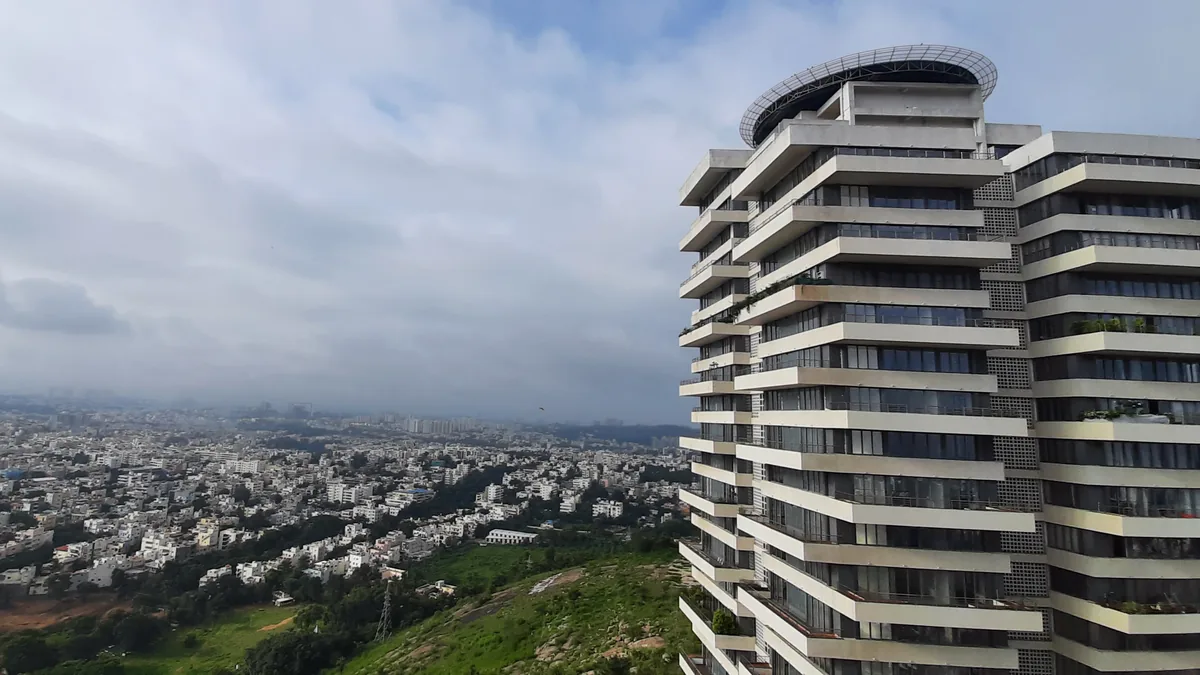

Photo: Ashwin Kumar, Wikimedia Commons.
Direct Answer: Betterment and improvement charges are one-time statutory capital recovery levies imposed by civic planning bodies (such as BBMP/GBA city corporations or the Bangalore Development Authority) when municipal roads, stormwater drains, or public layout infrastructure enhance a parcel's value. Unlike annual recurring property taxes, unpaid betterment charges attach directly to the immovable property under Section 467 of the Karnataka Municipal Corporations (KMC) Act, 1976. If a seller fails to clear them, statutory liability travels directly to the new buyer upon deed registration. An annual property tax receipt or an e-Khata extract is not proof of betterment clearance; buyers must demand original municipal challan receipts and verify the ledger on e-Aasthi before executing sale agreements.
Disclosure: acre&key's advice is free to buyers. We're an authorised sales partner for some projects and may be paid by the developer.
Understanding municipal charges prevents costly surprises when buying land or apartments in Bengaluru. Property tax calculation is detailed in our GBA tax-calculation note and how to verify a PID and tax receipt. Civic ownership records are explained in the A-khata vs B-khata guide, while layout approvals are covered in buying a plot in Bengaluru and the conversion and layout approval checklist.
Different labels, the same buyer problem
Bengaluru property buyers encounter these statutory dues under various municipal labels: 1. BBMP / GBA Improvement Expenses: Levied when civic infrastructure (tar roads, stormwater drains, culverts, street lighting) is provided to newly merged village areas, 110-village zones, or unapproved layouts transitioning toward regularisation. 2. BDA Betterment Levy: Assessed under Sections 18, 19, and 20 of the Bangalore Development Authority Act, 1976. This applies to private pockets of land or "left-out" survey numbers nestled inside or adjacent to BDA residential schemes that directly benefit from arterial roads and public layout utility networks. 3. Planning Authority Development Surcharges: Levied under the Karnataka Town and Country Planning (KTCP) Act, 1961 by authorities like BMRDA, BIAAPA, or DTCP at the stage of layout sanction or building plan approval.
The legal mechanism behind municipal improvement expenses is critical for buyers to understand. Under Sections 466 and 467 of the Karnataka Municipal Corporations Act, 1976, improvement expenses declared by the municipal commissioner constitute a statutory charge on the premises. The liability is tied to the physical land, not simply the personal credit of the previous owner. If the seller vacates without paying, municipal corporations possess statutory recovery powers under Section 468 to attach the property or demand the entire sum with penal interest from the incoming purchaser.
A clear distinction exists between the three main categories of civic levies: - Annual Property Tax: A recurring municipal tax assessed on Unit Area Value (UAV) or capital value for routine civic maintenance (street sanitation, garbage clearing, routine lighting). - Betterment / Improvement Charges: A one-time capital recovery fee assessed for specific public infrastructure works or layout regularisation. - Agricultural Conversion / Land Use Fees: Statutory compounding fees paid to the Revenue Department (Deputy Commissioner) under Section 95 of the Karnataka Land Revenue Act, 1964.
Paying one category does not extinguish another. A current property tax receipt does not satisfy an outstanding betterment notice, nor does an agricultural conversion order clear BDA betterment demands.
How betterment charges arise in Bengaluru property transactions
Betterment demands most frequently surface during specific property transitions:
| Property Profile | Typical Betterment / Development Scenario | Statutory Risk Level | Verification Document Required |
|---|---|---|---|
| BDA Left-Out Lands | Pockets excluded from initial BDA acquisition but benefiting from layout roads and water lines | High (BDA Sec 18-20 demand notices) | BDA Betterment Endorsement and official sealed challan receipt |
| Merged CMC / 110-Village Plots | Revenue layouts brought under BBMP limits requiring civic drainage and road laying | High (Historic BBMP improvement fee notices) | Municipal improvement fee challan and e-Aasthi zero-demand ledger |
| Apartment Plan Sanction | Multi-unit residential project where developer pays development charges per square metre | Moderate (Borne by builder during sanction) | Sanctioned Plan fee receipt and Commencement Certificate (CC) |
| B-Khata to A-Khata Transition | Older revenue sites seeking regularisation under civic schemes | High (Subject to High Court and municipal circulars) | Official BBMP treasury challan with Sakala service number |
In Bengaluru's legal history, the collection of betterment charges on revenue sites has seen substantial litigation. The Karnataka High Court has repeatedly scrutinised municipal circulars where corporations collected betterment fees without sanctioned statutory improvement schemes. However, where legitimate public schemes exist or where BDA has issued formal betterment notices, outstanding balances remain enforceable civic encumbrances.
What to ask, inspect, and write into agreements
Before paying an earnest money deposit or signing a sale agreement, follow this protocol:
1. The Written Dues Inquiry
Request a formal statement of outstanding municipal dues directly from the jurisdictional authority: - For BDA layouts and adjoining pockets: The Town Planning Member (TPM) or Special Land Acquisition Officer (SLAO) at BDA head office, Kumara Park West. - For city corporation limits: The Assistant Revenue Officer (ARO) of the relevant sub-division under Greater Bengaluru Authority. - Inquire specifically whether any improvement expense, layout surcharge, or betterment notice under Section 467 KMC Act has been issued for the target survey number or site.
2. Physical Document Verification
Do not accept oral assurances from property brokers or vendors. Insist on inspecting: - Original sealed treasury challans proving payment of betterment charges. - The specific assessment order detailing the square-metre calculation. - The online tax and dues ledger on the e-Aasthi or BBMP property portal confirming zero outstanding improvement balance under the Property Identification (PID) number.
3. Contractual Drafting in the Sale Agreement
Draft explicit protective covenants in the agreement to sell: - Specify by name all civic dues: "The Vendor represents and confirms that all property taxes, betterment charges, improvement levies under Section 466/467 KMC Act, and BDA layout surcharges notified up to the date of execution of the Sale Deed have been fully discharged." - Require the vendor to deliver certified receipts and a municipal no-objection certificate prior to final deed execution. - Include an indemnity clause making the seller personally liable for any undisclosed betterment demand originating prior to the sale deed date.
Interactive Betterment & Civic Charges Due Diligence Checklist
Use this interactive 10-step checklist to verify improvement and development charges before registering property in Bengaluru:
Interactive Due Diligence Checklist
Track your civic charge verification steps. Check items off as completed:
Frequently asked questions
It is a statutory municipal charge levied because a parcel of land benefits directly from public infrastructure—such as an asphalt road, stormwater drainage line, water main, or public layout utility network—or because planning regulations mandate a development contribution. Authorities use varying designations: betterment levy, improvement expenses, or layout development surcharges. The controlling legal reality is which authority assessed the charge, against which survey number, and whether it has been discharged.
Under municipal law, specifically Section 467 of the Karnataka Municipal Corporations Act, 1976, improvement expenses constitute a charge on the immovable property itself. While the current title holder is responsible for payment, any unpaid statutory balance travels with the title to the incoming buyer upon registration. If a vendor exits without paying, the municipal authority can legally attach the land or demand recovery directly from the new owner.
No. Property tax is a recurring yearly municipal levy assessed on Unit Area Value (UAV) or built-up square footage to support routine municipal administration. Betterment or improvement charges represent a separate, one-time capital recovery levy tied to specific public works or statutory permissions. Holding a zero-arrears property tax receipt does not mean betterment charges have been paid.
Betterment demands arise on revenue sites transitioning to municipal rolls, unapproved layouts seeking regularization, properties adjacent to BDA arterial road developments, private lands left out of BDA acquisition schemes, and during the building plan sanction stage for multi-storey residential projects.
Seek confirmation directly from the authority holding legal jurisdiction over the property: the Assistant Revenue Officer (ARO) of the relevant Greater Bengaluru city corporation zone for municipal improvement dues, or the Town Planning Member / Special Land Acquisition Officer at BDA head office for BDA betterment schemes. A verbal declaration from the seller or broker provides zero legal protection.
Allowing a vendor to pay after registration carries severe financial risk. Because Section 467 attaches the liability directly to the land, the municipal body will demand payment from you as the registered occupant. If deferred payment is unavoidable, hold back a substantial financial escrow from the sale consideration and establish an enforceable indemnity clause with strict timelines.
The agreement should explicitly enumerate all civic categories: property taxes, betterment levies, layout development charges, and Section 467 KMC improvement expenses. It must stipulate that the vendor holds sole responsibility for clearing all dues notified up to the date of deed registration, backed by verified treasury receipts.
No single flat rate applies city-wide. Betterment rates are governed by scheme-specific notifications, road frontage parameters, layout dimensions, and the date of infrastructure notification. Buyers must rely exclusively on the official assessment challan issued for that specific property rather than estimated rate charts.
Yes. B-Khata properties represent land records where layout regularisation, conversion verification, or civic infrastructure payments were never completed. When transforming a B-Khata property into an e-Khata or municipal A-Khata, municipal corporations typically assess accumulated improvement charges and layout conversion surcharges.
No. Land conversion fees are statutory compounding amounts paid to the Revenue Department under Section 95 of the Karnataka Land Revenue Act, 1964, permitting agricultural land to be used for residential purposes. Betterment charges are municipal levies collected by civic authorities for physical infrastructure. Paying conversion fees does not clear municipal betterment dues.
Lawyer note: The guidance on this page provides educational and procedural information under Karnataka civic legislation and does not constitute formal legal counsel. Evaluating specific demand notices, BDA betterment orders, or municipal improvement encumbrances requires thorough review by a practicing property advocate. Obtain qualified legal verification before paying booking advances.
CA note: Municipal betterment and improvement charges paid toward land regularisation or development permissions form part of the capital cost of acquisition under Section 48 of the Income-tax Act, 1961. Consult a chartered accountant for advice on capital gains indexation and cost treatment.
Sources
Checked 18 Nov 2026.
-
Karnataka Municipal Corporations Act, 1976, Sections 466, 467, and 468 (Improvement expenses as a statutory charge on premises): https://www.dtcp.gov.in/sites/dtcp.gov.in/files/PDF/acts%26Rules/Karnataka_Municipal_Corporations_Act_1976.pdf
-
Bangalore Development Authority Act, 1976, Sections 18, 19, and 20 (Levy of betterment tax and assessment procedures): https://bda.karnataka.gov.in/
-
Greater Bengaluru Property Tax Portal & Assessment Regulations: https://bbmptax.karnataka.gov.in/Forms/Calculator.aspx
-
Karnataka Town and Country Planning (KTCP) Act, 1961 (Development charges on land and buildings): https://dtcp.karnataka.gov.in/