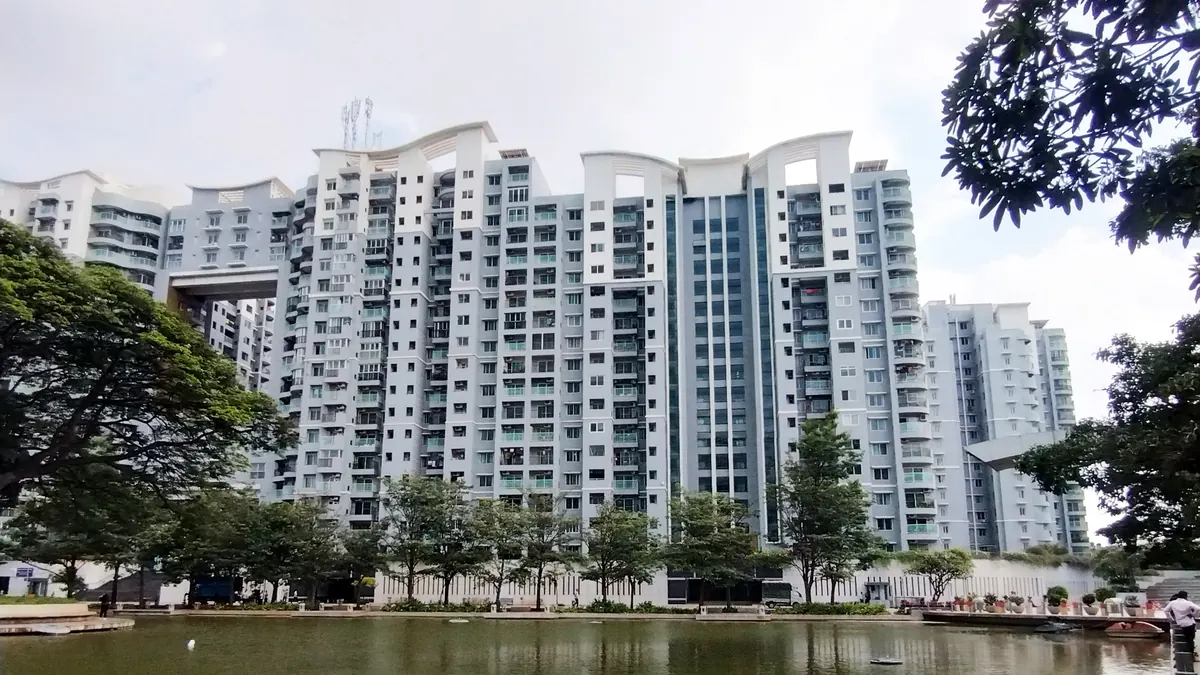
Photo: Bhonsley, Wikimedia Commons.
In Karnataka real estate transactions, an Allotment Letter, Agreement for Sale, and Sale Deed serve three fundamentally distinct legal functions. The Allotment Letter records provisional unit booking; under Section 13 of the RERA Act, 2016, promoters cannot accept more than 10% of property cost without executing and registering a formal Agreement for Sale. The Agreement for Sale legally binds commercial covenants, construction milestones, carpet area metrics, and possession deadlines. Finally, the Sale Deed operates as the definitive registered conveyance that permanently transfers ownership title and Undivided Share of Land (UDS) before the Sub-Registrar on Kaveri 2.0.
When acquiring an apartment or villa in Bengaluru, homebuyers are presented with a sequence of contracts, booking forms, and legal deeds.
Promoters and brokers frequently blur these legal instruments—assuring buyers that a signed booking allotment letter is "as good as an agreement" or pressuring buyers to disburse 20% to 30% of project funds before any document is registered.
Relying on informal booking letters leaves purchasers legally unprotected if a developer alters floor plans, delays construction, or encounters insolvency. Knowing the statutory boundaries of each document protects your capital and legal rights under Karnataka RERA.
The tripartite documentation hierarchy
+--------------------------------------------------------------------------------+
|                 KARNATAKA PROPERTY CONVEYANCING TRIANGLE                       |
+--------------------------------------------------------------------------------+
|  [STAGE 1: ALLOTMENT LETTER]                                                   |
|  Timing: Issued at initial booking (Max 10% token consideration)                |
|  Legal Status: Non-conveyance booking allocation; non-registrable              |
|  Key Role: Locks unit number, super built-up/carpet area, base rate            |
|                                                                                |
|  [STAGE 2: AGREEMENT FOR SALE (ATS)]                                           |
|  Timing: Executed upon reaching 10% payment threshold                         |
|  Legal Status: Compulsorily registered contract under RERA Section 13          |
|  Key Role: Enforces delivery date, payment milestones, defect liability period |
|                                                                                |
|  [STAGE 3: SALE DEED CONVEYANCE]                                               |
|  Timing: Executed upon building completion & Occupancy Certificate (OC)        |
|  Legal Status: Registered conveyance of freehold title under Sec 17 Reg. Act   |
|  Key Role: Transfers absolute ownership title, UDS share, and possession       |
+--------------------------------------------------------------------------------+
Detailed comparison of legal instruments
| Parameter | Allotment Letter | Agreement for Sale (ATS) | Sale Deed (Conveyance) |
|---|---|---|---|
| Primary Statute | Contract Act, 1872 | Section 13, RERA Act, 2016 | Transfer of Property Act, 1882 |
| Registration Required? | No (Internal developer letter) | Yes, compulsory under RERA | Yes, compulsory under Sec 17 |
| Permissible Advance | Max 10% of total property value | Up to 90% (tied to construction) | Final 10% / Full balance payout |
| Title Conveyance | Nil | Nil (Promise to convey future title) | Absolute Freehold Title Transfer |
| Karnataka Stamp Duty | Nil (or nominal Rs 100/200 bond) | 0.5% (Article 5(e) Stamp Act) | 5% BBMP/GBA area + 2% Reg. Fee |
| UDS Specification | Often omitted or estimated | Mandatorily specified in schedule | Legally vested in Schedule B |
| Defect Liability | Not enforceable | Governed by Section 14 (5 Years) | Governed by title warranty clauses |
Stage 1: The Allotment Letter and the 10% statutory cap
Under Section 13(1) of the Real Estate (Regulation and Development) Act, 2016:
"A promoter shall not accept a sum more than ten per cent of the cost of the apartment, plot, or building as an advance payment or an application fee, from a person without first entering into a written agreement for sale with such person and register the said agreement for sale."
Key rules governing allotment letters in Karnataka: - Strict Monetary Limit: If a developer demands 15% or 20% to "lock the festive pricing," they are in direct violation of Section 13. - Specification Locking: The letter must detail the specific unit number, tower name, sanctioned carpet area, and designated parking bay. - Cancellation & Refunds: If the buyer withdraws prior to agreement execution, RERA regulations govern refund timelines and restrict arbitrary cancellation penalties.
Stage 2: The Agreement for Sale (ATS)
The Agreement for Sale is the commercial backbone of an under-construction transaction. In Karnataka, promoters must utilize the model agreement format notified under the Karnataka RERA Rules:
- Construction-Linked Milestones: Every payment demand must correspond to certified physical construction stages.
- Specific Possession Sunset Date: The agreement must state an exact calendar handover date, incorporating grace periods.
- Reciprocal Delay Interest: Under RERA Section 18, if the promoter delays delivery, they must pay monthly interest to the allottee at the State Bank of India highest marginal cost of funds-based lending rate (MCLR) plus 2%, matching the interest rate charged to defaulting buyers.
- Karnataka Stamp Duty: Under Article 5(e) of the Karnataka Stamp Act, 1957, an Agreement for Sale attracts 0.5% stamp duty. Importantly, this 0.5% duty is fully adjustable against the final 5% stamp duty payable during the subsequent Sale Deed registration.
Stage 3: The Sale Deed
While an Agreement for Sale creates an enforceable contractual right to seek conveyance, it does not make you the legal owner of the property. Under Section 54 of the Transfer of Property Act, 1882, a contract for the sale of immovable property does not, of itself, create any interest in or charge on such property.
The Sale Deed is the sole instrument that: 1. Passes proprietary title from the promoter/vendor to the purchaser. 2. Formally conveys the Undivided Share of Land (UDS) recited in Schedule B. 3. Enables municipal mutation and the generation of an official Final e-Khata on e-Aasthi 2.0. 4. Extinguishes the promoter's development liens on Kaveri 2.0.
Property documentation transition checklist
Verify critical statutory covenants across each document stage of your purchase.
Frequently asked questions
Banks may issue an in-principle sanction based on an allotment letter and credit profile. However, lenders will not disburse funds beyond the initial 10% token until a formal, registered Agreement for Sale is executed and submitted.
In general legal parlance, the terms are interchangeable. However, in RERA terminology, the "Agreement for Sale" refers specifically to the statutory contract executed under Section 13 conforming to prescribed state rules.
Yes. Under Section 13 of RERA, registration of the Agreement for Sale is mandatory before accepting more than 10% consideration. In Karnataka, this is executed at the Sub-Registrar Office on 0.5% stamp duty under Article 5(e) of the Karnataka Stamp Act.
An allotment letter provides weak legal protection compared to a registered Agreement for Sale. RERA authorities enforce statutory delay compensation (SBI MCLR + 2%) primarily by examining the registered terms, possession dates, and default covenants in the formal Agreement for Sale.
No. Under the Karnataka RERA model agreement, a promoter cannot cancel an allotment unilaterally without issuing formal 30-day default notices and demonstrating non-payment of legitimate, verified construction-linked demands.
Legal Note: Property contracts are bound by the Real Estate (Regulation and Development) Act, 2016, the Registration Act, 1908, and the Karnataka Stamp Act, 1957. Consult a qualified real estate advocate to audit draft builder-buyer agreements prior to executing financial commitments.
Disclaimer: This article is published for educational guidance and regulatory compliance analysis. It does not constitute formal legal counsel.
Sources
Checked 18 Nov 2026.
- Real Estate (Regulation and Development) Act, 2016 (Section 13 - Agreement for Sale): https://rera.karnataka.gov.in/
- Karnataka Stamp Act, 1957 (Article 5(e) - Agreement relating to sale of immovable property): https://dpal.karnataka.gov.in/
- Department of Stamps and Registration, Government of Karnataka (Kaveri 2.0): https://kaveri.karnataka.gov.in/