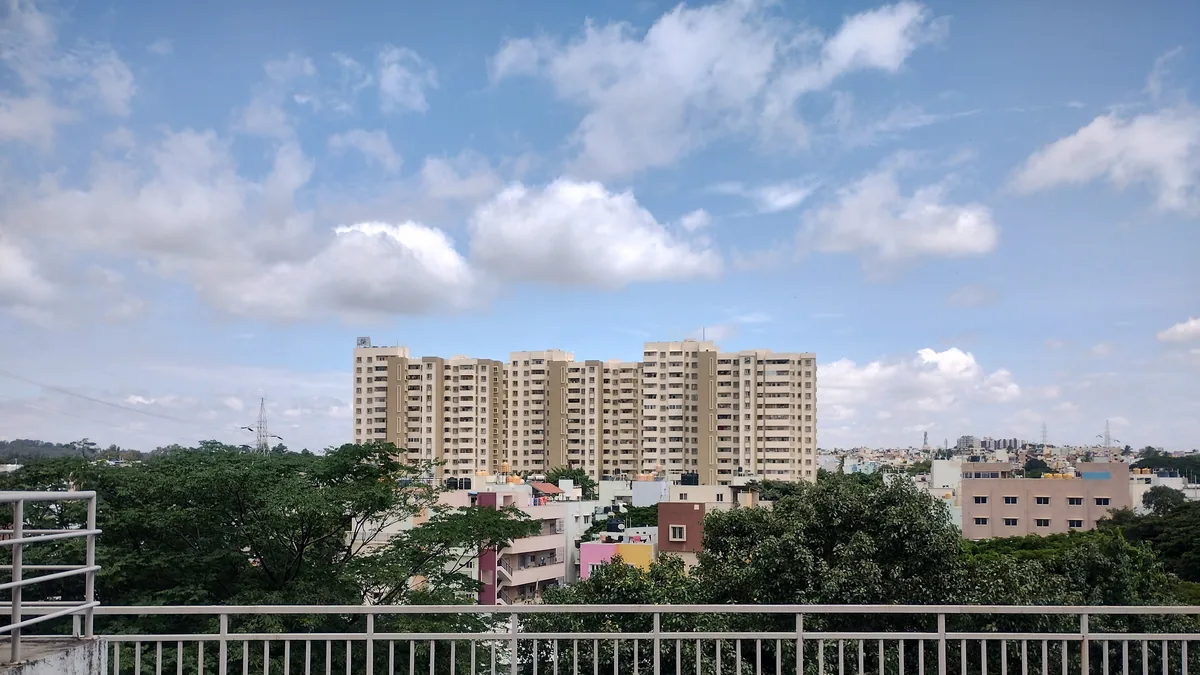
Photo: Gpkp, Wikimedia Commons, CC BY-SA 4.0.
Under the published provisions of the Karnataka Apartment (Ownership and Management) Act, 2026 (Karnataka Act No. 45 of 2026), a promoter is mandated to submit a formal declaration, hand over original engineering blueprints and title dossiers, and transfer all maintenance deposits, corpus reserves, and accrued interest alongside an audited statement to the registered Association of Allottees within 60 days of Occupancy Certificate (OC) issuance. However, because the Karnataka government has not yet published the Section 1(2) commencement notification in the official gazette, this 60-day statutory clock has not legally commenced. In the interim, apartment buyers and resident welfare associations must enforce immediate asset and fund handovers under existing RERA Section 11(4) and Section 17 mandates.
The broader constitutional and legislative status of the statute is analyzed in what in the 2026 Karnataka Apartment Act is currently in force. Operational procedures for civic mutation and utility accounts are detailed in our companion guide on Khata, BESCOM meters, and corpus handover. This guide clarifies the mechanics of the proposed 60-day statutory window and how to protect association rights today.
Deconstructing the 60-day handover framework in KAOMA 2026
The Karnataka Apartment (Ownership and Management) Act, 2026 introduces a consolidated statutory handover schedule to replace the protracted multi-year delays currently suffered by Bengaluru apartment owners.
Trigger Event: Unconditional Occupancy Certificate (OC)
   └── Day 0 to 60: Mandatory Promoter Handover Window
         ├── 1. Submit Section 16 Declaration to Competent Authority
         ├── 2. Transfer Original Title Deeds, Sanctioned Plans & As-Built MEP Drawings
         └── 3. Remit Corpus Fund + Sinking Reserves + Bank Interest with CA Audit Ledger
1. The statutory declaration to the competent authority
Within 60 days of receiving the Occupancy Certificate, the promoter must submit a comprehensive legal declaration detailing: * Undivided share of land (UDS) apportioned to each apartment unit. * Complete schedule of common areas, facilities, access roads, and recreational spaces. * Structural warranties and certified building specifications. * If a promoter fails or refuses to file this declaration, the Act enables the registered Association of Allottees (AoA) to petition the competent authority to file the declaration independently.
2. Comprehensive handover of technical records
Promoters frequently withhold engineering schematics, forcing resident associations into blind maintenance operations. The published Act obligates promoters to deliver physical and digital copies of: * Certified sanctioned architectural plans and structural design calculations. * As-built MEP (mechanical, electrical, plumbing) schematics, fire-fighting installation approvals, and water supply networks. * Environmental clearances, Consent for Operation (CFO) from KSPCB, and STP operational manuals. * Manufacturer warranty certificates and maintenance contracts for lifts, diesel generators, and solar equipment.
3. Fiduciary transfer of corpus, sinking, and security funds
The statute eliminates developer excuses regarding maintenance fund retention: * Audited Allottee-Wise Ledger: The promoter must provide a line-by-line accounting of all deposits collected from every buyer from the inception of the project. * Compulsory Interest Pass-Through: Any interest earned on corpus accounts maintained in scheduled banks must be transferred in full to the association. * No Unilateral Offsets: Promoters cannot deduct marketing shortfalls, administrative expenses, or unsold unit maintenance arrears from the corpus balance.
The Section 1(2) commencement gap: Why the clock is not running yet
While Karnataka Act No. 45 of 2026 received the Governor's assent and was published in the Karnataka Gazette on 15 October 2026, Section 1(2) contains an explicit statutory condition:
"It shall come into force on such date as the State Government may, by notification in the Official Gazette, appoint."
As of mid-November 2026, the Karnataka Urban Development Department has not notified the effective commencement date. The practical legal implications for buyers are straightforward:
- You cannot file KAOMA Section 16 petitions today: Municipal officers and competent authorities have not been officially designated under the Act to receive statutory declarations.
- Promoters cannot use the Act to justify delays: Developers who tell resident committees, "We are waiting for the new 2026 apartment rules to be notified before releasing funds," are misrepresenting the law.
- Existing RERA protections remain fully operative: Sections 11(4)(g), 14(3), and 17 of the Real Estate (Regulation and Development) Act, 2016 provide immediate statutory remedies that can be enforced without waiting for state government notifications.
Enforcing immediate handover under RERA and contract law
Rather than awaiting administrative notifications, apartment owners and ad-hoc associations must utilize current statutory machinery:
- Section 11(4)(g) of RERA: Promoters are legally responsible for all municipal taxes, maintenance outgoings, and utility charges until physical handover to the association.
- Section 17(1) of RERA: Promoters must execute a registered conveyance deed transferring title to common areas to the association within three months of receiving the occupancy certificate.
- Section 17(2) of RERA: Promoters must hand over all physical title documents and original project plans within thirty days after obtaining the completion certificate.
- K-RERA Asset Transfer Orders: Karnataka RERA consistently issues enforceable orders directing promoters to transfer corpus accounts, utility meters, and mother khatas within 60 to 90 days of an allottee petition.
Before accepting physical keys or signing handover certificates, review our comprehensive 25 final checks before taking possession, verify OC vs CC documentation standards, and understand possession letter legal limits.
Step-by-step interactive checklist: Apartment handover compliance
Frequently asked questions
No. Although Karnataka Act No. 45 of 2026 was published in the official gazette on 15 October 2026, Section 1(2) mandates that the Act will only take effect from a date specifically appointed by a future government notification. Until that notification is issued, the 60-day clock is not legally active.
Homebuyers and registered associations can file an immediate statutory complaint before Karnataka RERA under Section 31, citing violations of Section 11(4)(g) and Section 17. K-RERA possesses statutory powers to attach promoter accounts, direct handover within 60 to 90 days, and levy penal interest.
No. The Karnataka Apartment (Ownership and Management) Act, 2026 works concurrently with central RERA legislation. Where state apartment statutes provide enhanced local management frameworks, central RERA statutory obligations regarding title transfer, structural defect liability, and escrow integrity remain fully binding.
Managing a modern high-rise without as-built drawings creates serious operational vulnerabilities. Without certified schematics, maintenance teams cannot trace electrical conduits, sewage pipe junctions, or underground fire-line valves, significantly increasing the cost of future repairs and emergency restorations.
An ad-hoc resident committee coordinates with the builder to review draft bye-laws, audit incoming asset inventories, and supervise initial snag rectifications. However, formal financial transfers (such as sinking corpus funds) can only be received by a legally registered Association of Allottees with a dedicated society bank account.
Promoters frequently levy unexpected pre-handover charges for transformer installations, BWSSB water connections, or club memberships. Review our analysis on the K-RERA ruling on pre-handover charges to distinguish legitimate statutory deposits from unauthorized contractual markups.
For authoritative analysis on Karnataka real estate handovers and civic compliance, explore: - Khata, BESCOM Meters, and Corpus Handover in Bengaluru - Karnataka Apartment Act 2026: Comprehensive Enforceability Analysis - 25 Critical Pre-Possession Inspection Checks - OC vs CC: Legal Risks of Taking Possession Without Occupancy Certificate
Legal Notice: This guide provides analytical commentary on published Karnataka property legislation and real estate statutory obligations. It is not formal legal counsel. Apartment conveyance, developer default, and association formation procedures require tailored advice from a qualified property lawyer.
Accounting Notice: Corpus fund transfers, association maintenance trusts, and reserve capitalization involve tax and audit compliance under the Income-tax Act. Consult a Chartered Accountant regarding association GST registration thresholds and mutual concern tax exemptions.
Sources
- Karnataka Act No. 45 of 2026: Karnataka Apartment (Ownership and Management) Act, 2026 Official Text, PRS India
- The Real Estate (Regulation and Development) Act, 2016: Sections 11(4)(g), 14 & 17, India Code
- Karnataka Real Estate Regulatory Authority (K-RERA): Promoter Handover Obligations & Case Rulings
- Bruhat Bengaluru Mahanagara Palike (BBMP): Standard Operating Procedure for Occupancy Certificate Issuance