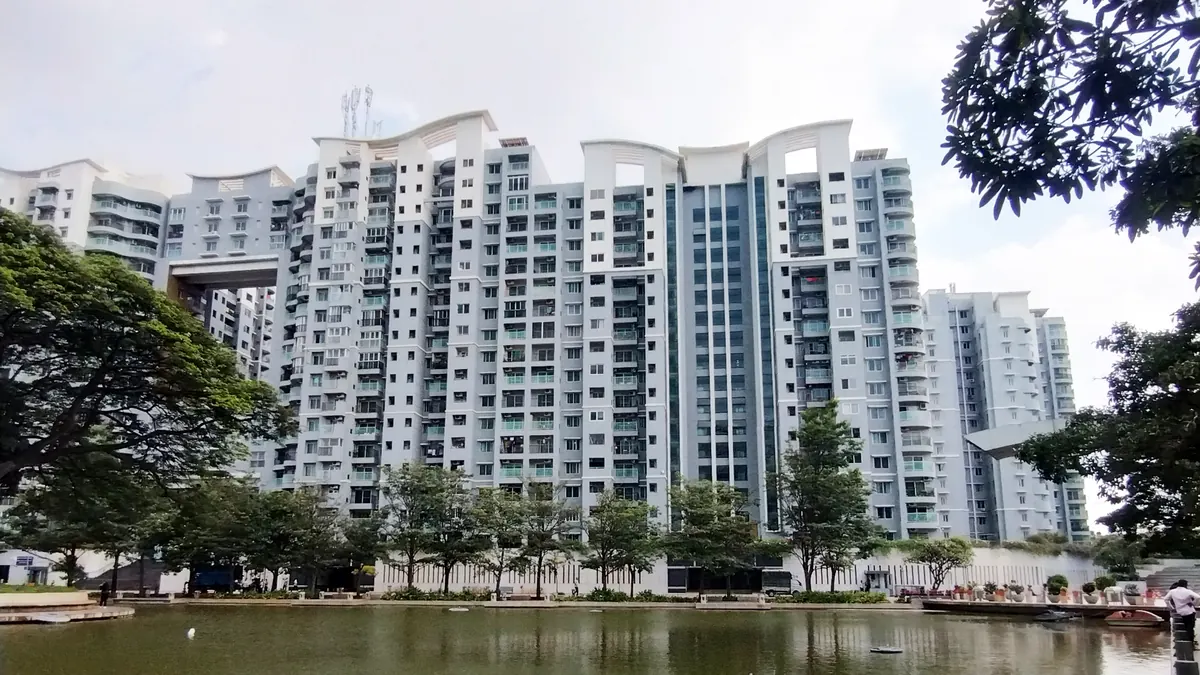
Photo: Gpkp, Wikimedia Commons, CC BY-SA 4.0.
A General Power of Attorney (GPA), whether accompanied by an Agreement to Sell or an unregistered Will (collectively termed "SA/GPA/Will transfers"), does not legally convey ownership title to immovable property. In the landmark judgment Suraj Lamp & Industries v. State of Haryana (2012), the Supreme Court established that immovable property can be lawfully transferred exclusively through a registered Sale Deed executed under Section 17 of the Registration Act. While a Power of Attorney cannot serve as a root of title, an agent holding a registered, task-specific Special Power of Attorney (SPA) can lawfully represent an absent owner to sign conveyance deeds and complete Sub-Registrar biometrics.
Across Bengaluru, buyers exploring revenue sites, unapproved layouts, or older inherited properties frequently encounter sellers offering properties "on GPA."
The seller presents a notarized GPA executed by an original landlord decades ago, alongside an agreement to sell and an affidavit, offering a substantial discount compared to surrounding market rates.
Purchasing real estate through GPA transfers is one of the most perilous traps in Indian real estate. Buyers pay market capital only to discover they hold zero legal title. The original owner or their legal heirs can revoke the power, execute a registered sale to a third party, or reclaim physical possession through summary court proceedings.
Understanding the legal distinction between lawful attorney agency and illegal "GPA sales" protects homebuyers from buying litigation.
The landmark precedent: Suraj Lamp & Industries (2012)
Prior to 2012, informal real estate markets extensively utilized "SA/GPA/Will" documentation bundles to evade state stamp duties, bypass municipal layout conversion rules, or circumvent agricultural ceiling laws.
In Suraj Lamp & Industries Pvt. Ltd. v. State of Haryana (2012) 1 SCC 656, the Supreme Court decisively invalidated this practice:
+--------------------------------------------------------------------------------+
|                 SURAJ LAMP RULING: CORE STATUTORY HOLDINGS                     |
+--------------------------------------------------------------------------------+
|  [HOLDING 1: NO TITLE CONVEYANCE]                                              |
|  A Power of Attorney is purely an agency instrument. It does not transfer title|
|  or create any proprietary interest in immovable property under Section 54 TPA.|
|                                                                                |
|  [HOLDING 2: WILLS ARE NOT CONVEYANCES]                                        |
|  A Will takes effect only post-mortem and is inherently revocable during life. |
|  It cannot be used as an instrument of inter vivos commercial transfer.        |
|                                                                                |
|  [HOLDING 3: ONLY REGISTERED CONVEYANCE WORKS]                                 |
|  Immovable property valued at Rs 100 or more can be transferred EXCLUSIVELY via|
|  a registered Sale Deed executed before the Sub-Registrar under Section 17.    |
|                                                                                |
|  [HOLDING 4: LEGITIMATE AGENCY PRESERVED]                                      |
|  A validly executed & stamped POA can authorize an attorney to represent an    |
|  absent principal to EXECUTE a registered sale deed.                           |
+--------------------------------------------------------------------------------+
GPA as title vs GPA as representation
Understanding when a power of attorney is lawful versus fraudulent requires evaluating the document's operational purpose:
| Parameter | "GPA Sale" (Unlawful Transfer) | Legitimate Attorney Representation (Lawful Agency) |
|---|---|---|
| Operational Role | Used as a substitute for a registered Sale Deed | Used by an agent to sign the registered Sale Deed |
| Title Ownership | Stays with original landlord; zero title passes | Passes completely to buyer via registered conveyance |
| Karnataka Stamp Duty | Evaded via Rs 100-500 stamp paper / notary | Full 5% Stamp Duty + 2% Registration Fee paid |
| Bank Loan Eligibility | Completely ineligible; banks reject GPA files | Eligible; banks finance deeds executed by valid attorneys |
| On Principal Demise | Power self-terminates; buyer evicted by heirs | Title already secured in buyer's registered deed |
| Municipal e-Khata | Cannot obtain a Final e-Khata on e-Aasthi 2.0 | Seamless municipal mutation via Kaveri 2.0 push |
Five critical vulnerabilities of buying "on a GPA"
If you purchase real estate relying solely on an agreement to sell and a general power of attorney without a registered sale deed, you face severe legal vulnerabilities:
1. Automatic revocation upon death
Under Section 201 of the Indian Contract Act, 1872, an agency relationship automatically terminates upon the death or mental incapacity of the principal. If the original landowner passes away, the GPA becomes a legal nullity. The legal heirs can legitimately evict you and claim unencumbered ownership.
2. Unilateral cancellation by the principal
Unless a power of attorney is explicitly created as an irrevocable agency coupled with interest under Section 202 of the Contract Act (which requires paying full conveyance stamp duty on the instrument itself), a principal can revoke a GPA at any time by executing a registered Deed of Revocation.
3. Double sale fraud
Because an unregistered GPA sale does not reflect as an encumbrance on Kaveri 2.0 Form 15, the dishonest original owner can sell the identical property to a third party via a registered Sale Deed. Under Section 48 of the Transfer of Property Act, the registered deed holder wins absolute legal ownership over the unregistered GPA holder.
4. Zero home loan finance
No scheduled commercial bank or housing finance company approved by RBI will sanction a mortgage loan against property held on GPA. Financial institutions mandate an unbroken chain of registered title deeds.
5. Municipal e-Khata blockage
Under the Greater Bengaluru Authority (GBA) e-Aasthi 2.0 system, digital property cards are generated strictly through automated Kaveri 2.0 registration bridges or validated registered parent deeds. Unregistered GPA sales are permanently excluded from obtaining a Final A-Khata.
The lawful use of an SPA in Bengaluru transactions
When is a power of attorney legitimate in a real estate purchase?
A power of attorney is lawful when an owner who holds clear registered freehold title cannot physically appear before the Sub-Registrar (e.g., an NRI residing in Singapore, an elderly seller with mobility impairments, or a co-owner traveling abroad).
To ensure legitimacy: 1. Special POA Preferred: Execute a Special Power of Attorney (SPA) limited strictly to the single transaction and single property schedule, rather than an expansive general power. 2. Proper Stamping: Pay the prescribed Karnataka stamp duty under Article 41 of the Karnataka Stamp Act. 3. Overseas Adjudication: If executed abroad, the instrument must bear an Indian Consular seal or Hague Apostille, and must be formally adjudicated and stamped at the District Registrar office in Karnataka within 90 days of arrival. 4. Direct Payment to Principal: The consideration cheques or RTGS transfers must be drawn directly in favor of the principal owner's bank account, not the attorney's personal savings account.
Attorney representation verification checklist
Mandatory due diligence checks before executing a conveyance with a power of attorney holder.
Frequently asked questions
No. While municipal regularization schemes (like Akrama-Sakrama) target building bylaw setback deviations, they cannot regularize defective title. A transfer executed without a registered conveyance deed remains void under the Registration Act and cannot be cured by paying municipal compounding penalties.
No. An agent occupies a fiduciary position. Under Indian agency law, an attorney cannot convey the principal's property to themselves or appropriate sales consideration without explicit, documented written authorization from the principal.
Under Section 17 of the Registration Act, as amended in Karnataka, any power of attorney authorizing an agent to convey immovable property must be compulsorily registered before the Sub-Registrar to be admissible for registering a conveyance deed.
Even if the GPA transfer took place prior to the 2012 Suraj Lamp ruling, the Supreme Court clarified that Suraj Lamp did not make new law; it merely reiterated the existing statutory mandate of Section 54 of the Transfer of Property Act, 1882. Such titles remain defective and unmarketable.
Yes. An NRI can execute a Special Power of Attorney abroad before an Indian consular officer or a local notary with an Apostille certificate. Once couriered to India, the attorney must get it adjudicated at the District Registrar office within 90 days, after which it is fully valid for registration.
Legal Note: Property conveyance mandates under Section 54 of the Transfer of Property Act, 1882 and Section 17 of the Registration Act, 1908 are non-negotiable statutory requirements. Never pay token advances for properties held under GPA bundles without a formal legal title opinion.
Disclaimer: This article is published for educational guidance and risk mitigation analysis. It does not constitute formal legal counsel.
Sources
Checked 18 Nov 2026.
- Supreme Court of India, Landmark Ruling on Property Transfers via POA (Suraj Lamp & Industries v. State of Haryana): https://main.sci.gov.in/
- Transfer of Property Act, 1882 (Section 54 - Definition of Sale and Conveyance): https://www.indiacode.nic.in/handle/123456789/2338
- Registration Act, 1908 (Section 17 - Documents of which registration is compulsory): https://www.indiacode.nic.in/handle/123456789/2186