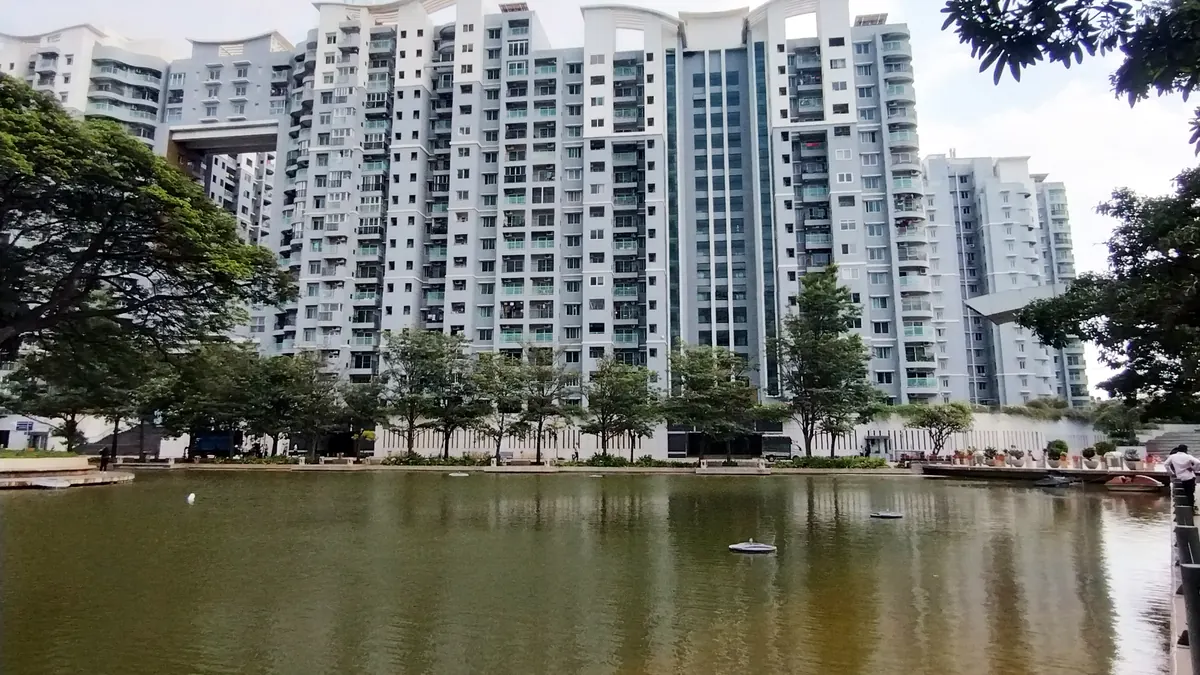
Photo: Saad Faruque, Wikimedia Commons.
Under Section 52 of the Transfer of Property Act, 1882, any property transfer executed during active court litigation remains entirely subservient to the final judicial decree (doctrine of lis pendens). A "Nil" Encumbrance Certificate (EC) on Kaveri 2.0 does not disprove active litigation, because many interim injunctions, debt attachments, and writ stays are never submitted to the Sub-Registrar. Conducting thorough pre-token due diligence requires a three-tier search: e-Courts case searches across Bengaluru City Civil and High Court registries, revenue record (RTC/Pahani) column 11 remark checks, and public notice publications.
When evaluating real estate in Bengaluru, prospective buyers often believe that an Encumbrance Certificate (Form 15) reflecting zero registered mortgages confirms an entirely "clean" title.
This is a dangerous legal assumption. In Indian jurisprudence, an Encumbrance Certificate captures only documents that have been formally registered before the Sub-Registrar. It does not automatically reflect an active partition suit filed by disgruntled family members, a debt attachment order under Section 60 of the CPC, an ongoing SARFAESI tribunal proceeding, or a High Court stay restraining construction.
Under the doctrine of Lis Pendens, if you purchase a property entangled in active litigation, your registered Sale Deed can be legally set aside when the court rules—even if you acted in complete good faith and paid full market value.
The legal mechanics: Section 52 Transfer of Property Act
+--------------------------------------------------------------------------------+
|                 DOCTRINE OF LIS PENDENS (SECTION 52)                           |
+--------------------------------------------------------------------------------+
|  [PENDING SUIT / PROCEEDING]                                                   |
|  Active civil suit regarding title, partition, mortgage, or specific performance|
|                                                                                |
|  [UNAUTHORIZED ALIENATION]                                                     |
|  Seller conveys property to an unsuspecting third-party buyer during suit      |
|                                                                                |
|  [LEGAL CONSEQUENCE]                                                           |
|  The buyer takes title STRICTLY SUBJECT to the final court judgment.           |
|  If the plaintiff wins: Buyer's sale deed is void; buyer evicted.            |
|  "Good faith purchaser for value without notice" defense is NOT AVAILABLE.     |
+--------------------------------------------------------------------------------+
The three primary litigation encumbrances
| Legal Instrument | Statutory Power | Legal Consequence on Buyer | Where to Search |
|---|---|---|---|
| Lis Pendens | Section 52, Transfer of Property Act | Buyer is bound by final decree; title is conditional | e-Courts portal & Kaveri registered notices |
| Court Attachment | Order 38 Rule 5 / Section 64 CPC | Any private transfer of attached property is void against claims | Execution petitions, Sub-Registrar Book 1 |
| Injunction / Stay | Order 39 Rules 1 & 2 CPC | Contempt of court; sale deeds executed in breach are set aside | City Civil Court / High Court case dockets |
1. Lis Pendens: Why "innocent buyers" are not protected
Under Section 52, the law does not require the plaintiff to notify prospective purchasers. The mere pendency of a suit involving immovable property in a competent court restricts the seller's authority to alienate the asset. If an estranged sibling wins a partition decree 5 years after you purchased the flat, the court will partition your home, leaving you with an unsecured monetary claim against a long-departed seller.
2. Pre-judgment attachment
Under Order 38 Rule 5 of the Code of Civil Procedure (CPC), a creditor can apply for attachment of the debtor's immovable property before judgment to prevent fraudulent disposal. Under Section 64 of the CPC, any private transfer of the property during the subsistence of the attachment is legally void against all claims enforceable under the attachment.
3. Interim injunctions and stays
A temporary injunction restraining the defendant from "alienating, encumbering, or altering the physical status of the suit schedule property" renders any subsequent sale deed an illegal act punishable under the Contempt of Courts Act. Civil courts routinely invalidate conveyances executed in violation of existing injunction orders.
The multi-tier litigation search protocol
To uncover unrecorded litigation before handing over earnest money or token advances, real estate lawyers execute a four-part search:
+--------------------------------------------------------------------------------+
|                 FOUR-TIER LITIGATION DISCOVERY PROTOCOL                        |
+--------------------------------------------------------------------------------+
|  [TIER 1: E-COURTS REGISTRY SEARCH]                                            |
|  Search Bengaluru City Civil Court, Commercial Courts, and Karnataka High Court|
|  Query parameters: Current owner name, previous vendors, property survey number|
|                                                                                |
|  [TIER 2: KAVERI 2.0 SECTION 18 SEARCH]                                        |
|  Pull 30-year Form 15 EC; search specifically for registered lis pendens notices|
|                                                                                |
|  [TIER 3: REVENUE RECORD (RTC) INSPECTION]                                     |
|  Examine Column 11 (Other Rights) on Bhoomi RTC for revenue stays / attachment |
|                                                                                |
|  [TIER 4: PUBLIC NEWSPAPER NOTICE]                                             |
|  Publish legal notice in English and Kannada dailies inviting adverse claims   |
+--------------------------------------------------------------------------------+
1. Searching the e-Courts portal
The National Judicial Data Grid (NJDG) and e-Courts platform (services.ecourts.gov.in) provide searchable databases for the Bengaluru Urban district:
- Search by Party Name: Search the exact names of the seller, developer, and previous titleholders across the City Civil Court (CCH), Chief Metropolitan Magistrate (CMM), and Small Causes Courts.
- Search by Case Type: Look specifically for Original Suits (O.S.), Miscellaneous Cases (Misc), Execution Petitions (Ex.P.), and Commercial Suits (Com.O.S.).
- High Court Scrutiny: Search the Karnataka High Court portal (karnatakahihecourt.kar.nic.in) for Writ Petitions (W.P.) or Regular First Appeals (R.F.A.) affecting layout approvals, master plans, or BDA acquisition schemes.
2. Bhoomi portal RTC column 11 check
For villa developments, plots, or peripheral apartments situated on converted agricultural lands: - Access the Karnataka government Bhoomi portal. - Download the latest Record of Rights, Tenancy and Crops (RTC / Pahani). - Scrutinize Column 11 (Other Rights and Liabilities): Tahsildars and Assistant Commissioners record revenue court stays, land acquisition notices, and civil court attachment orders directly in this column.
3. Public legal notice in newspapers
Prior to executing high-value sale agreements, property advocates standardly publish a public notice in one widely circulated English daily and one leading Kannada newspaper. The notice describes the property schedule and invites any claimant to submit written objections backed by documentary evidence within 14 calendar days.
Pre-token litigation audit checklist
Mandatory due diligence checks before paying booking tokens or signing sale agreements.
Frequently asked questions
No. Never pay token advances or earnest money based on verbal promises that an injunction or court stay "will be vacated next week." Court litigation timelines are unpredictable. Demand that the seller produce a certified copy of the formal court order vacating the stay before executing contracts.
Standard title insurance policies explicitly exclude pre-existing, known, or active court disputes disclosed during legal title searches. Title insurance primarily covers undiscovered historical fraud or hidden forged conveyances, not open civil suits.
Under the Karnataka Land Reforms Act, 1961, land tenancy claims decided under Section 48A (Form 7 filings) create permanent occupancy rights. If an ancestral tenancy dispute is pending before the Land Tribunal or High Court, subsequent conversion to residential use does not extinguish tenant claims.
Registering a formal notice of lis pendens under Section 18 of the Registration Act serves constructive legal notice to the entire public. Any subsequent purchaser cannot claim ignorance of the dispute, solidifying the plaintiff's legal priority.
A mortgage is a voluntary contractual security interest created by a borrower in favor of a lender (such as a bank home loan). An attachment is an involuntary statutory seizure ordered by a civil court or revenue authority to secure execution of a decree or recover unpaid taxes.
Legal Note: The doctrine of lis pendens under Section 52 of the Transfer of Property Act, 1882 operates strictly by matter of law and binds subsequent purchasers regardless of good faith. Consult an experienced property litigation advocate to conduct thorough court searches before committing funds.
Disclaimer: This article is published for educational guidance and risk mitigation analysis. It does not constitute formal legal counsel.
Sources
Checked 18 Nov 2026.
- Transfer of Property Act, 1882 (Section 52 - Transfer of property pending suit relating thereto): https://www.indiacode.nic.in/handle/123456789/2338
- Code of Civil Procedure, 1908 (Order 38 Rule 5 & Section 64 - Attachment of Property): https://www.indiacode.nic.in/handle/123456789/2191
- High Court of Karnataka Official Case Status Portal: https://karnatakahihecourt.kar.nic.in/