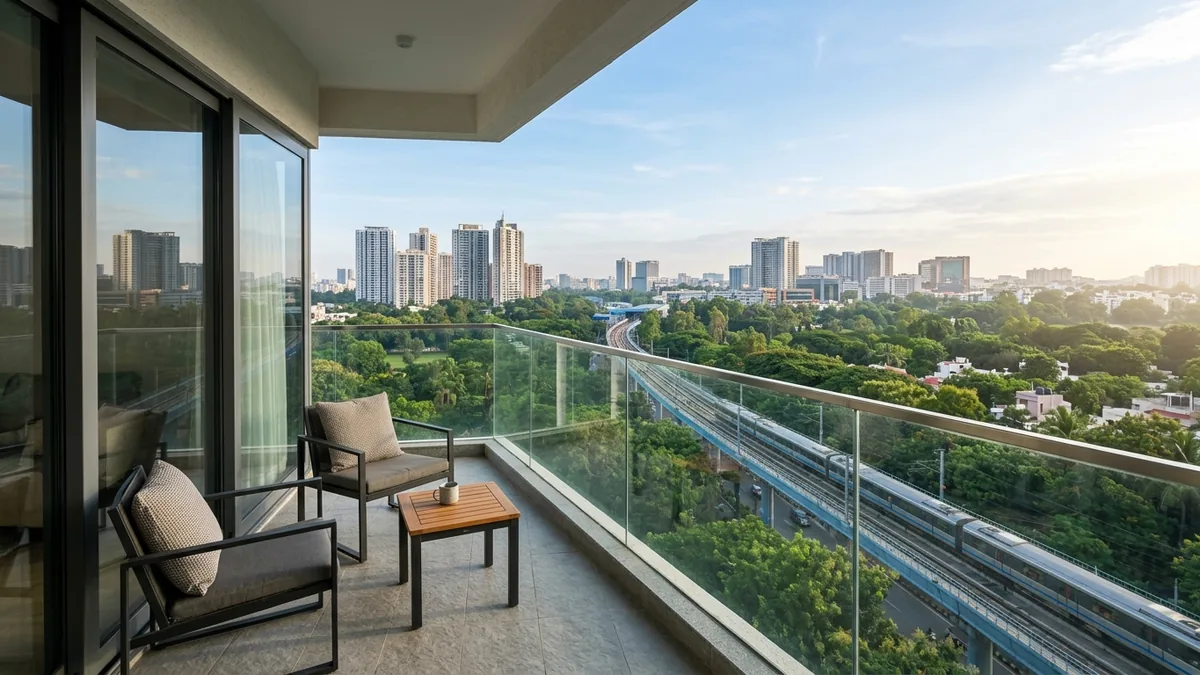
Short answer: It depends on the line, the trains and where your flat faces. Find out which line it is and whether it's part of the Bengaluru Suburban Rail Project, since those corridors will carry more trains once they open. Then visit at night and early morning, stand in the bedroom with the windows open, and listen. For reference, the national residential noise standard is 55 dB(A) by day and 45 dB(A) at night.
Railway lines run through a lot of Bengaluru's growing areas: Yeshwanthpur, Hebbal, Whitefield, K R Puram, Baiyappanahalli, Yelahanka, Kengeri and Heelalige. A flat near one can be handy for commuting. The question is how it sounds at 5 am.
Which railway lines matter in Bengaluru?
The Bengaluru Suburban Rail Project is run by K-RIDE, a joint venture of the Government of Karnataka and the Ministry of Railways. It has four corridors:
| Corridor | Route | Length |
|---|---|---|
| Sampige | KSR Bengaluru City to Devanahalli | 41.40 km |
| Mallige | Baiyyappanahalli Terminal to Chikkabanavara | 25.01 km |
| Parijaata | Kengeri to Whitefield | 35.52 km |
| Kanaka | Heelalige to Rajankunte | 46.24 km |
In July 2026 the Railways Minister told the Lok Sabha that land acquisition for the Mallige corridor was complete and works were in progress. On Kanaka, land acquisition was under way and station contracts had been awarded. Sampige and Parijaata had approved alignments, with land acquisition and utility shifting taken up. If your flat is near one of these, expect construction for a while and, later, more trains than the line carries today. K-RIDE publishes the project documents, including the detailed project report, on its website.
What do the noise rules say?
The Noise Pollution (Regulation and Control) Rules, 2000 set ambient noise standards by zone. For residential areas, the limits are 55 dB(A) Leq in the daytime (6 am to 10 pm) and 45 dB(A) Leq at night (10 pm to 6 am). The rules also tell development authorities and local bodies to treat noise as a quality-of-life factor in planning.
These are ambient standards for an area, averaged over time. A single train passing can be louder for a short time. So use them as a reference point, not as a test your flat will pass or fail.
How do you check noise on a site visit?
- Go at night and early morning, not just on a weekend afternoon. Ask locals or check the railway timetable for when trains run.
- Stand in the bedroom, with the windows open and then shut.
- Note what you hear: horns at a level crossing, freight trains, brakes at a station, or a yard where engines idle.
- Check a few floors. Noise can be different on lower and higher floors, and depends on what's between you and the track.
- Use a sound-meter app for a rough reading. It isn't a calibrated instrument, but it lets you compare flats on the same visit.
- Feel for vibration in the floor when a heavy train passes, especially in a ground-floor or low flat close to the track.
What should you ask the developer or seller?
- How far is the tower from the railway boundary, according to the sanctioned plan?
- Which rooms face the track?
- What windows and glazing are specified? Get it in the specification attached to the agreement.
- Does the project show any noise barrier, buffer planting or wall on the railway side?
- For a resale flat, ask the association about complaints, and talk to a resident on the track side.
Buyer checklist: railway proximity and noise
- [ ] Line identified, and checked against the four K-RIDE corridors
- [ ] Construction stage of any nearby corridor noted
- [ ] Visit made at night or early morning
- [ ] Bedroom checked with windows open and shut
- [ ] Horns, level crossings, stations or yards nearby noted
- [ ] Window and glazing specification in writing
- [ ] Track-side residents or association spoken to (resale)
Related reading
Frequently asked questions
Under the Noise Pollution (Regulation and Control) Rules, 2000, it's 55 dB(A) Leq from 6 am to 10 pm and 45 dB(A) Leq from 10 pm to 6 am.
The corridors are planned to carry suburban trains, so expect more train movements once a corridor opens, plus construction before that. How much it changes for you depends on the line and your flat.
There's no single answer. It depends on the distance, walls, trees and other buildings in between. Check two or three floors on the same visit.
Window and glazing design affect how much noise gets in. Ask for the specification in writing and listen with the windows shut.
Lawyer note: Noise rules and project status on this page are general information, not legal or technical advice. Corridor timelines change, so check K-RIDE's latest updates before you decide.
Sources
Checked 30 Oct 2026.
- K-RIDE, about the Bengaluru Suburban Rail Project and its four corridors: https://kride.in/about/
- K-RIDE, Bengaluru Sub-Urban Rail Project documents: https://kride.in/sub-urban-rail-project/
- Lok Sabha, Unstarred Question No. 583, 22 Jul 2026, Bengaluru Suburban Rail Project: https://sansad.in/getFile/lsapps/loksabhaquestions/annex/188/AU583_1DCngB.pdf
- CPCB, Noise Pollution (Regulation and Control) Rules, 2000: https://cpcb.nic.in/noise-pollution-rules/
- Noise Pollution (Regulation and Control) Rules, 2000, full text with Schedule: https://ngms.delhi.gov.in/pdf_files/noise_rules_2000.pdf