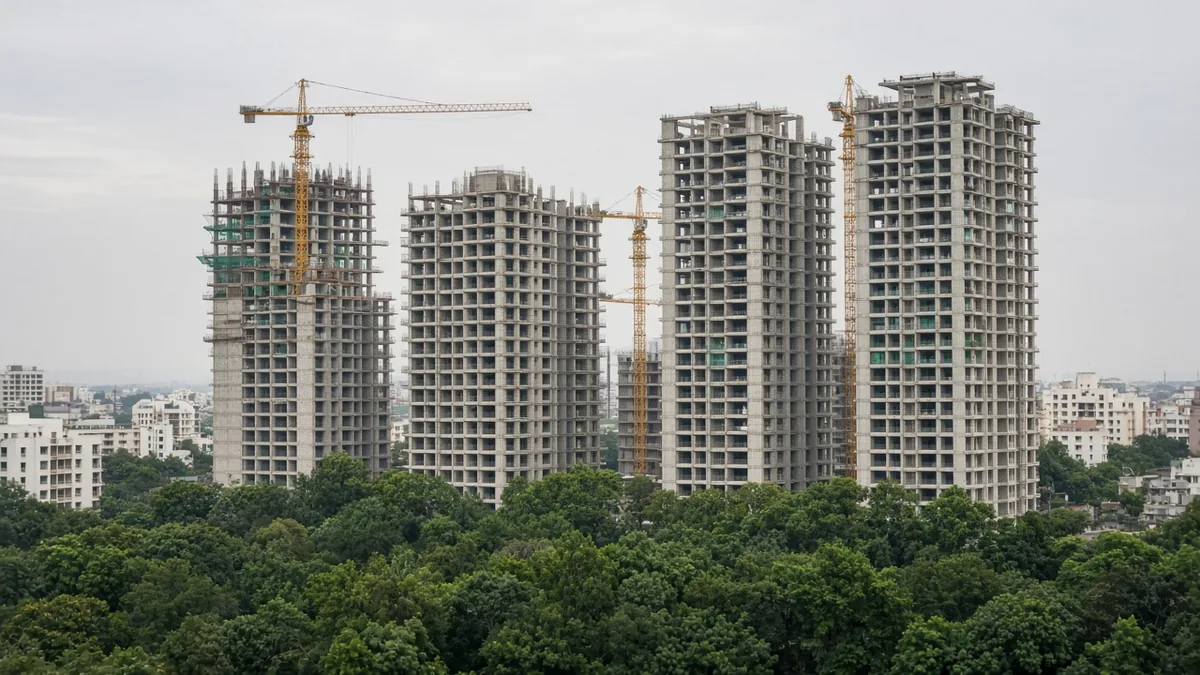
Short answer: Is it a good time to buy property in Bengaluru in 2026? If you'll live in it, it's a reasonable time, not a rush. Sales are rising slowly, unsold stock is up 35% in a year, prices grew 8% to 11%, and the RBI raised rates on 7 Oct 2026. Your own finances matter more than the market.
- Demand: steady. Q3 2026 sales rose 1% to 12% year on year depending on the tracker.
- Supply: building. About 80,200 unsold homes, up 35% (ANAROCK), so you have choice.
- Prices: still rising, 8% (ANAROCK) to 11% (Knight Frank) a year, but RBI's registration-based index shows a slower rise nationally (3.6%).
- Rates: repo up to 5.50%; the RBI says cuts are off the table for now.
- Rental yield: about 4% gross in the areas we checked, below home loan rates. Buy to live, not as a pure investment play.
- Our test: if you'll hold 7+ years, have your cash-to-keys ready, and can carry the EMI at +2 pp, the market timing matters less than the property.
- What is the Bengaluru market doing right now?
- Are prices going to fall?
- Does buying beat renting right now?
- What does the rate hike do to your EMI?
- What does waiting cost?
- The four-question timing test (our framework)
- What mistakes do buyers make when timing the market?
- What to do if...
- Checklist before you decide
- Frequently asked questions
- Talk it through with acre&key
- Sources
Everyone asking "is now a good time?" is really asking two questions: what's the market doing, and is it a good time for me? This page answers both with current data, and we update it every quarter.
What is the Bengaluru market doing right now?
Here's the Q3 2026 (July to September) dashboard. Full detail is in our Q3 2026 market report.
| Signal | Latest reading | Direction | What it means for a buyer | Source |
|---|---|---|---|---|
| Sales | 15,172 to 17,340 homes; +1% to +12% YoY | Up, slowly | Demand is real, not frenzied | ANAROCK, Knight Frank, PropEquity |
| Unsold stock | 80,200 homes, +35% YoY | Up fast | More choice; more room to negotiate on terms | ANAROCK |
| Overhang | 15 months (lowest of 7 cities) | Eased 2% QoQ | Stock isn't excessive by national standards | ANAROCK |
| Average price | ₹9,600 per sq ft (+8%); ₹9,794 (+11%) | Up | Waiting hasn't made homes cheaper so far | ANAROCK; Knight Frank |
| Launch mix | 52% of launches above ₹1.5 crore; ~1% under ₹80 lakh | Top-heavy | Smaller budgets: look at resale and ready flats | ANAROCK |
| Repo rate | 5.50% (from 5.25%) on 7 Oct 2026 | Up | EMIs on repo-linked loans may rise | RBI |
| RBI House Price Index (Bengaluru) | 127.08 in Apr–Jun 2026 (2022-23 = 100) | Up | Registered prices about 27% above the 2022-23 average | RBI HPI via DBIE dataset |
Sources: ANAROCK Q3 2026; Knight Frank Q3 2026; Outlook Money on PropEquity; RBI policy, 7 Oct 2026; RBI HPI Q1 2026-27 and city series.
Why do the price numbers differ?
The consultants quote base prices on new and unsold stock. Knight Frank says its 11% partly reflects more expensive stock entering the market. The RBI's House Price Index is built from registered transactions and covers 18 cities. Nationally it rose 3.6% in the year to Apr–Jun 2026. Bengaluru's index stood at 127.08 (provisional) against 117.49 for all-India, so Bengaluru registered prices have risen faster than the national average since 2022-23. We couldn't capture the city's year-on-year change from the RBI portal itself, so we don't quote one.
Are prices going to fall?
Nobody can tell you that honestly, and we won't guess. What the data does say:
- Prices have kept rising through 2026 on every measure we checked.
- Stock is building fast, which usually slows price growth before it reverses it. Knight Frank's Q3 view is that the market "is not overheating in aggregate".
- Rates have turned up, which cools demand at the margin.
So the case for waiting for a big fall is weak on current evidence. The case for waiting because more stock gives you more choice and better terms is stronger.
Does buying beat renting right now?
Purely as an investment, not on rental income alone. Here's gross yield on ANAROCK's Q1 2026 quoted rents and base rates for a 1,000 sq ft 2BHK:
| Area | Rent per month (quoted range) | Base rate per sq ft | Gross yield (mid-rent ÷ base price) |
|---|---|---|---|
| Sarjapur Road | ₹33,000–46,000 | ₹11,400 | about 4.2% |
| Whitefield | ₹30,000–45,000 | ₹10,680 | about 4.2% |
| Electronic City | ₹20,000–31,000 | ₹7,200 | about 4.3% |
Source: ANAROCK Bengaluru Q1 2026. These are before maintenance, tax, vacancy and the cost of buying (stamp duty, registration, GST), so net yield is lower.
A 4% gross yield is about half a typical home loan rate. If you're buying with a loan to rent out, you're betting on price growth, not income. If you're buying to live in, the comparison is different: you're buying stability, control and an asset you'd otherwise rent.
What does the rate hike do to your EMI?
Worked example 1: two scenarios on a ₹75 lakh loan
Illustrative 20-year loan. Your bank's rate and when it passes changes through will differ.
| Rate | Monthly EMI | vs 8.00% |
|---|---|---|
| 8.00% | ₹62,733 | |
| 8.25% (one 0.25 pp hike passed on) | ₹63,905 | +₹1,172 |
| 8.50% (two hikes passed on) | ₹65,087 | +₹2,354 |
The RBI called its stance "calibrated tightening", meaning the next move is a hike or a pause. Plan for the 8.50% line, and stress-test at 2 points above your sanctioned rate. The home loan EMI calculator and home affordability calculator let you run your own numbers.
What does waiting cost?
Worked example 2: waiting 12 months on a ₹1 crore flat
Illustrative. We don't know next year's prices, so here are three scenarios. Government charges are taken at the 7.6% resale rate on the price rise.
| Price change over 12 months | Extra price | Extra stamp duty and registration | Total extra cost of waiting |
|---|---|---|---|
| 0% | ₹0 | ₹0 | ₹0 |
| +4% | ₹4,00,000 | ₹30,400 | ₹4,30,400 |
| +8% (Q3 2026 ANAROCK pace) | ₹8,00,000 | ₹60,800 | ₹8,60,800 |
Set that against what waiting gives you. If another year lets you save ₹6 lakh more for the down payment, clear a loan, or find a better property from a bigger pool of unsold stock, waiting can still be the right call. If you're waiting only to "time the bottom", you're paying for a guess. Our first-time buyer guide has the full cost-of-waiting method.
The four-question timing test (our framework)
Market timing matters less than these four. If you can answer yes to all of them, it's a good time for you.
- Will you hold for 7 years or more? Buying costs (about 7.6% in government charges on resale, more with GST and extras) take years to earn back. The stamp duty calculator guide shows the exact figure.
- Is your cash-to-keys ready? Down payment, government charges, interiors and a buffer, in hand. Our total cost guide lists every line.
- Can you carry the EMI at +2 pp? If a 2-point rise would break your budget, the timing is wrong for you whatever the market does.
- Does the right property exist in your budget? With 52% of new launches above ₹1.5 crore, check this before anything else.
Then run the property-level checks: title, RERA, khata, water and flood. Start with our before-token checklist, then follow how to buy a flat in Bengaluru, step by step.
What mistakes do buyers make when timing the market?
- Reading one headline number. Sales were +12% on one tracker and +1% on another in the same quarter.
- Waiting for a crash with no plan. Every quarter of waiting has a cost if prices keep rising.
- Rushing because of a "price hike from next month" pitch. With 80,200 unsold homes, you usually have time.
- Buying to rent out on a loan at 4% yield. The maths relies on price growth.
- Ignoring rates. The RBI's stance has changed; budget for higher EMIs.
What to do if...
...you're ready on all four questions? Shortlist with confidence. Use the stock build-up to negotiate on terms: payment plan, parking, extras.
...you fail question 3? Bring the loan down (bigger down payment, smaller home, co-borrower), or wait and save.
...your budget is under ₹80 lakh? Look at resale and ready flats, and check khata and water carefully.
...you're an investor? Compare the 4% gross yield with your loan rate and other options. Speak to a financial adviser.
Checklist before you decide
- [ ] Holding period of 7+ years
- [ ] Cash-to-keys in hand (down payment, charges, interiors, buffer)
- [ ] EMI affordable at +2 pp above the sanctioned rate
- [ ] Shortlist exists in your budget
- [ ] Rent vs EMI compared for the same area
- [ ] Property checks done before token
Frequently asked questions
For an end-user, it's a reasonable time. Sales are rising slowly, unsold stock is up 35% year on year, which gives you choice, and prices are still rising 8% to 11%. The RBI raised rates on 7 Oct 2026. Your holding period, savings and EMI capacity matter more than timing.
Nobody can say reliably. Every measure we checked showed prices rising through 2026. Stock building up usually slows price growth before it reverses it, and Knight Frank says the market isn't overheating overall. Waiting for a crash, with no other reason to wait, is a guess.
The RBI moved to calibrated tightening on 7 Oct 2026 and said rate cuts are off the table in the near term. Waiting for lower rates may mean waiting a while. On a ₹75 lakh, 20-year loan, a 0.25 pp rise adds about ₹1,172 to the EMI.
As an investment, rental yields of about 4% gross in Sarjapur Road, Whitefield and Electronic City are below home loan rates. As a home, buying gives stability and an asset. If you'll stay 7+ years and can afford the EMI with a buffer, buying usually makes sense.
It depends on prices. On a ₹1 crore flat, a 4% rise adds about ₹4.3 lakh including the extra stamp duty and registration; an 8% rise adds about ₹8.6 lakh. If prices stay flat, waiting costs nothing in price terms.
Use more than one source. Consultants like ANAROCK and Knight Frank quote prices on new and unsold stock; the RBI's House Price Index uses registered transactions. Compare each source with its own history, and check guidance values and recent registrations for the specific area.
CA note: Tax benefits on home loans and capital gains depend on your situation and the regime you choose. Check with a chartered accountant before you decide.
Sources
Checked 19 Oct 2026.
- ANAROCK Research, Residential Market Viewpoints, Pan-India Q3 2026: https://investmentguruindia.com/editorial/uploads/news-pdf/12601e58_Q3_2026_Pan_India_Residential_Market_Viewpoints_9cf1a7e616.pdf
- Knight Frank India, Residential Market, July–September 2026: https://content.knightfrank.com/research/3138/documents/en/india-real-estate-residential-market-jul-sep-2026-13033.pdf
- Outlook Money, PropEquity Q3 2026 data (news): https://www.outlookmoney.com/personal-finance/housing-sales-soften-6-per-cent-in-q3-as-developers-pull-back-on-new-supply-propequity
- RBI, Monetary Policy Statement, 7 Oct 2026: https://www.rbi.org.in/Scripts/BS_PressReleaseDisplay.aspx?prid=63742
- RBI, All-India House Price Index for Q1 2026-27, 24 Aug 2026: https://www.rbi.org.in/Scripts/BS_PressReleaseDisplay.aspx?prid=63436
- RBI HPI city series (Bengaluru 127.08, provisional), via Dataful (source: RBI DBIE): https://dataful.in/datasets/17611/
- ANAROCK, Bengaluru Q1 2026 Residential Market Viewpoints (rents and base rates): https://websitemedia.anarock.com/media/Bengaluru_Q1_2026_Residential_Market_Viewpoints_84d41ec09a.pdf