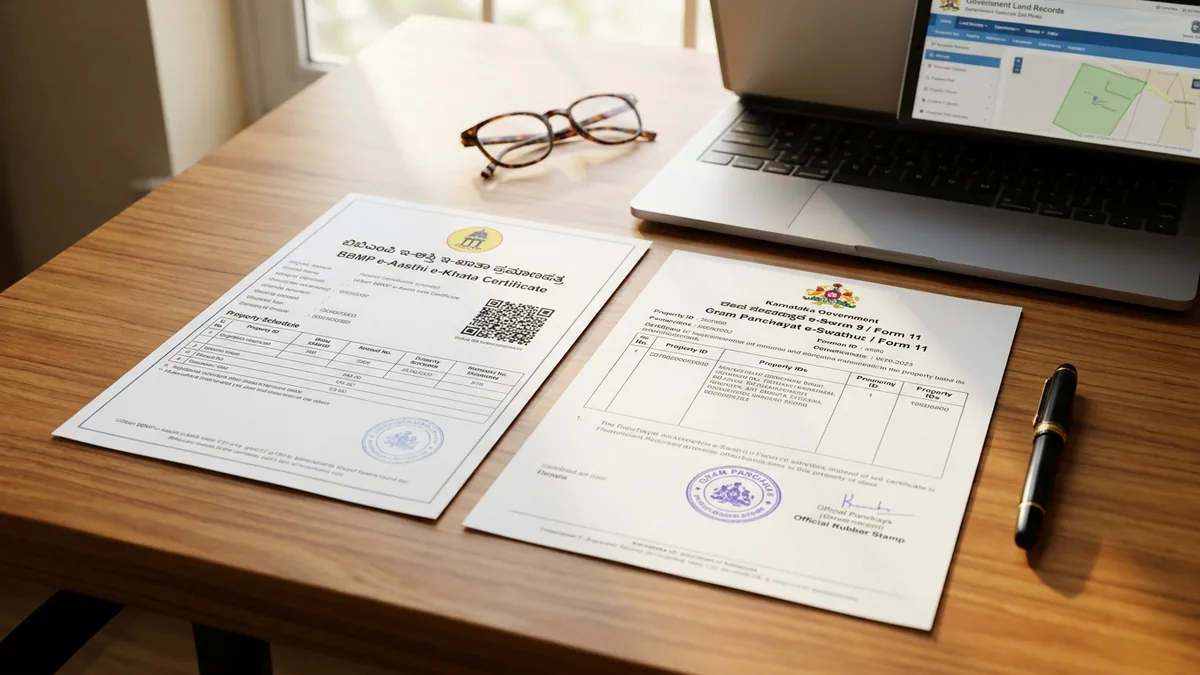
e-Khata is the municipal record on e-Aasthi under the Greater Bengaluru Authority. e-Swathu is the gram panchayat system. Form 9 and Form 11A are not a city e-Khata, and Form 11B is a tax entry the 2025 amendment says does not confer title. From 30 September 2024, registration was tied to e-Aasthi in urban areas and e-Swathu in rural areas. Read the tax receipt before you pay a token.
A lot of new flats and plots marketed as Bengaluru sit outside the five city corporations. The seller may still say "e-Khata" because that is the word buyers have learned. If the tax receipt is from a gram panchayat, the file is on e-Swathu, and the questions change.
Inside the city, A-Khata, B-Khata and draft or final status are a different argument. That one is in our A-Khata, B-Khata and e-Khata guide. This page is the comparison that guide only touches.
Which office keeps the record?
The city corporations keep municipal property records on e-Aasthi. e-Aasthi 2.0 launched on 22 September 2026. Buyers use it to see whether a city e-Khata is draft or final, and to move the khata after a Kaveri registration. What opened that day is in our e-Aasthi 2.0 guide.
Gram panchayats keep their own records on e-Swathu. The public FAQ describes Form 9 as the extract for non-agricultural property under the panchayat budgeting rules, and only in the cases those rules allow: land converted under the Karnataka Land Revenue Act, 1964, with an approved plan, or government housing, or gramathana property certified by the tahsildar. Form 11 is the register of demand, collection and balance. A revenue circular made Form 9 and Form 11 necessary for registering non-agricultural property in panchayat areas. Labels on the portal move, so trust the screen on the day you search.
The pin code will not settle this. Our ward and corporation lookup shows how many Bengaluru pin codes cross a boundary. The tax receipt names the office. Start there.
What does each form say?
| Record | Who issues it | What it is | What it does not say |
|---|---|---|---|
| City e-Khata | City corporation, on e-Aasthi | The municipal property record. Draft and final differ | That the flat has an occupancy certificate |
| Form 9 | Gram panchayat, on e-Swathu | Extract for a non-agricultural property that meets the rule | Clean title. The conversion order is a separate paper |
| Form 11 | Gram panchayat | The tax register: demand, collection and balance | That the layout was approved |
| Form 11A | Panchayat, on e-Swathu 2.0 | Record for an authorised property, as described at the December 2025 launch | A substitute for the conversion order and the plan |
| Form 11B | Panchayat, on e-Swathu 2.0 | Tax entry for existing unauthorised property | Title, ownership, or a right to regularise |
The New Indian Express, on 2 December 2025, reported the chief minister launching e-Swathu 2.0, with Form 11B for the tax entry on unauthorised property and Form 11A for authorised property. The legal text is the Karnataka Gram Swaraj and Panchayat Raj (Amendment) Bill, 2025. Section 199C lets panchayats tax certain existing unauthorised buildings and plots. It says paying that tax does not confer any right to regularise the violation, or title, ownership or legal status. Section 199B says no new khata or property ID for a building site without a layout sanctioned by the planning authority.
Our note on B-Khata plots and revenue sites walks through those two sections. Read them before you treat an 11B printout as something a bank will mortgage.
How does registration use the two systems?
On 30 September 2024 the revenue minister, Krishna Byre Gowda, said e-Khata would be mandatory for registration, and that e-Aasthi for urban property and e-Swathu for rural property were linked to the registration system. The Hindu reported that statement. A city e-Khata does not answer a panchayat plot. A Form 9 does not answer a flat inside a city corporation.
"Linked" is not "accepted in every form". A draft city e-Khata and a final one are not equal. A Form 11B and a Form 9 are not equal. Ask for the document the portal will see, then open the portal yourself.
For a panchayat search, use district, taluk, panchayat and village, then the property ID or the owner's name. Download the form from the portal. The Bapuji Seva Kendra note on Form 9 and Form 11 says the panchayat development officer signs the certificate digitally after the panchayat's process. An unsigned screen is not that certificate.
What changes in the charges and the loan?
The stamp duty rate is statewide. The surcharge is not. In the Greater Bengaluru Area the surcharge is 2% of the duty. In panchayat areas the CAG stamp duty manual sets out a 3% rural surcharge. On a resale, the combined charge is 7.6% inside the GBA and 7.65% in a panchayat area. The lines are in the stamp duty calculator. The gap is small next to a wrong form.
Banks lend against their own valuation and the Reserve Bank's loan-to-value caps. They also ask for the property record. A draft city file, and a panchayat file that is only 11B, are both reasons a sanction can stall. Ask the lender, in writing, whether this form is acceptable before you pay a token. We do not keep a list of which bank accepts which form. The sanction does.
The next buyer will need the same record. An 11B plot you could buy for cash can be a plot the next buyer cannot mortgage.
A worked comparison
Illustrative. Same ₹80 lakh resale price, higher than guidance, so duty is on ₹80 lakh. A resale does not get the first-sale flat rates.
| Inside GBA, city e-Khata | Panchayat, e-Swathu | |
|---|---|---|
| Duty at 5% | ₹4,00,000 | ₹4,00,000 |
| Cess at 10% of duty | ₹40,000 | ₹40,000 |
| Surcharge | 2% of duty, ₹8,000 | 3% of duty, ₹12,000 |
| Registration at 2% | ₹1,60,000 | ₹1,60,000 |
| Combined | ₹6,08,000 (7.6%) | ₹6,12,000 (7.65%) |
The cash difference is ₹4,000. If the panchayat column is a Form 11B, that ₹4,000 is the wrong thing to negotiate. The question is whether a sale can be registered and financed at all.
A plot still needs a sanctioned layout and, where the land was agricultural, a conversion order. Those papers are separate from the form number.
The next step is to sit the tax receipt, the Form 9 or 11A or 11B, or the city e-Khata, the conversion order and the draft deed on one table, and to use the portal that matches the tax receipt. From 30 September 2024, registration is tied to e-Aasthi in urban areas and e-Swathu in rural areas. A city printout will not register a panchayat plot. The form you hold changes the deal by more than the 0.05 percent surcharge step in the worked comparison above.
Buyer checklist
Related reading
Frequently asked questions
No. e-Khata is the municipal record on e-Aasthi. e-Swathu is the gram panchayat portal. People use "e-Khata" for any electronic printout. The form and the office are what the sub-registrar and the bank look at.
At the December 2025 launch, Form 11A was described as the record for authorised property and Form 11B as the tax entry for unauthorised property. The 2025 amendment says that tax does not confer a right to regularise, or title, ownership or legal status. An 11A record still needs the conversion and the plan checked. It is not a title deed.
Not if the property is outside the city system. From 30 September 2024 the minister tied registration to e-Aasthi in urban areas and e-Swathu in rural areas. Use the portal that matches the tax receipt.
It is supposed to be issued only where the rules are met, including conversion where that applies. The form is not a substitute for the conversion order. Match the survey number.
On a resale the step from 7.6% to 7.65% is small. On ₹80 lakh it is ₹4,000 in the example above. The form you hold changes the deal by more than the surcharge.
Lawyer note: This is general information, not a title opinion. Conversion, layout sanction, and whether a given 11B property can be sold are questions for a property lawyer. Checked 17 Nov 2026.
Sources
Checked 17 Nov 2026.
-
The Hindu. e-Khata mandatory from 30 September 2024. e-Aasthi for urban property and e-Swathu for rural property linked to registration: https://www.thehindu.com/news/cities/bangalore/e-khata-is-mandatory-from-september-30-krishna-byre-gowda/article68691510.ece
-
e-Swathu public FAQ, Form 9 and Form 11: https://eswathu.karnataka.gov.in/PublicFAQ.aspx
-
The New Indian Express, 2 December 2025, launch of e-Swathu 2.0, Form 11A and Form 11B: https://www.newindianexpress.com/states/karnataka/2025/Dec/02/cm-siddaramaiah-launches-e-swathu-20-eyes-rs-2000-crore-revenue-boost
-
Karnataka Gram Swaraj and Panchayat Raj (Amendment) Bill, 2025, sections 199B and 199C: https://prsindia.org/files/bills_acts/bills_states/karnataka/2025/Bill18of2025KA.pdf
-
CAG Stamp Duty and Registration Manual (2020), section 7.4, rural surcharge: https://saiindia.gov.in/uploads/media/Stamp-Duty-and-Registration-Manual-20200914191933.pdf
-
Greater Bengaluru Governance Act, 2024, section 170: https://dpal.karnataka.gov.in/uploads/media_to_upload1750663489.pdf
-
Bapuji Seva Kendra note on Form 9 and Form 11, including a digital signature by the panchayat development officer: https://bsk.karnataka.gov.in/BSK/cs/loadOnlineServicesBeforeLogin