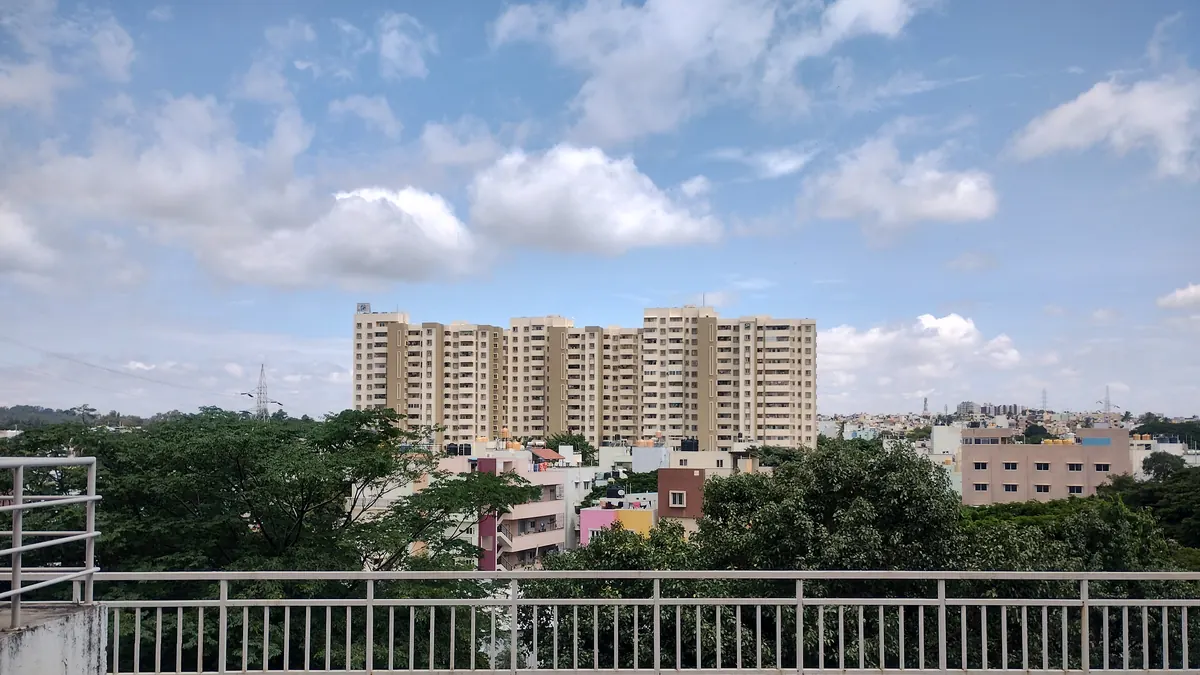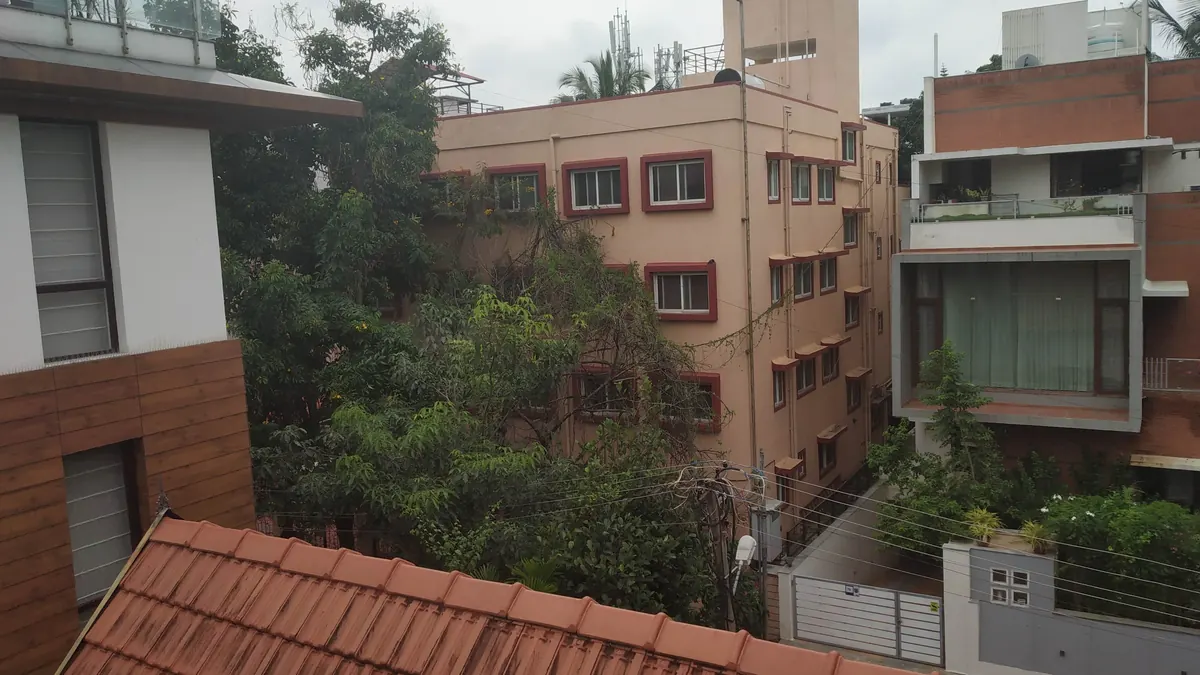
Photo: Shaivikshetty, Wikimedia Commons, CC BY-SA 4.0.
Section 38(D) of the Bangalore Development Authority Act, 1976 enables eligible occupants to apply for the regularisation, via formal re-allotment, of habitable houses constructed before 10 July 2008 on land acquired by the BDA under a final notification and approved award. Under the BDA (Amendment) Act, 2026 (effective 7 September 2026), statutory regularisation charges were reduced by half to 5%, 12.5%, 20%, or 25% of current guidance values depending on plot dimensions, with corner sites assessed at twice the standard rates. BDA's 9 November 2026 media annexure stipulates an application deadline of 15 December 2026. Because an unapproved application exposes properties to eviction under Section 38D(3), occupants and buyers must verify survey numbers, confirm statutory exclusions, and submit verified documentation online before the deadline.
Disclosure: acre&key's advice is free to buyers. We're an authorised sales partner for some projects and may be paid by the developer.
If you already live in a house on old BDA-acquired land, or you are being offered one, this is a title issue, not a casual fee waiver. The window is short. The rules are narrow. A few news reports also mixed this drive up with other BDA schemes announced on the same day. This note separates what the Act says, what BDA put in its 9 November annexure, and what you still need a lawyer to confirm on your survey number.
This is not the same as B-khata to A-khata conversion, and it is not a general approval check for a plot in a layout. For ordinary layout and conversion checks, start with our BDA, BMRDA and DTCP plot checklist.
What does Section 38(D) actually cover?
Section 38(D) was added to the Bangalore Development Authority Act, 1976 by a government notification dated 28 May 2020 (Notification No. as cited in BDA's 9 November 2026 media annexure). It is a route for the Authority to re-allot, to an eligible occupant, certain unauthorised residential properties that stand on land the BDA has already acquired.
BDA's annexure for the Chief Minister's review on 9 November 2026 describes the covered cases as qualifying habitable houses constructed before 10 July 2008 on BDA-acquired land that is covered by a final acquisition notification and an approved acquisition award. Eligible cases may be considered for regularisation through re-allotment, subject to the statutory conditions (BDA media annexure, 9 November 2026; The Hindu, 9 November 2026).
Three things follow from that, and they are easy to miss on a site visit.
- The cutoff is the date the house was built, 10 July 2008, not the date you bought it.
- The land has to be BDA-acquired land with a final notification and an award. A revenue site in a village, a BMRDA layout plot, or a house on land the BDA never acquired is a different problem.
- Regularisation here means the Authority may re-allot the site if you qualify and pay. It is not an automatic khata upgrade, and it does not by itself fix every other title defect.
Consult a property lawyer before paying, signing or registering. Only a file review of your survey number can tell you whether Section 38(D) applies.
Who is eligible, and who is left out?
Start with eligibility, then read the exclusions. A house can miss the scheme even if it is old and the occupant has paid tax for years.
From the annexure and The Hindu's report of the 9 November announcement, you are in the zone of eligibility only if all of these hold:
- There is a habitable house on the land.
- The house was constructed before 10 July 2008.
- The land was acquired by the BDA, and is covered by a final acquisition notification and an approved award.
- You can show the documents BDA has listed, including the sale history from the original khatedar where that applies.
The same annexure says the provision does not apply to buildings on:
- land reserved for parks, playgrounds, open spaces or civic amenities
- land required for roads, or land that obstructs the alignment of a proposed Ring Road
- land connected with national highways, bypass roads or mass rapid transit projects
- stormwater drains, lakes or riverbeds
- land beneath high-tension electricity lines
- acquired land affected by disputes or impediments arising from interim court orders
The Hindu's report named parks, playgrounds, open spaces, land connected with national highways and bypass roads, and properties tied up by interim court orders. The annexure is fuller, and that is the list you should work from, then confirm on the portal and with your lawyer.
One news conflict is worth a straight flag. The Times of India, reporting the same review, wrote that corner sites are excluded from the scheme. The Amendment Act and BDA's annexure say the opposite: a corner site with a building is charged twice the rate for its size. Do not treat a corner site as ineligible on the strength of that one report. Confirm the classification of your site with BDA.
What are the charges after the 2026 amendment?
The charges sit in the Bangalore Development Authority (Amendment) Act, 2026 (Karnataka Act No. 42 of 2026). The Act received the Governor's assent on 7 September 2026, was published in the Karnataka Gazette Extraordinary the same day, and "shall come into force at once" (section 1(2)). It substitutes the payment table in section 38D(1)(ii).
The payment is a percentage of the current guidance value fixed by the Revenue Department. These rates are for sites other than corner sites. A corner site with a building pays twice the rate.
| Extent of land with building (other than a corner site) | Earlier charge | Charge after the 2026 Act |
|---|---|---|
| Up to 20 ft by 30 ft | 10% of guidance value | 5% of current guidance value |
| More than 20 ft by 30 ft and up to 30 ft by 40 ft | 25% | 12.5% |
| More than 30 ft by 40 ft and up to 40 ft by 60 ft | 40% | 20% |
| More than 40 ft by 60 ft and up to 50 ft by 80 ft | 50%, plus a penalty as may be prescribed | 25%, plus a penalty as may be prescribed |
Sources: the Amendment Act, 2026, and the same table in BDA's 9 November 2026 annexure. The Hindu reported the top and bottom slabs and the double rate for corner sites. It did not print the two middle slabs. Use the Act.
The penalty on the top slab is "as may be prescribed." I have not treated any rupee figure for that penalty as confirmed. Ask BDA and your lawyer what is in force on the day you pay.
Guidance value means the official benchmark used for stamp duty, not the price a broker quotes. Look it up for your survey number on Kaveri 2.0 before you budget. Our guide to the full cost of a Bengaluru flat explains how guidance value is used at registration. A statewide guidance-value revision was still under consultation as of mid-November 2026, and no new gazette for that revision had been found. Budget on the value in force on Kaveri the day you pay, and get a chartered accountant (CA) to help if the number is large.
Worked examples, using illustrative guidance values
These are illustrations, not asking prices and not a quote from BDA. They ignore the unconfirmed top-slab penalty and any other fee the portal may add.
| Assumed current guidance value | Non-corner site, 5% (up to 20 ft by 30 ft) | Non-corner site, 25% (largest slab) | Corner site at twice the 5% rate |
|---|---|---|---|
| ₹50 lakh | ₹2.5 lakh | ₹12.5 lakh | ₹5 lakh |
| ₹1 crore | ₹5 lakh | ₹25 lakh | ₹10 lakh |
If a seller says "regularisation is cheap now," ask for the site dimensions, whether BDA treats it as a corner site, and the current guidance value on Kaveri. Then do this sum yourself.
When is the last date to apply, and what is the two-year clock?
There are two clocks, and news reports have mixed them with other BDA drives.
The current application window. BDA's 9 November 2026 media annexure says Section 38(D) is already in force, applications are being accepted, and "the last date to submit applications is 15.12.2026." It also says that, in future, applications will be accepted only online, and that an online application must be submitted within two months of receiving a notice.
The Hindu, reporting the same review, wrote that applications would be accepted until 17 December. The Times of India quoted the Chief Minister asking owners to apply before 17 December, and said a citizen portal was launched for this and other BDA services. The same annexure gives 17 December 2026 as the deadline for two other drives announced that day: allotment of marginal land, and a special drive for registration of absolute sale deeds. It is possible the 17 December date in the newspapers belongs to those drives, or that BDA will accept 38(D) applications until then. I cannot resolve that from the papers alone.
Treat 15 December 2026 as the date BDA put on the 38(D) page of its own annexure, treat 17 December as a date that appeared in news reports, and confirm the live date on the official portal before you cut it fine.
The two-year allotment clock. This one is in the Act, not in a press note. The 2026 amendment substitutes section 38D(3): if unauthorised occupants in Authority lands "do not obtain allotment of site under this section within two years from the date of commencement of the Bangalore Development Authority (Amendment) Act, 2026, the Authority shall evict such unauthorized occupants." The Act came into force on 7 September 2026, so that two-year period runs from that date. Obtaining an allotment is not the same as filing an application. An application filed inside the December window could still be undecided when the two years run out. Ask your lawyer what that means for your file. The Act does not spell out that leftover case.
The Times of India also reported that the scheme was expected to cover nearly one lakh property owners, and that only about 600 applications had come in by the 9 November review. That is context for why BDA is pushing the window. It is not a reason to assume you will be approved.
How do you apply, and which documents does BDA want?
Start on the official BDA website. The older public site, bdabangalore.org, has carried a "38(D) apply online" link, and BDA has also pointed people to its newer official site, kbda.karnataka.gov.in. Use the link on the official page, not a forwarded PDF or a broker's form. If the link is down, call or visit the BDA office at Kumara Park West and get the current URL in writing.
The 9 November annexure lists these supporting records with the prescribed application form:
- Certified copies of sale deeds for revenue sites purchased from the original khatedar of the land, and purchaser particulars.
- An encumbrance certificate in Form 15, covering the period from the date of the preliminary notification to the present.
- A recent photograph and specimen signature in the prescribed format, attested by a Gazetted Officer.
- The latest property or revenue tax receipt.
- A self-declaration duly attested by a notary.
- Khata certificate and khata extract.
- The approved building plan.
- Water-connection work order.
- Electricity-connection work order.
- Proof of residential address, such as Aadhaar, voter identity card, ration card, or another document BDA will accept.
The annexure says all documents must be submitted, and the applicable fees paid, online. It also requires an online application within two months of receipt of a notice. If you have received a BDA notice, that two-month clock may be the one that matters for you. Keep the notice, the envelope if you have it, and a note of the date you received it.
The Hindu's shorter list (sale deeds, encumbrance certificates, property tax receipts and khata documents) is consistent with this, but it is not complete. Work from the annexure list, then add whatever the live portal asks for.
If you are buying a house that may fall under Section 38(D)
Do not treat a "BDA regularisation is open" pitch as a reason to pay a token. The seller may be eligible, or may not. The application may be pending, or may have been refused. The site may sit on a park, a drain, a proposed road or a court stay.
Before you pay anything, get a property lawyer to check:
- the acquisition notifications and award on the survey number
- the date of construction, with something firmer than a seller's memory
- whether any exclusion on the annexure list applies
- whether an application has already been filed, and in whose name
- whether a mortgage, family claim or court case sits on the encumbrance certificate
- who will pay the regularisation charge, and what happens if BDA refuses
The broader title file still matters: parent deeds, legal checks from title to OC, planning approval, and, if the land was agricultural, DC conversion under section 95. A Section 38(D) receipt is not a substitute for those. For a conventional BDA allotment, which is a different process, see our answer on how a Karnataka domicile applies for a BDA site.
Checklist
Frequently asked questions
It is a statutory route under the Bangalore Development Authority Act, 1976 for the Authority to re-allot, to an eligible occupant, certain unauthorised habitable houses built before 10 July 2008 on land the BDA had already acquired under a final notification and an approved award. It is not a general B-khata conversion, and it does not apply to every old house in Bengaluru.
BDA's 9 November 2026 media annexure gives 15 December 2026 as the last date to submit Section 38(D) applications. The Hindu and The Times of India, reporting the same announcement, said 17 December. That 17 December date is also the annexure deadline for two other BDA drives launched the same day. Confirm the live date on the official BDA portal.
For sites other than corner sites, the Bangalore Development Authority (Amendment) Act, 2026 sets the charge at 5%, 12.5%, 20% or 25% of the current guidance value, by site size. The largest slab also carries a penalty as may be prescribed. A corner site with a building pays twice the applicable rate. Look up your guidance value on Kaveri and ask BDA to confirm the slab and any penalty before you pay.
Yes, on the face of the 2026 Act and BDA's 9 November annexure. They are not left out of the table. They are charged twice the rate for their size. One Times of India report of the same announcement said corner sites are excluded. That does not match the Act. Confirm the classification of your site with BDA and your lawyer.
The construction cutoff in BDA's annexure and in The Hindu's report is the date the house was built, before 10 July 2008, not the date of your purchase. A later sale does not automatically disqualify you, and it does not automatically qualify you either. Your lawyer needs to see the sale chain, the acquisition papers and the proof of the construction date.
BDA's 9 November 2026 annexure asks for the prescribed form plus certified sale deeds from the original khatedar, a Form 15 encumbrance certificate from the preliminary notification to date, an attested photograph and signature, the latest tax receipt, a notarised self-declaration, khata certificate and extract, the approved building plan, water and electricity connection work orders, and address proof. The live portal may ask for more. Submit and pay online.
The 2026 amendment says that if unauthorised occupants in Authority lands do not obtain allotment under Section 38(D) within two years from 7 September 2026, the Authority shall evict them. The Chief Minister, as reported by The Hindu, also warned that BDA would be compelled to take legal action against people who continue to occupy such land without regularising. Ask your lawyer what that means on your survey number. Do not wait for a notice if you think you may qualify.
No. B-khata to A-khata conversion is a municipal khata process, now run on GBA's e-Aasthi 2.0, with its own fee. Section 38(D) is a BDA re-allotment of certain houses on BDA-acquired land. You may still need a proper khata after a re-allotment. Treat them as separate files.
Not by itself, and not automatically. If BDA re-allots the site, that is a major step, but a buyer or a bank will still want the allotment or sale deed, the encumbrance certificate, khata, tax receipts and a lawyer's title report. Family claims, mortgages and court stays do not disappear just because a regularisation application was filed.
Apply through the official BDA 38(D) online link. Start at bdabangalore.org or kbda.karnataka.gov.in and use the Authority's own form. BDA's annexure says applications and fees are to be submitted online, and that an application should be filed within two months of receiving a notice. Keep the acknowledgement.
Lawyer note: The legal points on this page are general information, not legal advice. Section 38(D) turns on the facts of a particular survey number, the acquisition record, the construction date and any court order. Consult a property lawyer before you apply, pay, sign or register.
CA note: The charge is a percentage of current guidance value, and a later guidance-value revision or an unconfirmed penalty could change the amount you pay. Ask a chartered accountant (CA) how to budget the payment and how it is treated in your case.
Sources
Checked 17 Nov 2026.
-
Bangalore Development Authority media annexure for the Chief Minister's review, 9 November 2026: https://ifxng3igsmvptlcs.public.blob.vercel-storage.com/doc/news/769da52a-fac7-45de-b764-66c06458bc6a.pdf
-
The Hindu, 9 November 2026, on the 50% cut in guidance-value charges for regularisation of BDA sites: https://www.thehindu.com/news/cities/bangalore/bengaluru-shivakumar-announces-50-cut-in-guidance-value-for-regularisation-of-bda-sites/article71682832.ece
-
The Times of India report of the same review: https://timesofindia.indiatimes.com/city/bengaluru/bda-halves-regularisation-charges-invites-applications-for-absolute-sale-deeds/articleshow/135686756.cms
-
The Bangalore Development Authority (Amendment) Act, 2026 (Karnataka Act 42 of 2026), in force from 7 September 2026: https://egazette.servantsofknowledge.in/details/in.gazette.karnataka_eo.2026-09-07.11247/
-
Official BDA starting points: https://www.bdabangalore.org/ and https://kbda.karnataka.gov.in